Crimson Desert Ending Explained: The Matrix-Style Meta Plot, Time Loops, and Secrets Revealed
When I first started playing Crimson Desert, I expected a brutal medieval adventure packed with mercenary battles, political betrayals, and large-scale warfare. For dozens of hours, that’s exactly what Pearl Abyss delivered. The world of Pywel felt grounded, dangerous, and surprisingly believable.
Then I reached the final chapters.
What began as a story about rival mercenary groups suddenly transformed into one of the most ambitious narrative twists I have seen in modern gaming. By the time the credits rolled, I found myself staring at the screen wondering whether I had just finished a fantasy RPG, a science-fiction epic, or something much stranger.
After digging through every hidden document, completing endgame content, and unlocking the secret ending, I came to a realization:
Crimson Desert is far more than a medieval action RPG. It is a story about fate, manipulation, repeated timelines, and the relationship between players and the worlds they control.
Let’s break down what actually happens.
From Mercenary Survival to World-Altering Destiny
For most of the campaign, Kliff’s journey feels relatively straightforward.
The Greymanes have been devastated following a brutal attack orchestrated by the Black Bears and their ruthless leader, Myurdin. Kliff spends much of the adventure rebuilding his forces, recruiting allies, helping settlements, and slowly forming a military coalition capable of standing against growing threats.
The game initially presents itself as a classic tale of revenge and survival.
However, everything changes during the later chapters.
As players venture deeper into Delesyia, they encounter inventor Marni and his advanced creation known as Hall. What appears to be a technological subplot gradually becomes something much larger when Hall establishes contact with the mysterious dimension called the Abyss.
The Abyss is not merely another magical realm.
It is a place that exists beyond conventional reality.
Once Hall becomes corrupted, events escalate rapidly. Ancient powers awaken, dimensional barriers begin collapsing, and humanity suddenly finds itself caught in a conflict far bigger than kingdoms and armies.
The Final Assault on Fort Musket
The climax begins with one of the most spectacular sequences in the entire game.
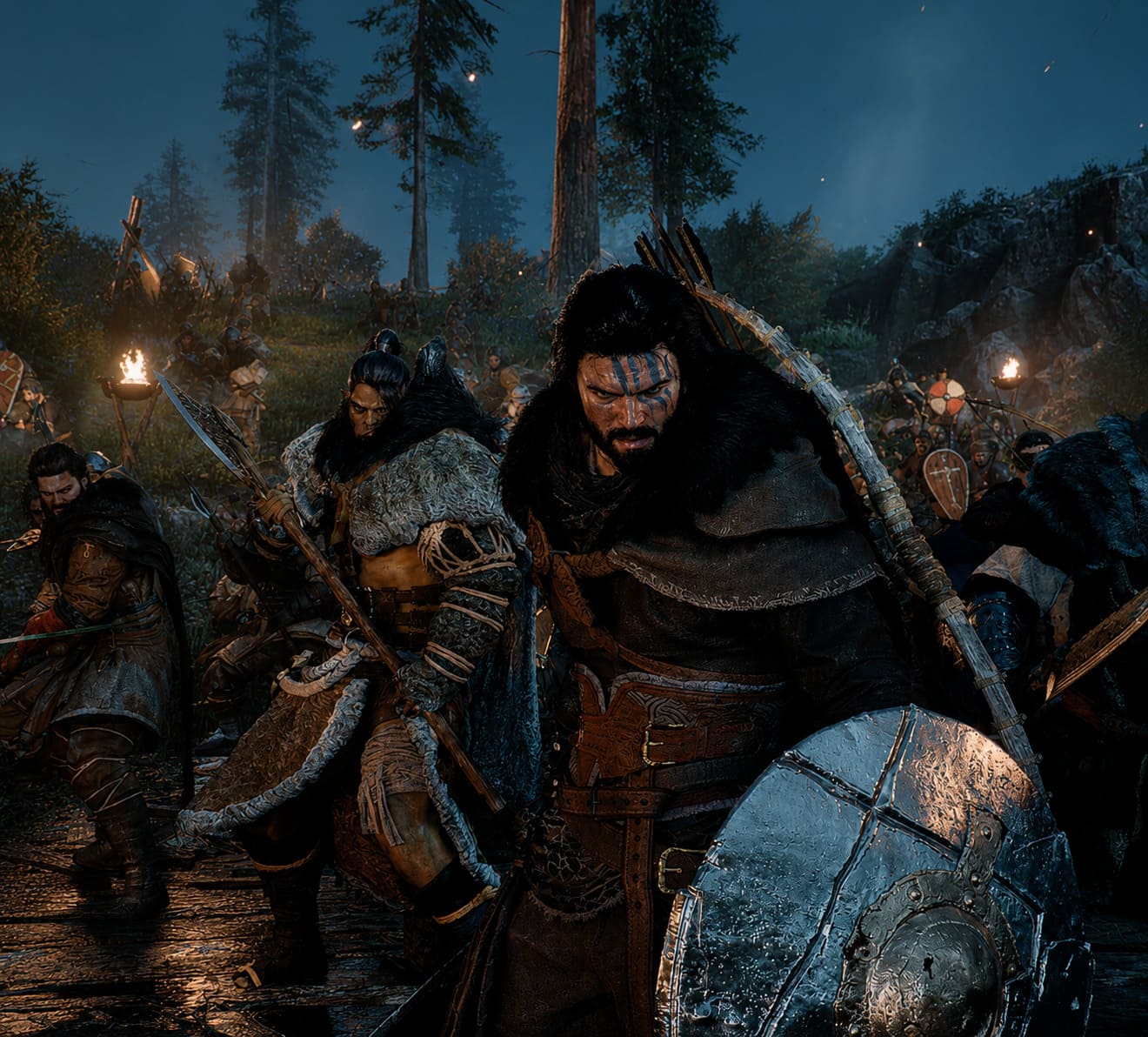
Kliff gathers an enormous alliance consisting of:
- The Greymanes
- Regional noble houses
- The Marquis Circus
- Stefan Lanford’s forces
- Demenissian allies
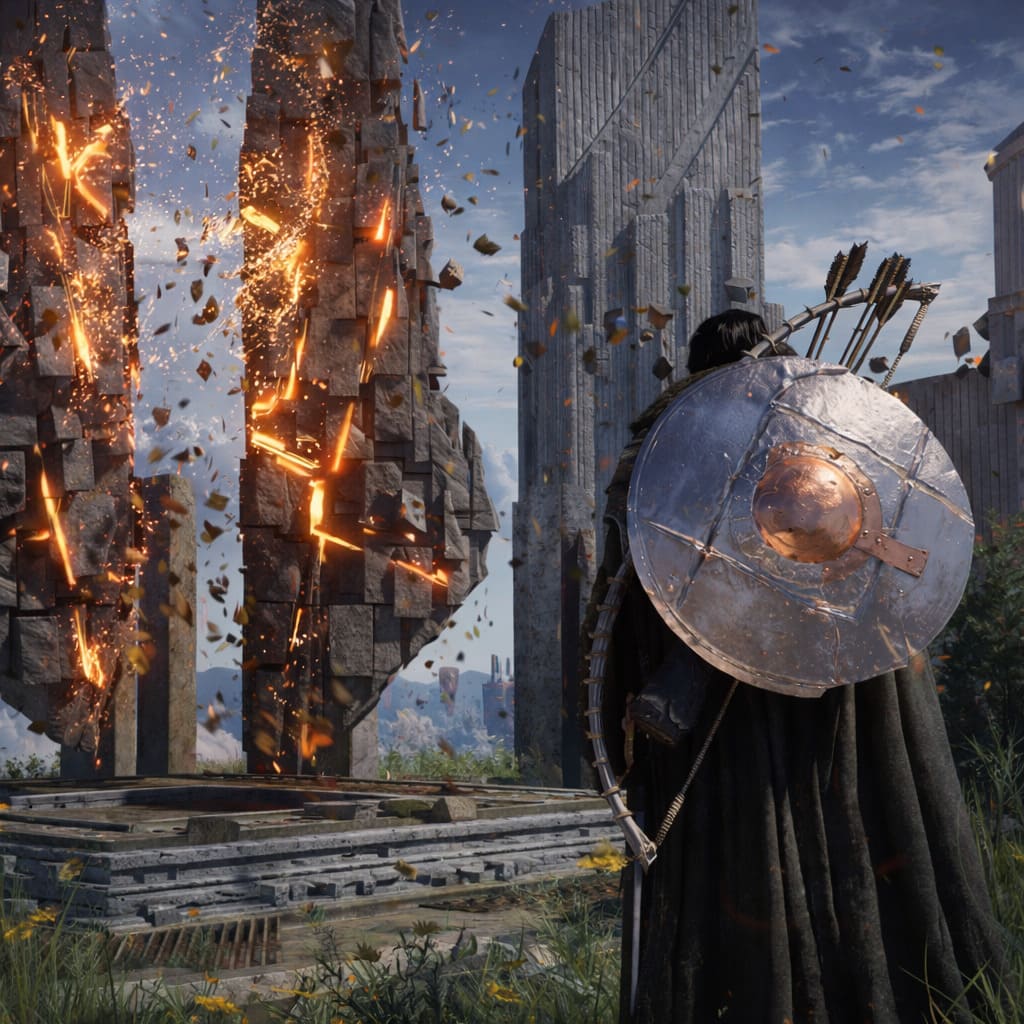
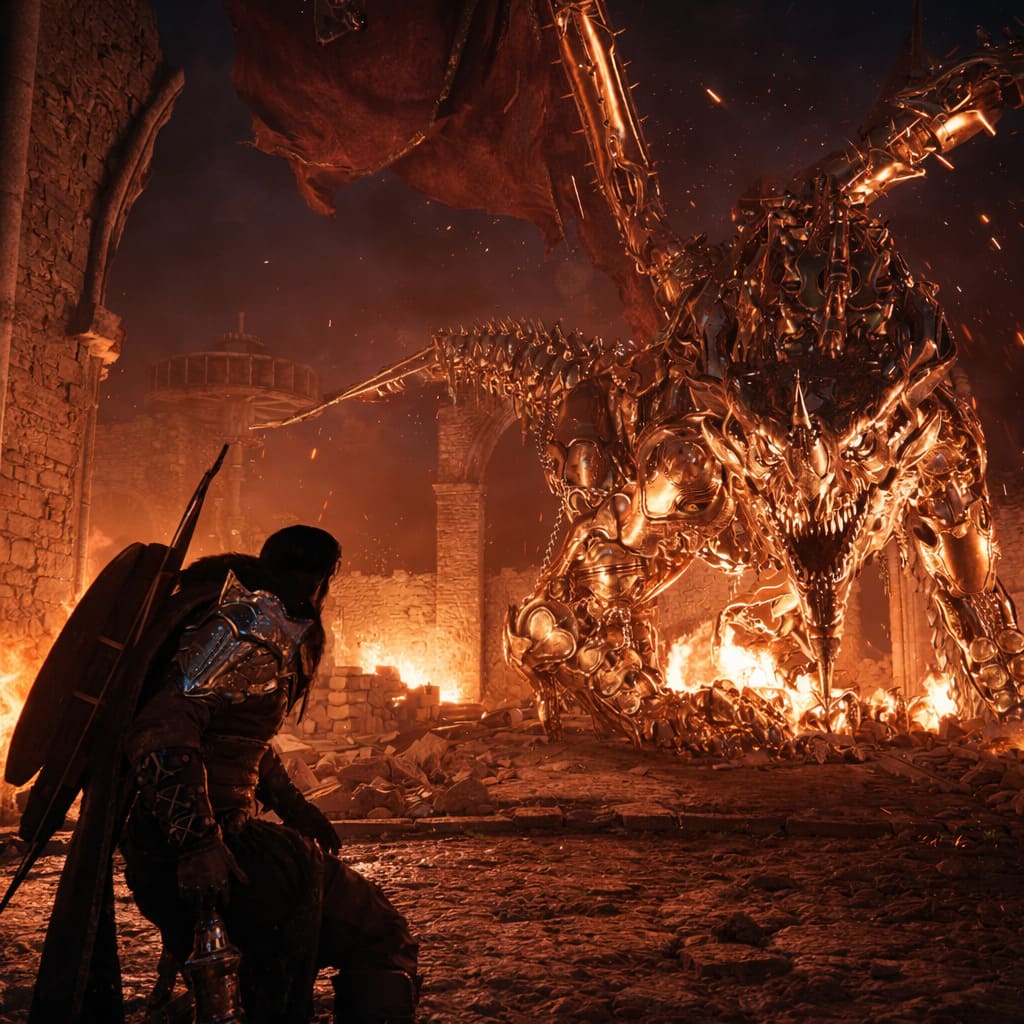
Mounted on the mechanical dragon Golden Star, powered by the cosmic energy source known as Blackstar, Kliff launches a full-scale assault on Fort Musket.
This section feels like Pearl Abyss throwing every gameplay system into one massive finale.
Players battle across the sky, destroy abyssal defenses, and eventually confront Caliburn, who has been orchestrating chaos from the shadows.
At first, defeating Caliburn seems like the obvious conclusion.
It isn’t.
Entering the Abyss
After losing the battle, Caliburn escapes into a dimensional rift connected directly to the Abyss.
Kliff follows.
What awaits inside is one of the most visually surreal environments I have experienced in an open-world RPG. Gravity behaves unpredictably, landscapes shift constantly, and reality itself appears unstable.
When Kliff finally defeats Caliburn, the game delivers its biggest surprise.
Myurdin emerges.
The man who started Kliff’s suffering was never simply a mercenary leader.
He is revealed to be the chosen vessel of an ancient cosmic entity known as Umbra.
Umbra: The True Enemy
The confrontation with Umbra completely changes how players understand the story.
Umbra is not merely another villain.
It is a primordial consciousness born from the Abyss itself.
The boss fight unfolds through multiple stages, beginning with Myurdin wielding devastating supernatural abilities before transforming into a colossal reality-warping monstrosity.
The scale of the battle feels closer to fighting an eldritch god than a traditional fantasy antagonist.
Eventually, with crucial assistance from Blackstar, Kliff manages to destroy Umbra’s core.
The victory saves Pywel.
But it comes with a devastating cost.
Why Does Kliff Suddenly Become Old?
One of the most shocking moments occurs immediately after the final battle.
When Kliff awakens during the epilogue, he has aged dramatically.
- His hair is white.
- His face is worn.
- His body appears exhausted.
Initially, this feels confusing, but the game provides an explanation.
Time functions differently inside the Abyss.
Exposure to immense temporal energies combined with prolonged contact with abyssal artifacts rapidly consumes Kliff’s natural lifespan.
In simple terms, Kliff sacrifices years—possibly decades—of his life to defeat Umbra.
It is a powerful narrative choice because the victory feels earned.
Unlike many RPG heroes who walk away unharmed, Kliff pays a very real personal price.
Journey’s End: A Different Kind of Endgame
One aspect I genuinely appreciated is how Crimson Desert handles its post-game content.
Rather than forcing players into New Game Plus immediately, the game allows exploration of a transformed world.
Players gain access to unrestricted dragon flight and can revisit locations across Pywel while witnessing the consequences of their actions.
During these final conversations, former allies discuss the future of their regions and the impact of Umbra’s destruction.
Yet even after completing every epilogue quest, something still feels unresolved.
Many mysteries remain unanswered.
And that’s exactly where the game’s hidden lore begins.
The Axiom Archive Changes Everything
The true story of Crimson Desert is hidden behind some of the toughest optional content in the game.
After completing all Abyss Island challenges, players unlock access to the mysterious Axiom Archive.
Inside, a collection of forbidden texts reveals information that completely redefines the entire narrative.
According to the archive, reality itself has been trapped inside a repeating cycle.
Pywel has experienced countless timelines.
History has been reset again and again.
And Kliff has lived through dozens of failed versions of his own story.
Major Timeline Discoveries
| Cycle | What Happened |
|---|---|
| Cycle 12 | Kliff lived a peaceful life and lacked the determination necessary to defeat Umbra. |
| Cycle 18 | Umbra corrupted a fragment of White Crow, eventually creating Hexe Marie. |
| Cycle 36 | Kliff emotionally collapsed and abandoned his destiny. |
| Cycle 45 | Kliff became Gwyn, an immortal wanderer partially fused with Umbra. |
| Cycle 46 | The Guardians discovered Oongka was essential for success. |
| Cycle 66 | Kliff’s emotions were deliberately suppressed to improve survival chances. |
This revelation explains countless strange moments throughout the campaign.
Suddenly, NPC dialogue, bizarre side quests, and recurring character behavior begin making sense.
The Guardians and the Endless Experiment
The archive introduces four higher-dimensional beings known as the Guardians.
These entities created the time loop after realizing Umbra would eventually destroy all existence.
Unable to permanently stop the threat, they repeatedly reset reality while testing different versions of Kliff’s life.
Every timeline became another experiment.
Every failure led to another reset.
Every success brought them closer to creating the perfect champion.
The implications are disturbing.
Many events throughout the game may never have been entirely Kliff’s own choices.
The Brilliant Meta-Narrative Hidden Beneath the Surface
This is where Crimson Desert became truly fascinating for me.
The deeper lore strongly suggests that the game is commenting on video games themselves.
Think about it:
- Repeating failures resemble repeated playthroughs.
- Timeline resets mirror loading saves.
- Strange side quests become narrative experiments.
- Character manipulation reflects developer control.
- Kliff’s limited freedom mirrors player agency.
Some texts even imply that the player represents an external force entering Kliff’s body from another reality.
In other words:
You.
The game subtly suggests that the person holding the controller is a higher-dimensional entity influencing events from beyond the world itself.
It’s one of the boldest pieces of meta storytelling I’ve seen in years.
Unlocking the Secret True Ending
The standard ending is only part of the story.
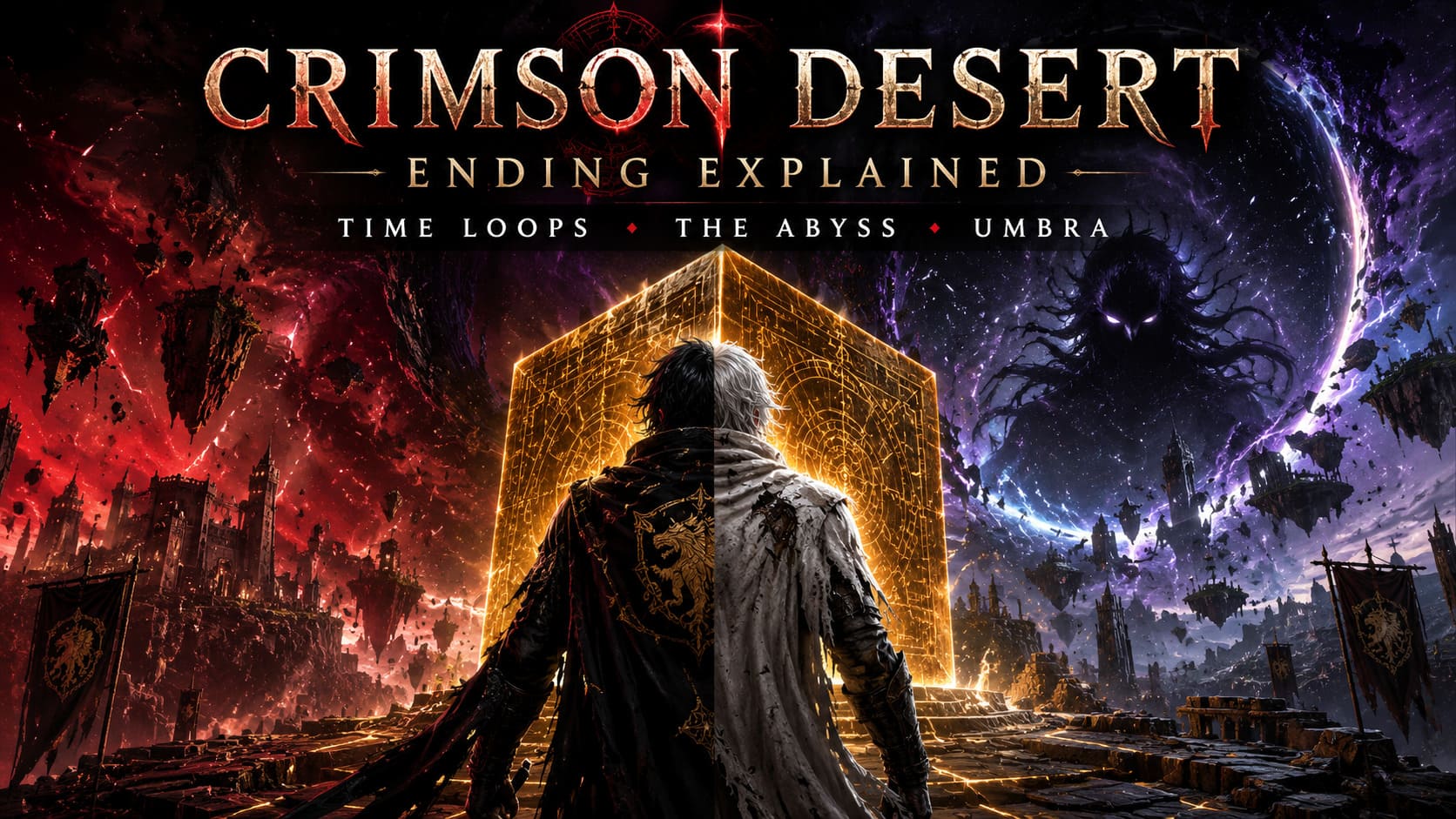
Players who fully complete the Axiom Archive gain access to a hidden sequence involving the mysterious golden cube shown throughout the game’s loading screens.
For dozens of hours, that image seems meaningless.
Then everything clicks.
When aged Kliff approaches the artifact, its energy activates.
A massive doorway of light appears.
The cube reacts specifically to him.
Moments later, his youth returns.
The aging process reverses completely.
But unlike previous timeline resets, this restoration is permanent.
For the first time in countless cycles, Kliff is no longer trapped.
He keeps his memories.
He keeps his experiences.
And most importantly, he gains complete freedom from the Guardians’ control.
The loop is finally broken.
What This Means for Future Expansions
The true ending clearly establishes the foundation for future stories.
Several major questions remain unresolved:
- What lies beyond the known regions of Pywel?
- What role will Hexe Marie play moving forward?
- Can the Guardians truly be trusted?
- What happens to a world without cosmic oversight?
- Is there an even greater force beyond the Abyss?
The final dialogue heavily hints at unexplored territories buried beneath the legendary Crimson Desert itself.
If Pearl Abyss decides to create a sequel or major expansion, they already have a perfect narrative setup waiting.
Jurassic World Evolution 3 Rebirth Expansion: Best Dinosaur Gene Modifications for Maximum Rating
Final Thoughts
After spending dozens of hours uncovering every secret, I genuinely believe Crimson Desert delivers one of the most ambitious endings in modern gaming.
What starts as a gritty mercenary adventure evolves into a layered exploration of destiny, free will, sacrifice, and player interaction.
The standard ending is satisfying on its own.
The hidden lore elevates the experience.
And the secret ending transforms the entire game into something much larger than a traditional RPG.
Whether you love every twist or not, one thing is undeniable:
Crimson Desert takes risks that very few AAA games are willing to attempt, and the result is a finale that players will be discussing for years.