A Plague Tale Legacy Leon Character Background and Lore History Explained
The world of A Plague Tale has never been afraid to make its players uncomfortable. Rats, plague, religious fanaticism, ancient mysteries, and the supernatural Macula have always been important, but the series has earned its reputation because the monsters are rarely the most frightening part. The real emotional damage comes from watching people protect each other, lose each other, and keep moving when every sensible part of them is screaming to stop.
That makes Resonance: A Plague Tale Legacy such an interesting chapter for fans who enjoy digging beneath the surface. The 2026 prequel moves away from the central story of Amicia and Hugo de Rune and takes players roughly 15 years before the events of A Plague Tale: Requiem. This time, the spotlight falls on a younger Sophia, a reckless plunderer whose past is tangled with ancient secrets, dangerous enemies, and a curse that reaches much further back than anyone initially realizes.
For players searching for A Plague Tale Legacy Leon character background and history, the subject becomes especially fascinating because Leon is tied to one of the series’ most memorable ideas: the emotional importance of protectors and companions. His place in the broader lore also opens the door to discussions about names, symbolism, sacrifice, and the recurring pattern surrounding the Carriers of the Prima Macula.
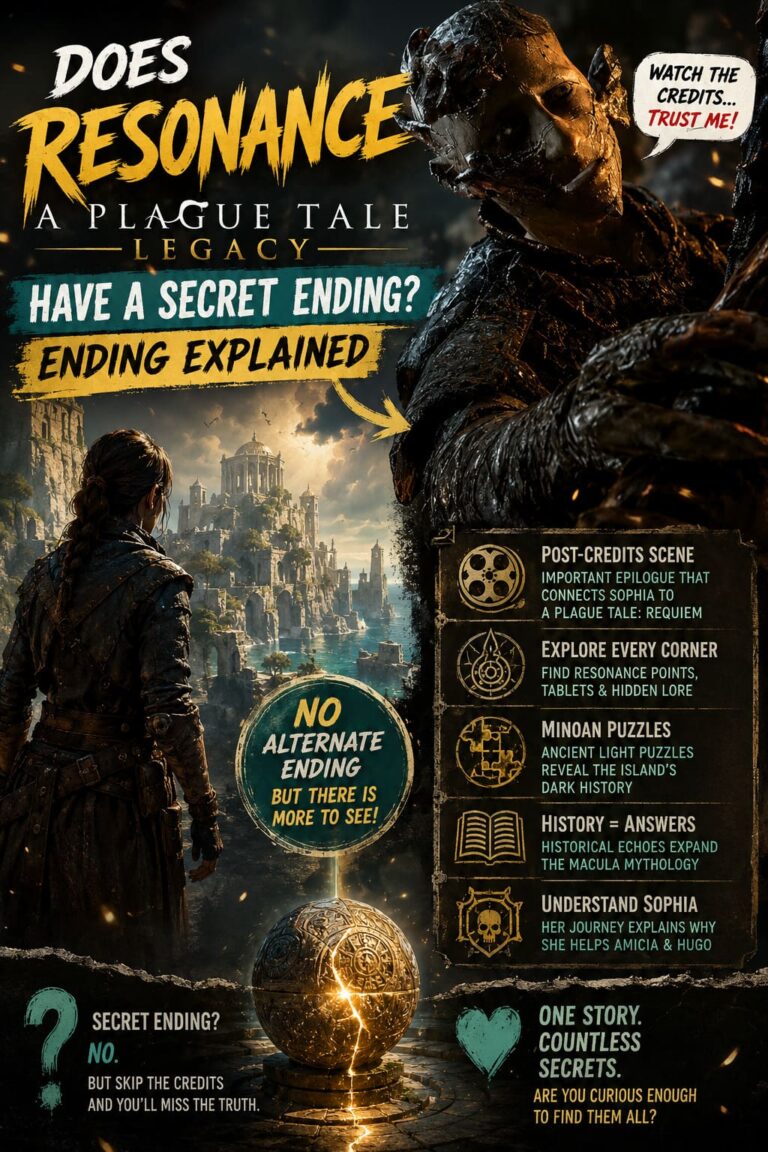
Does Resonance: A Plague Tale Legacy Have a Secret Ending? Ending Explained
Where A Plague Tale: Legacy Fits Into the Timeline
Unlike A Plague Tale: Innocence and Requiem, which keep the de Rune family at the heart of their stories, Legacy expands the historical scope of the franchise. Sophia is considerably removed from Amicia’s journey, yet the horrors she encounters feel unmistakably familiar.
The game takes place across the Mediterranean, with Minotaur’s Island serving as one of its most important locations. Sophia is already living a dangerous life when the story begins. She is not a sheltered noble girl discovering the horrors of the outside world; she is a hardened survivor, a plunderer, and someone accustomed to running when powerful people decide they want her dead.
That attitude gives Sophia a very different energy from Amicia. Amicia’s transformation was painful because she had to learn how to survive. Sophia, by contrast, already knows how ugly survival can get. Her journey is about discovering what lies beneath the life she has built and confronting a history that refuses to stay buried.
The narrative also introduces a dual-timeline structure, allowing players to explore both the medieval world and the ancient Minoan civilization. This is a clever way to expand the mythology because the Macula no longer feels like a problem belonging to one family or one century. It becomes something ancient, recurring, and almost terrifyingly patient.
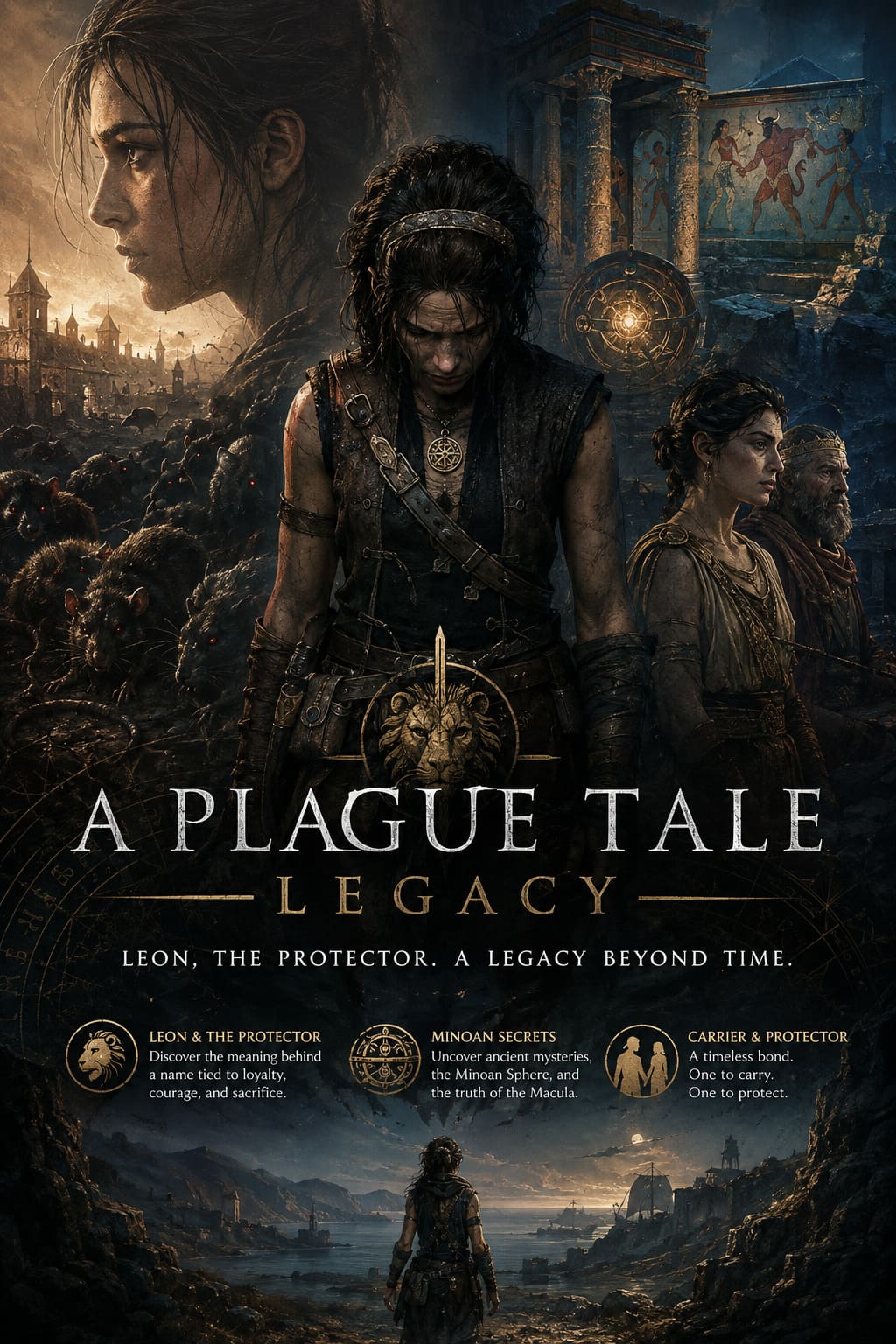
Who Is Leon in A Plague Tale Lore?
The name Leon naturally catches the attention of long-time players because A Plague Tale has already attached emotional significance to a very similar name.
At the beginning of A Plague Tale: Innocence, Amicia’s family dog, Lion, is one of the last innocent pieces of her old life. He represents the comfortable existence Amicia is about to lose. His fate is brutal, sudden, and unforgettable precisely because it happens before the player has fully understood what kind of nightmare the game is preparing to unleash.
That moment is more important than it initially appears. Lion’s death isn’t simply a shocking opening scene. It tells players that the old rules no longer matter. Nature itself has become hostile, the underground is alive with something monstrous, and Amicia’s childhood is effectively over.
This is why discussions surrounding Leon and A Plague Tale character history can become surprisingly deep. Names associated with lions traditionally evoke strength, courage, guardianship, and protection. Those qualities fit one of the franchise’s biggest recurring themes: someone standing between a vulnerable Carrier and the forces trying to consume them.
It is important not to confuse similarly named figures or assume that every reference represents a direct bloodline connection. A Plague Tale encourages speculation through symbolism, recurring themes, and historical echoes, but thematic parallels are not automatically proof of literal ancestry.
The Protector and the Carrier
The relationship between the Carrier and the Protector is arguably one of the most important pieces of A Plague Tale mythology.
The Carrier is connected to the Prima Macula, an ancient supernatural force capable of unleashing horrifying consequences. The Protector, meanwhile, exists as the human counterweight. This person isn’t merely a bodyguard. Their role is emotional, physical, and sometimes spiritual.
Amicia becomes Hugo’s Protector, and her entire journey can be understood through that responsibility. She fights soldiers, cultists, monsters, and impossible circumstances because she refuses to abandon her brother.
Long before the de Runes, however, other Carrier and Protector relationships existed. Aelia and Basilius represent an ancient example of this dynamic, giving the concept a much larger historical footprint than players might expect during the opening hours of the original game.
The Protector Pattern
| Element | Role in the Lore |
|---|---|
| Carrier | Person connected to the Prima Macula |
| Protector | Guardian responsible for keeping the Carrier alive |
| Macula | Ancient supernatural force driving the central conflict |
| Sacrifice | Recurring price of protecting the Carrier |
| Historical Echoes | Events that connect different eras |
| Legacy | The continuation of these conflicts across generations |
This cycle is one reason the series feels bigger than the individual stories of Amicia, Hugo, Sophia, or Basilius. Their lives may be separated by centuries, but the same fundamental struggle keeps resurfacing.
Sophia’s Story Follows the Same Emotional Blueprint
Sophia may not initially look like another version of Amicia, and that is exactly what makes her compelling.
She grew up among outsiders and thieves after being rescued by her father from a brutal system of experimentation. Instead of developing into a conventional hero, she became someone who learned to survive by being quick, aggressive, suspicious, and willing to bend the rules.
Yet underneath that rough exterior is the same emotional question that drives much of A Plague Tale: how far would you go to protect someone you care about?
Sophia’s relationships with her companions are therefore more important than her combat abilities. She may be able to fight her way through situations where Amicia would have relied heavily on stealth, but violence doesn’t protect a person from grief. The game still puts Sophia in situations where loyalty and sacrifice matter more than simply surviving the next encounter.
That’s where the franchise feels consistent despite the changes in gameplay and setting.
The Minoan Sphere and the Ancient Mystery
One of the most intriguing additions to the Legacy mythology is the Minoan Sphere, an artifact connected to Sophia’s exploration of the island.
The Sphere allows Sophia to manipulate light and interact with ancient mechanisms, turning exploration into something more than a straightforward trek through ruined environments. The puzzles tied to Daedalus and the ancient structures reinforce the idea that the island has been hiding its secrets for centuries.
For lore hunters, these sequences are particularly valuable because the ancient environment acts almost like a giant historical record. Ruins, symbols, mechanisms, and forgotten stories reveal that previous generations were already struggling against forces that modern characters barely understand.
The dual-timeline approach makes this even more interesting. Players aren’t simply being told that ancient people fought the Macula. They get to experience fragments of that history and see how old decisions can continue influencing people centuries later.
That is classic A Plague Tale storytelling: the past never really dies. It just waits.
Why the Macula Is More Than a Supernatural Curse
It is tempting to look at the Macula as nothing more than the franchise’s explanation for giant swarms of rats and supernatural disasters. That undersells what the series is doing with it.
The Macula functions as a bridge between generations. Each appearance creates another set of Carriers, Protectors, victims, manipulators, and people convinced they can control something that clearly does not want to be controlled.
The Order’s interest in the Macula also demonstrates how human ambition can be every bit as dangerous as the supernatural force itself. People don’t merely fear the Macula; some want to understand it, weaponize it, or exploit the Carrier connected to it.
That creates one of the strongest contrasts in the series. The Carrier is often treated as a threat or an object of study, while the Protector sees an actual human being standing in front of them.
Amicia sees Hugo.
Aelia sees Basilius.
And Sophia’s story continues exploring what happens when human relationships collide with ancient forces that seem almost impossible to escape.
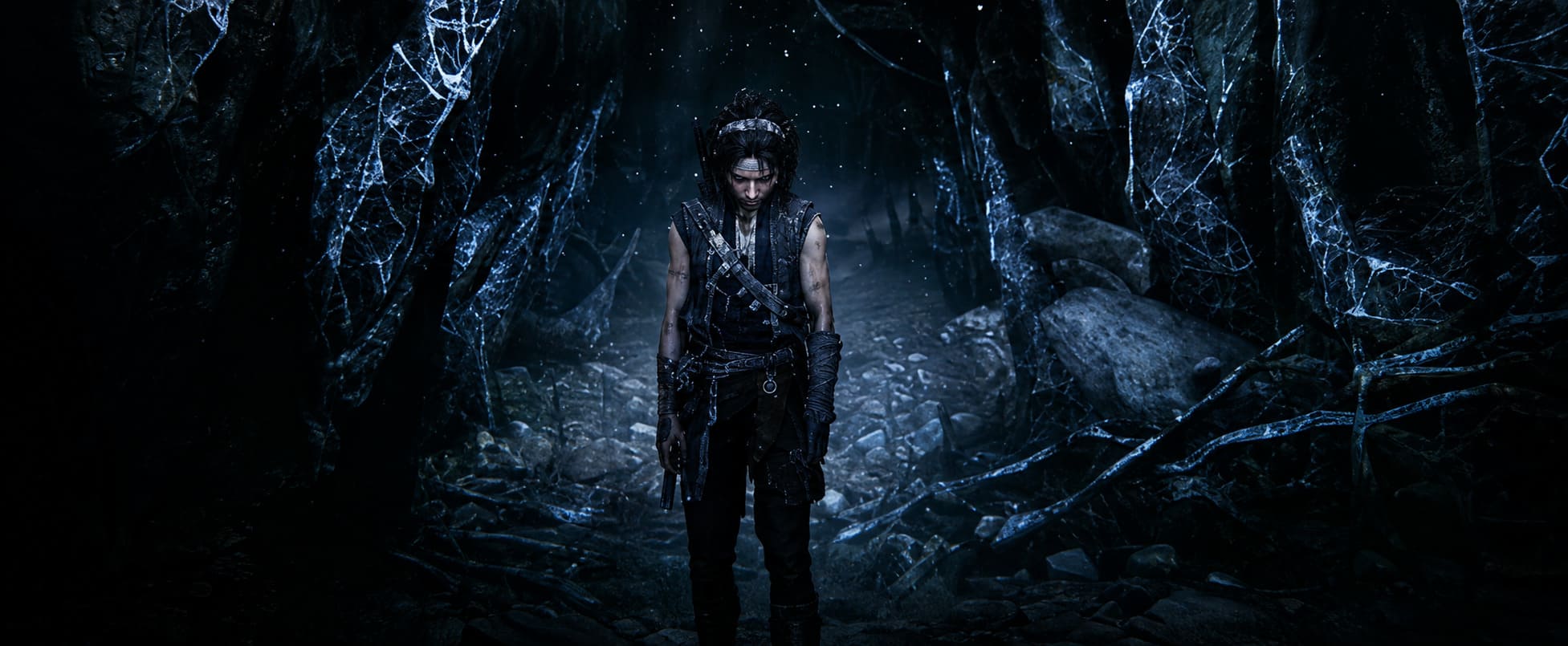
Why Fans Keep Digging Into Leon’s Background
There is something almost irresistible about hunting for hidden connections in the A Plague Tale universe.
A minor character name can lead to theories. A symbol carved into a wall can trigger hours of discussion. A historical reference can make players wonder whether they have discovered another piece of the Macula’s enormous timeline.
Leon becomes interesting in that environment because the name carries an obvious association with the lion imagery already present in the franchise. For some fans, that creates a thematic connection to courage, loyalty, and protection. Others approach it more cautiously, looking for actual narrative evidence before accepting a theory.
That distinction matters.
A good lore theory should be exciting without pretending speculation is confirmed canon. The strongest discussions separate what the game explicitly establishes from what the community has inferred from recurring imagery and narrative patterns.
And honestly, that’s part of the fun. A game that leaves absolutely nothing to interpret is easy to finish and forget. A Plague Tale gives players enough unanswered questions to keep conversations alive long after the credits roll.
From Sophia the Survivor to the Captain Fans Know
Sophia’s character arc also gains extra weight when viewed through her later reputation.
The young woman introduced in Legacy is reckless, angry, and shaped by a life where trust is dangerous. Her evolution into the capable captain players eventually recognize isn’t simply a power fantasy transformation. It is the result of everything she loses, everything she learns, and every person who forces her to reconsider what loyalty actually means.
The island becomes more than a location. It becomes a pressure cooker.
Every battle, puzzle, betrayal, and revelation pushes Sophia toward becoming someone capable of leading others. She doesn’t get there by becoming less emotional. She gets there by learning how to turn those emotions into determination.
That makes her an excellent fit for the A Plague Tale universe. The series has never really been about becoming invincible. Its characters become stronger by surviving things that should have destroyed them.
The Bigger Legacy of A Plague Tale
Looking at Leon, Sophia, Aelia, Basilius, Amicia, and Hugo together reveals what makes the franchise’s mythology work so well.
These characters don’t need to share the same century to feel connected. Their stories are linked by recurring ideas: the Carrier, the Protector, sacrifice, fear, human cruelty, forbidden knowledge, and the desperate need to protect someone when the entire world seems determined to take them away.
Resonance: A Plague Tale Legacy pushes that concept further by showing that the roots of these conflicts extend deep into the past. The Minoan era isn’t just background decoration, and Sophia isn’t simply another protagonist dropped into a familiar formula. Her story expands the timeline and gives fans another perspective on a mythology that has always been larger than the de Rune family.
And that is why the Leon character background and A Plague Tale lore discussions remain so interesting. Whether a particular connection turns out to be literal, symbolic, or simply an intentional echo, the franchise keeps rewarding players who pay attention.
The rats may be the image everyone remembers, but they aren’t the heart of A Plague Tale. The heart is the person standing beside you when everything falls apart.
That’s the real legacy.