Does Resonance: A Plague Tale Legacy Have a Secret Ending? Ending Explained
If there is one thing A Plague Tale fans have learned to fear almost as much as the rats, it is a suspiciously quiet credits sequence. After the emotional gut punch of A Plague Tale: Requiem and its infamous post-credits tease, it is completely understandable that players are now watching every final scene in Resonance: A Plague Tale Legacy with their detective glasses firmly on.
This prequel takes a different route through the series’ dark medieval world. Instead of following Amicia and Hugo, the spotlight belongs to Sophia, the tough-talking smuggler and pirate captain who players first encountered in Requiem. Set roughly 15 years before the events of that game, the adventure sends Sophia to the mysterious Minotaur’s Island, where forgotten Minoan ruins, ancient legends, deadly enemies, and the terrifying history of the Prima Macula all collide.
And naturally, one question keeps popping up: does Resonance: A Plague Tale Legacy have a secret ending?
The short version is that there is not a completely separate alternate ending that changes Sophia’s fate depending on your choices. The game remains deliberately linear, much like the previous entries. But that does not mean you should treat the credits as your cue to grab a snack and leave.
There are additional pieces of story and a post-credits sequence that are extremely important if you want to understand Sophia’s journey and how it connects to the wider A Plague Tale mythology.
Resonance A Plague Tale Legacy Full Story Explained: The Ending and Lore Breakdown
Does Resonance: A Plague Tale Legacy Have an Alternate Ending?
No, not in the traditional sense.
Resonance: A Plague Tale Legacy does not suddenly split into several dramatically different conclusions based on dialogue choices, collectibles, or decisions made during the campaign. Your exploration and completion progress can affect the amount of lore and additional dialogue you uncover, but the central conclusion remains the same.
Honestly, I think that is the right decision for this series.
A Plague Tale has never felt like a choose-your-own-adventure RPG. Its strength comes from tightly controlled storytelling, carefully timed reveals, and characters being pushed toward events that often feel unavoidable. Turning Sophia’s story into a branching morality system would probably weaken the narrative rather than improve it.
The game also has to fit into the established timeline. Sophia eventually becomes an important ally to Amicia and Hugo, so Asobo Studio has limited room to completely rewrite her future without creating a giant continuity headache.
That said, ‘no alternate ending’ absolutely does not mean ‘nothing hidden.’
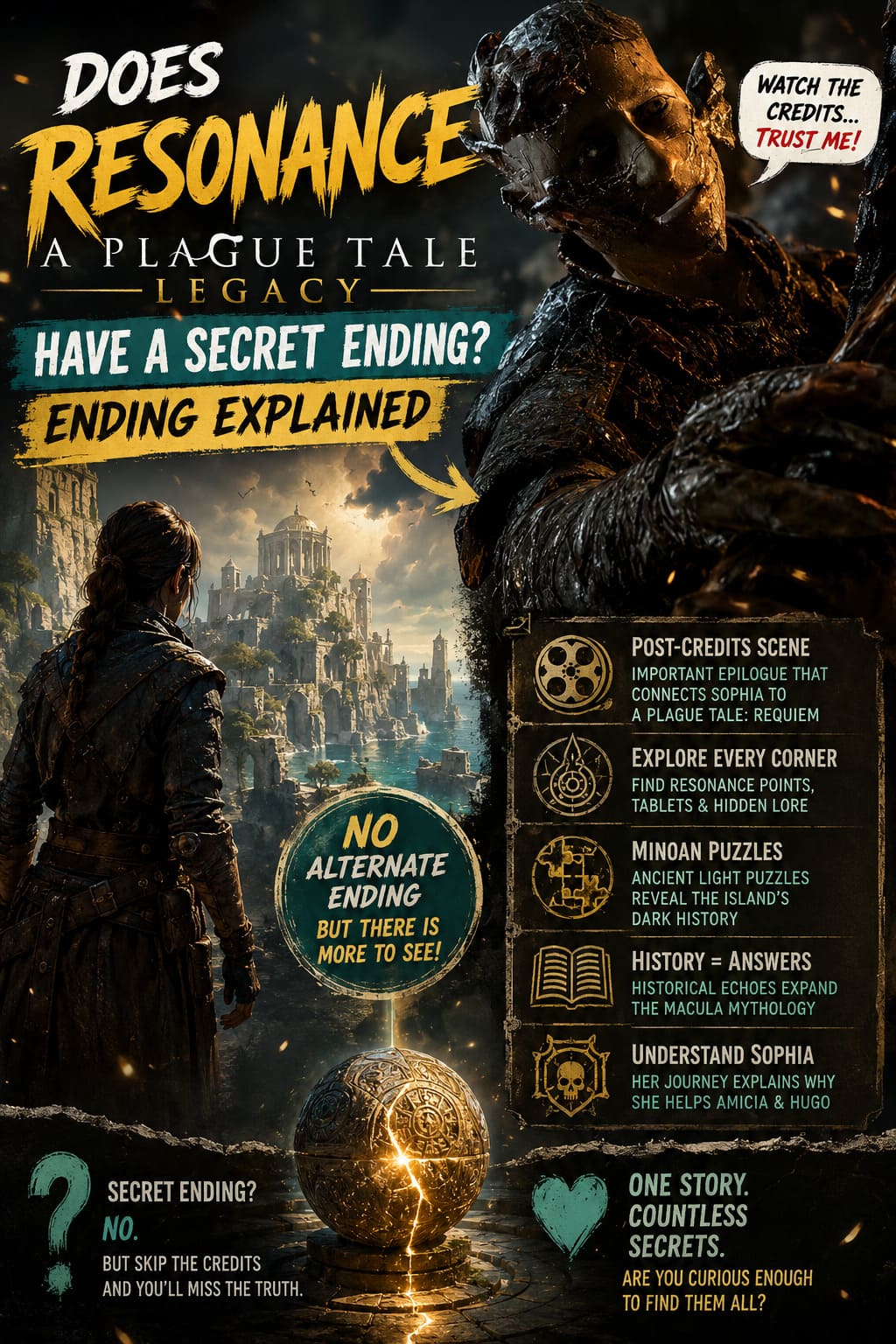
The Post-Credits Scene Is the Real Surprise
If you have finished the main story and immediately closed the game, you may have missed one of the most interesting pieces of the finale.
The post-credits material is effectively the game’s extended epilogue. It provides additional context for Sophia and helps bridge the gap between the events of this prequel and her appearance in A Plague Tale: Requiem.
That is especially important because Sophia’s personality makes her relationship with Amicia and Hugo feel slightly unusual when you first encounter her in Requiem. She is a hardened survivor, a smuggler, and someone who clearly understands how dangerous the world can be. She does not exactly scream ‘I am going to risk everything for two strangers.’
The events on Minotaur’s Island give that relationship considerably more emotional weight.
The final scenes are less about throwing another enormous plot twist at the player and more about showing why Sophia becomes the person we eventually meet later in the timeline.
And yes, you should watch the entire credits sequence if you want the full story.
Is the Post-Credits Scene Required?
Strictly speaking, you can finish the campaign without seeing every piece of bonus material.
But if you are a fan who wants the complete A Plague Tale experience, skipping the post-credits scene is basically leaving the treasure chest unopened after fighting your way through the entire dungeon.
The important material comes after the main conclusion, so don’t rush back to the title screen when the credits appear. Let them play.
This is particularly worth doing if you have been following the series’ larger mystery surrounding the Macula. The post-credits content adds another piece to that puzzle and gives fans plenty of ammunition for theories about where the franchise could go next.
What Changes If You Explore the Island Thoroughly?
The main ending does not transform into a completely different conclusion because you found every collectible.
What changes is how much of the story you understand.
Minotaur’s Island is packed with optional discoveries, environmental details, historical clues, and moments that flesh out Sophia’s connection to the strange forces surrounding the island. Players who sprint through the critical path will see the essential story, but completionists get a much richer picture.
That distinction matters.
The optional content is not simply there to inflate your completion percentage. Some discoveries provide additional context for Sophia’s motivations, while others expand the ancient history behind the Macula and the mysterious Minoan civilization.
Taken together, these fragments make the Minoan sections feel like more than a flashy historical backdrop. They become part of the larger mythology of the franchise.
Resonance Points and Sophia’s Development
Resonance Points are scattered around the island and can be easy to miss when you’re concentrating on survival.
They contribute to Sophia’s progression and encourage players to investigate corners of the environment that the main route does not require you to visit. Finding more of them can also expand the information available through Sophia’s personal records and provide additional insight into her mindset.
If you’re playing like I do—checking every suspicious-looking hallway because there is absolutely no way that giant pile of rubble isn’t hiding something—these rewards become much easier to collect.
If you are running straight toward the next objective, expect to leave plenty behind.
The Minoan Puzzles Hide More Than Just Gameplay Rewards
One of the most distinctive elements of the adventure is the ancient sphere used to manipulate light.
These sequences give the game a different flavor from the more familiar stealth and survival gameplay of the main series. Instead of simply hiding from enemies or managing a swarm of rats, players have to understand how light interacts with the environment and use it to progress through ancient locations.
The optional puzzles are worth solving for more than the satisfaction of finally figuring out what the developers are trying to make you rotate.
Exploration can uncover tablets and other pieces of ancient lore that help explain what happened long before Sophia arrived on the island. Taken together, these fragments make the Minoan sections feel like more than a flashy historical backdrop.
They become part of the larger mythology of the franchise.
The Dual-Timeline Story Is Especially Important
The ancient history of the island is not presented as simple exposition.
Sophia’s connection to the Macula allows the game to explore events separated by centuries, creating a narrative relationship between her medieval journey and the distant Minoan past. These historical echoes are one of the most interesting parts of the story because they make the Macula feel less like an isolated curse affecting a handful of characters.
Instead, the game suggests something much bigger.
The struggle surrounding the Macula has roots that stretch back through human history, with different generations confronting variations of the same horrifying problem.
That idea gives the ending considerably more weight.
What Happens If You Find Every Memory?
Players who investigate the historical echoes and complete the associated notebook material can uncover additional dialogue and character reflections.
These details don’t create a secret ending, but they can change the way you interpret Sophia’s final moments.
Her journey is not simply about defeating whatever monster happens to be waiting beneath the island. She is gradually forced to confront the possibility that the horrors surrounding her are part of something ancient and recurring.
That realization becomes critical to understanding her later actions.
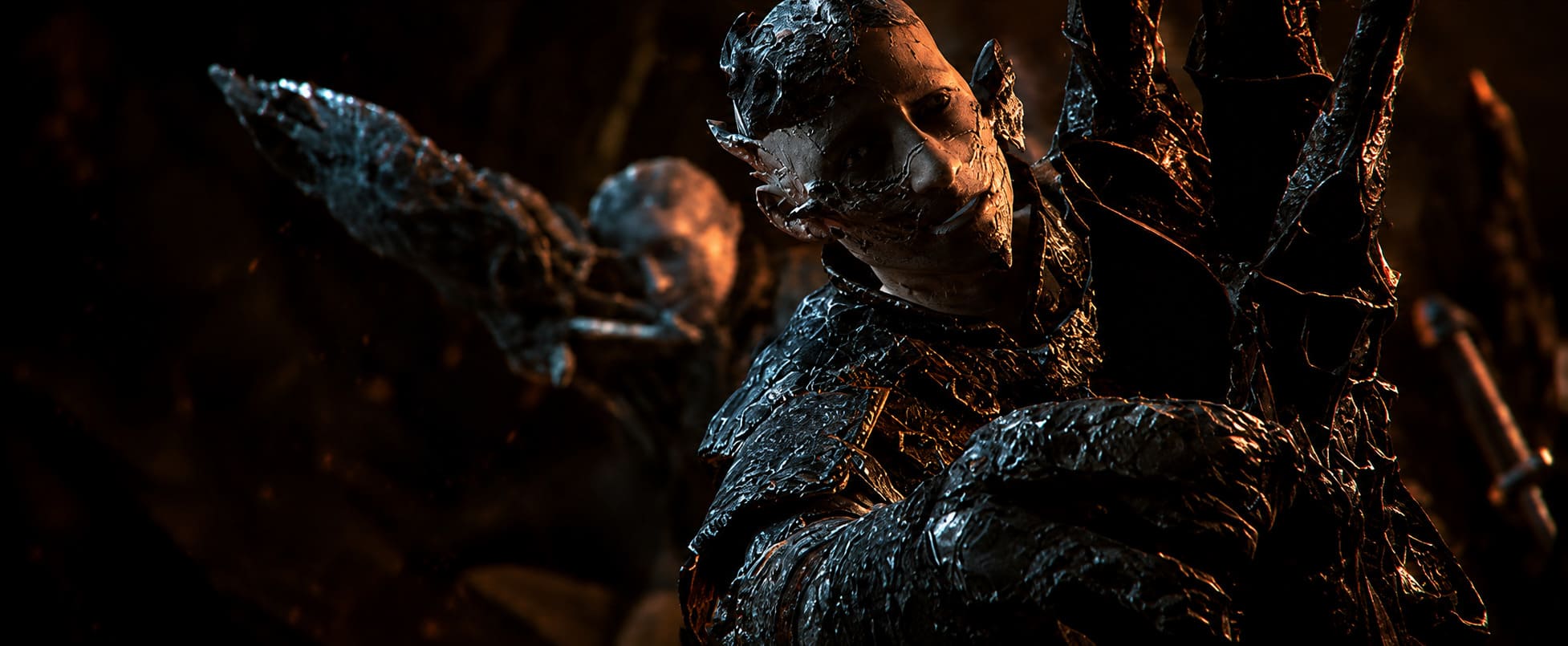
Resonance: A Plague Tale Legacy Ending Explained
The finale brings Sophia face-to-face with the dangers hidden beneath Minotaur’s Island while simultaneously forcing her to confront uncomfortable truths about herself.
For much of the game, Sophia’s motivation is straightforward on the surface. She wants answers. She wants to understand the strange pull she feels toward the island and uncover the truth behind the mysteries buried beneath its ruins.
But the deeper she goes, the harder it becomes to separate mythology from reality.
The ancient presence associated with the island represents more than a conventional monster. It is tied to the broader history of the Macula and the repeated cycle that has affected different generations throughout history.
Sophia survives the immediate crisis, but she does not walk away unchanged.
That is arguably the most important part of the ending.
The game is not saying that Sophia simply completed a dangerous job and returned to her old life. She has witnessed something that fundamentally alters how she sees the world and her place within it.
The Macula is no longer an abstract mystery.
It is a historical cycle.
Why Sophia’s Ending Matters for A Plague Tale: Requiem
This is where the prequel becomes particularly interesting.
In Requiem, Sophia eventually becomes someone willing to help Amicia and Hugo despite having every reason to keep her distance from their problems. She is already an experienced survivor, and getting involved with the siblings is obviously dangerous.
The events of Legacy provide additional context for that decision.
Sophia has already encountered the consequences of the Macula and witnessed how devastating its influence can become. Her experience on Minotaur’s Island gives her a much deeper understanding of what is at stake when she meets another young bearer caught in the same nightmare.
That makes her relationship with Hugo feel less like a random act of kindness and more like a conscious choice.
She understands the cycle.
She has seen where it can lead.
And she chooses to help anyway.
Does the Ending Set Up A Plague Tale 3?
This is where the fan theories get spicy.
The A Plague Tale series has deliberately left players with unanswered questions about the ultimate nature of the Macula. The ending of Requiem, particularly its post-credits material, opened the door to speculation about whether the story could eventually move beyond the medieval setting.
Resonance: A Plague Tale Legacy adds more mythology to that conversation without providing an easy solution.
The Minoan history suggests that the Macula is not a recent phenomenon. It has survived across enormous stretches of time, repeatedly becoming intertwined with human lives.
That raises a fascinating question: can the cycle actually be broken?
Or is every bearer simply another link in an endless chain?
The game does not hand players a clean answer, which I personally prefer. A definitive explanation would kill a lot of the mystery that makes the series so compelling.
Instead, the ending gives fans more pieces and lets them argue about the picture.
And judging by how much speculation this franchise generates, people are going to be arguing about it for a long time.
What Completionists Should Do Before Finishing
If you want to squeeze every possible story detail out of Resonance: A Plague Tale Legacy, don’t treat the main objectives as your only priority.
A good completionist run should focus on the following:
- Explore every suspicious side area. Hidden paths often contain Resonance Points, lore, and environmental clues.
- Solve optional light puzzles. The Minoan sphere is not just a progression gimmick; it is closely tied to the game’s ancient lore.
- Investigate historical echoes. Completing Sophia’s notebook gives additional context for her character and the Macula.
- Check your collectibles before the finale. If you care about 100% completion, don’t assume you can casually grab everything after finishing the story.
- Watch the credits completely. The post-credits sequence is important and should not be skipped.
| Feature | Affects Main Ending? | Adds Lore? | Worth Doing? |
|---|---|---|---|
| Resonance Points | No | Yes | Yes |
| Minoan Tablets | No | Yes | Yes |
| Light-Manipulation Puzzles | No | Yes | Yes |
| Historical Echoes | No | Yes | Definitely |
| Full Credits | No | Yes | Absolutely |
Final Verdict: Is There a Secret Ending?
So, does Resonance: A Plague Tale Legacy have a secret ending?
Not in the sense of a completely different finale determined by player choices. The main story has a fixed conclusion, and exploring more of the island does not unlock a radically different fate for Sophia.
But there is absolutely additional ending content worth seeing.
The post-credits sequence provides important context, while optional collectibles, historical memories, puzzles, and exploration deepen the mythology surrounding Sophia and the Macula. If you rush through the campaign, you’ll understand what happens. If you explore everything, you’ll understand why it matters.
And that’s the difference.
For me, the biggest strength of this ending is that it does not try to outdo Requiem with an even louder shock. Instead, it expands the mythology and makes Sophia’s place in the A Plague Tale story more meaningful.
So when those credits start rolling, don’t quit.
Put the controller down, grab a drink, and let the credits finish. If you’ve spent hours crawling through ancient ruins, manipulating beams of light, dodging monsters, and piecing together the history of the Macula, you might as well stay for the final reward.
There may not be a traditional ‘secret ending,’ but Resonance: A Plague Tale Legacy clearly has secrets worth sticking around for.