Fire Emblem Fortune’s Weave Direct Breakdown: Story, Classes, Combat, and Switch 2 Details
For years, Fire Emblem fans have argued over one simple question: should the series focus on deep political storytelling like Three Houses, or embrace colorful heroes and flashy battles like Engage? After watching Nintendo’s latest presentation for Fire Emblem: Fortune’s Weave, I honestly think Intelligent Systems is trying to satisfy both camps at once.
And from what we’ve seen so far, it actually looks convincing.
This isn’t another safe sequel built around familiar mechanics. Instead, the developers are taking some surprisingly ambitious risks with the narrative, the progression system, and even the way battles work outside traditional tactical maps. That’s exactly what I wanted to see from a franchise entering the Nintendo Switch 2 generation.
Approximately Up Beginner’s Guide: Tips, Tricks, and Spaceship Building Strategies (2026)
A Return to Political Drama Without Forgetting the Fantasy
One of the biggest reasons Three Houses became such a phenomenon wasn’t just its combat. Players cared about the characters because every battle carried political consequences.
Fortune’s Weave appears ready to recapture that feeling.
The story unfolds in Dagda, a region that already exists within the Fire Emblem universe but has never received this level of attention. Rather than introducing another isolated continent, Intelligent Systems is expanding existing lore while telling an entirely new conflict.
The opening immediately raises the stakes.
Humanity has already lost.
The resurrected demon god Balor has devastated the empire, leaving almost no hope for survival. Instead of throwing the player into another standard ‘save the kingdom’ adventure, the game begins after the apocalypse has essentially happened.
Thankfully, time itself becomes the greatest weapon.
With help from the returning goddess Sothis and a mysterious new deity named Fortuna, the player travels five years into the past, hoping to prevent history from repeating itself. It’s an idea that immediately reminded me of Awakening, but the presentation made it clear this isn’t just another time-loop gimmick. The entire campaign revolves around changing multiple destinies instead of simply defeating one final boss.
Four Main Heroes, One Shared Destiny
Perhaps my favorite reveal was the game’s structure.
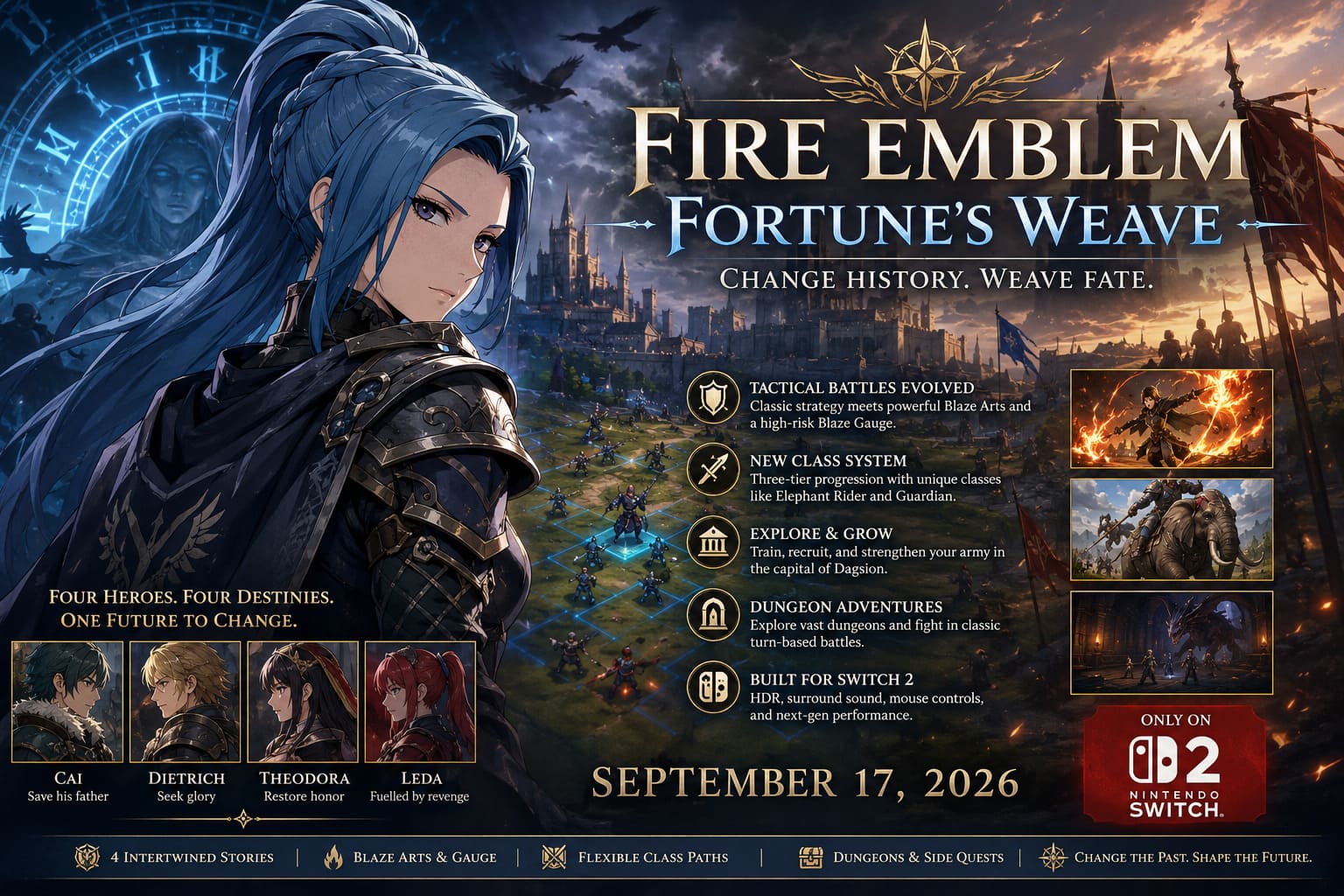
Instead of forcing players down one storyline, Fortune’s Weave lets you experience four different protagonists almost simultaneously.
Each character has completely different motivations.
- Cai fights to rescue his imprisoned father.
- Dietrich seeks glory after surviving a deadly maritime disaster.
- Theodora wants to restore her kingdom’s honor while protecting its borders.
- Leda is driven entirely by revenge after losing her father.
Normally, multiple protagonists mean multiple full playthroughs.
That isn’t the case here.
A central hub known as the Pale Raven’s Perch allows players to switch between campaigns whenever they want. Progress for every hero is saved independently, meaning you can alternate between storylines without constantly restarting the game.
Honestly, that’s one of the smartest quality-of-life improvements Fire Emblem has introduced in years.
Instead of replaying identical early chapters four separate times, players can naturally build the larger narrative piece by piece.
Tactical Combat Is Still the Heart of the Experience
Fortunately, Intelligent Systems hasn’t forgotten why people fell in love with Fire Emblem in the first place.
Grid-based tactical combat remains the foundation of every major battle.
Movement ranges, positioning, terrain advantages, and careful planning still determine success. Veterans should feel immediately comfortable once the maps begin.
That said, combat isn’t simply repeating older systems.
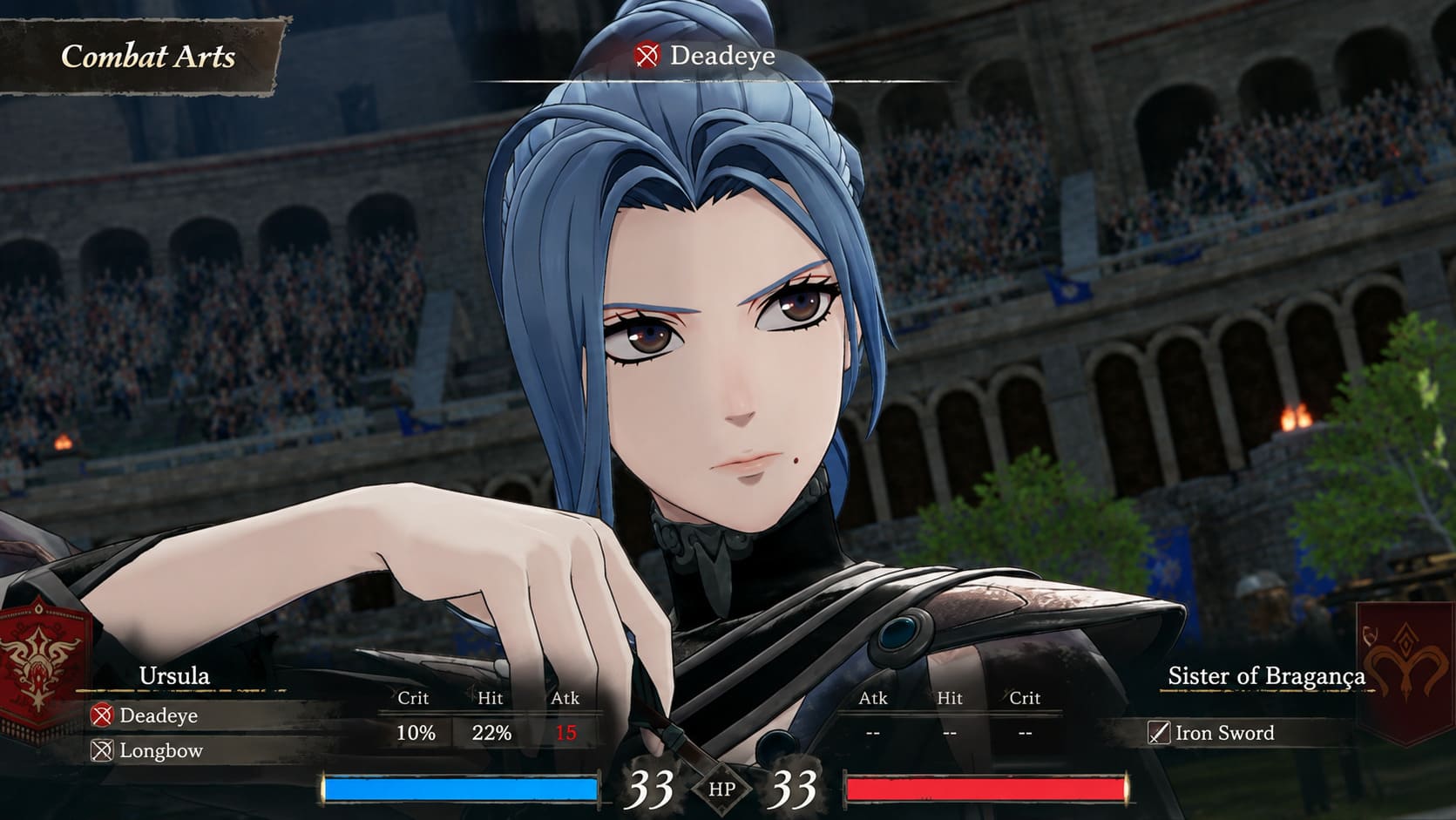
Classic Combat Arts return, once again consuming weapon durability in exchange for devastating attacks. This mechanic already worked well in previous entries, so bringing it back feels like the right decision.
The real headline, however, is Blaze Arts.
These signature abilities belong exclusively to the four main protagonists, and they’re intentionally risky.
Using one sacrifices a significant amount of HP in exchange for incredibly powerful battlefield effects.
Imagine teleporting behind enemy lines to eliminate fragile archers before they act.
Or covering multiple tiles with flames that continue damaging enemies long after the initial attack.
Those kinds of abilities have the potential to completely reshape tactical planning.
Blaze Gauge Could Completely Change High-Level Strategy
The Blaze Gauge might end up becoming the mechanic competitive players obsess over.
Every Blaze Art fills the gauge, rewarding aggressive play with temporary boosts to the entire army.
Sounds great, right?
Not entirely.
Push your luck too far and the gauge enters Burst mode.
Instead of becoming stronger, your unit permanently loses half of its maximum HP for the remainder of the battle.
That’s a brutal punishment.
As someone who’s spent hundreds of hours resetting Fire Emblem maps because one critical hit ruined everything, I love this design philosophy. Powerful abilities should force meaningful decisions instead of becoming automatic panic buttons.
Thankfully, the familiar rewind mechanic returns, allowing players to undo disastrous turns before frustration takes over.
The New Class System Looks Much More Flexible
Class progression has always been one of Fire Emblem’s strongest features, and Fortune’s Weave appears to expand it considerably.
Rather than relying on a simple promotion path, characters advance through three distinct stages.
| Tier | Purpose | Examples |
|---|---|---|
| Beginner | Learn core weapon skills | Gladiator, Diviner, Ornius Rider |
| Specialty | Unlock unique tactical roles | Armored Knight, Wing Soldier, Charioteer |
| Advanced | Endgame elite classes | Cataphract, Guardian, Elephant Rider |
Certification exams also make a return, encouraging players to specialize weapon proficiencies before chasing stronger promotions.
Some of the newly revealed classes genuinely stood out.
Elephant Riders look absolutely ridiculous—in the best possible way. Watching heavily armored soldiers charge across the battlefield atop giant war elephants immediately caught my attention.
Meanwhile, Guardians combine offensive spear combat with healing magic, opening interesting hybrid strategies for players who prefer adaptable team compositions.
Dagsion Feels Like More Than Just Another Hub
Fire Emblem has experimented with hub areas for years.
Sometimes they work.
Sometimes they drag the pacing down.
Dagsion appears to strike a much healthier balance.
Between tournament battles, players can train units, improve equipment, recruit allies, accept timed side quests, and earn temporary blessings through religious shrines.
None of those systems feel particularly groundbreaking individually.
Together, though, they create the sense that your army actually belongs in a living capital instead of simply moving from mission to mission.
If Intelligent Systems keeps these activities meaningful without overwhelming players with repetitive chores, Dagsion could become one of the franchise’s best social spaces.
Dungeon Exploration Was the Biggest Surprise
Then Nintendo revealed something I genuinely wasn’t expecting.
Dungeons.
Not tactical maps disguised as caves.
Actual explorable dungeons.
Even more surprising, combat inside them abandons the traditional grid entirely.
Instead, encounters shift into classic turn-based JRPG battles where characters fight side by side against monsters.
I had to rewind the presentation just to make sure I saw that correctly.
It’s an enormous departure from everything Fire Emblem has traditionally done.
Whether longtime fans embrace this idea remains to be seen, but I appreciate developers willing to experiment instead of playing it safe for the eighteenth mainline entry.
If dungeon exploration offers worthwhile rewards and doesn’t overstay its welcome, this could become one of the game’s defining features.
Built to Showcase Nintendo Switch 2
From a technical perspective, Fortune’s Weave clearly aims to demonstrate what Nintendo Switch 2 can do.
Among the confirmed features are:
- HDR support for richer visuals.
- Surround sound compatibility.
- Approximately 29.5 GB installation size.
- Mouse-style Joy-Con 2 controls.
- Traditional controller support.
The pointer controls are especially interesting.
Dragging units directly across tactical maps sounds far more natural than endlessly navigating menus with a control stick. Strategy games have always benefited from mouse input, so adapting that experience for console players feels like a logical step forward.
Collector’s Edition Worth Talking About
Nintendo also announced the Dagdan Collection for collectors.
- SteelBook case.
- Physical copy of the game.
- Premium artbook.
- Character art cards.
- Fabric world map of Dagda.
It’s refreshing to see a collector’s edition focused on physical memorabilia instead of filling the box with downloadable content codes.
As someone who still keeps old Fire Emblem artbooks on the shelf, this edition definitely caught my eye.
Final Verdict
Fire Emblem: Fortune’s Weave already looks like one of the most ambitious strategy RPGs Nintendo has produced in years.
The combination of four interconnected protagonists, dangerous Blaze Arts, expanded class progression, explorable dungeons, and a richer political storyline gives the impression that Intelligent Systems isn’t interested in making a predictable sequel. Instead, the studio appears determined to evolve nearly every major pillar of the franchise while respecting what longtime fans love most.
Of course, ambitious ideas don’t always translate into flawless execution. The dual combat systems, multiple narratives, and extensive progression mechanics need to work together smoothly if the experience is going to stay engaging for dozens of hours. Still, after watching the Direct, my excitement is considerably higher than it was beforehand.
If the developers can maintain strong map design, meaningful character writing, and balanced tactical gameplay from beginning to end, Fortune’s Weave has every chance of joining Three Houses among the finest entries the series has ever produced.
September 17, 2026, suddenly feels much farther away than it should.