Quest Cards in Slay the Spire 2: Risk, Rewards, and Meta Guide
I’ve been following Slay the Spire 2 pretty closely, and I’ll be honest—Quest Cards are one of those mechanics that immediately changes how you feel about a run. Not just how you play it. There’s a difference.
In the original game, events were usually simple: take a curse for gold, heal or skip, risk or reward. Clean, fast decisions.
Now Quest Cards add this slow-burning tension where you basically say, “Okay, I’m going to suffer for a while… but I’m trusting future me to cash this out.”
Sometimes future you absolutely delivers. Sometimes you die with a useless card clogging your hand and you question your life choices. Classic roguelike energy.
Slay the Spire 2 Enchantments Guide: Best Builds & Synergies
What Quest Cards Actually Are
Quest Cards are basically delayed reward contracts disguised as curses. When you pick one up from an Unknown event node, you immediately get a card that has no energy cost, cannot be played, clutters your draw, and tracks a hidden objective.
Once you complete that objective, it transforms into something powerful—sometimes absurdly powerful. The idea is simple: survive long enough while carrying a problem, and the game pays you back with interest.
The Three Stages of Every Quest Card
1. The “Why did I click this?” Phase
You pick it up, and immediately regret it. Your deck is objectively worse. No debate.
2. The “Please don’t draw it in boss fight” Phase
This is where good runs are made or broken. You’re routing fights, elites, and rests around one idea: don’t die while holding garbage in your hand.
3. The “Oh… that was actually insane” Phase
If you survive, you cash out into something that can swing the entire run—relics, gold, or companion-style cards that redefine your deck.
Major Quest Cards and Why Players Care
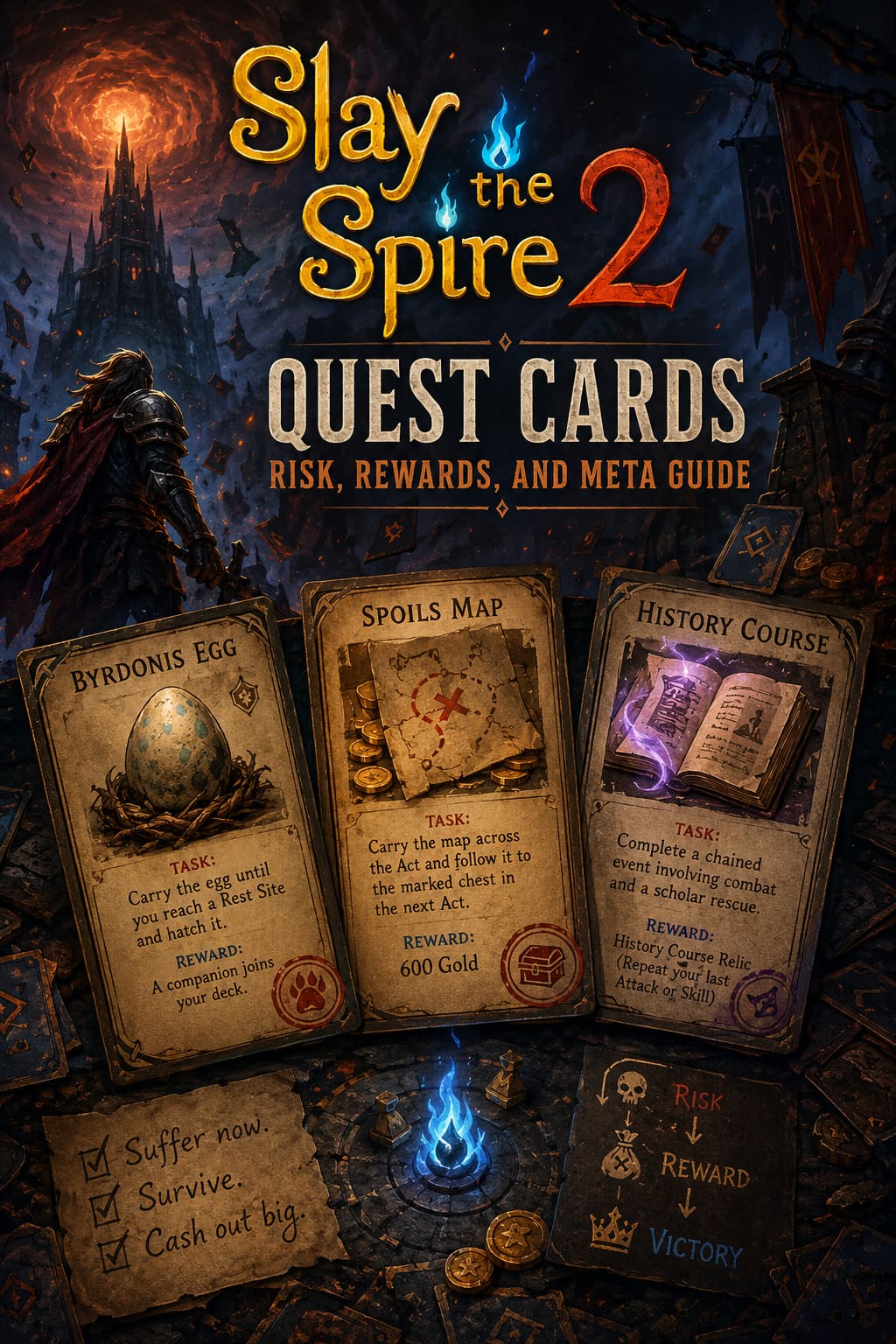
Byrdonis Egg Quest
This is the most beginner-friendly quest and also one of the most deceptively strong early picks.
Task: Carry the egg until you reach a Rest Site and hatch it.
Reward: A companion-style card that acts as a zero-cost combat advantage tool.
Why it’s good: Fast completion window, low routing risk, huge early tempo gain.
From a streamer perspective, this is the kind of pick that creates instant chat debates. Half say it’s greed, half say it’s free value. Honestly, if it’s Act 1 and the path looks safe, I usually take it.
Spoils Map Quest
This is where things get spicy and slightly terrifying.
Task: Carry the map across the Act, then follow it into a marked treasure chest in the next Act.
Reward: Massive 600 gold injection.
600 gold in this game is borderline absurd. We’re talking full shop resets, relic stacking, card removal, and power spikes all at once.
The downside is real though. You are literally dragging a curse through an entire Act transition and hoping your deck holds together under pressure.
Streamer verdict: If the deck is stable, I take it. If I’m already struggling in hallway fights, I skip without hesitation.
History Course Quest
This one feels like a long-term investment that either wins you the run or makes you regret everything.
Task: Complete a chained event involving combat and a scholar rescue scenario.
Reward: History Course relic or alternative reward bundles depending on pathing.
Effect: At the start of your turn, it repeats your last played attack or skill.
And yes, it’s as broken as it sounds in the right deck.
If your build relies on strong scaling skills or heavy attacks, this relic turns every turn into a value loop. It’s the kind of reward that makes chat spam “WHAT IS THAT” in all caps.
How Quest Cards Change Decision-Making
This system completely changes how you evaluate risk. You’re no longer just asking if a reward is good—you’re asking if your deck can survive being worse for a while before becoming better than it has ever been.
That is a very different mindset compared to the original Slay the Spire.
Decision Table (Streamer Cheat Sheet)
| Quest Type | Early Act | Mid Act | Late Act | Risk Level | Worth It? |
|---|---|---|---|---|---|
| Byrdonis Egg | High | Medium | Low | Low | Usually Yes |
| Spoils Map | Medium | High | Very High | High | Sometimes |
| History Course | Low | Medium | High | Very High | Only if strong deck |
What High-Level Players Actually Do
After watching strong players and testing these runs myself, patterns become obvious very quickly.
- They only take Quest Cards when routing is already favorable
- They prioritize safe completion paths over greedy rewards
- They treat quests as investments, not loot
- They avoid quests entirely if the deck lacks consistency
The key idea is simple: Quest Cards don’t just require survival, they require controlled survival under pressure.
The Biggest Mistake New Players Make
It’s not taking Quest Cards. It’s taking them at the wrong time.
Most failed runs happen when players already have a weak or unstable deck and then stack a Quest Card on top of it, hoping for a miracle. That’s not strategy—that’s gambling with extra steps.
Final Thoughts: Why This System Works
Quest Cards are a strong evolution of the roguelike deckbuilder formula because they turn passive rewards into active commitments. Instead of simply receiving value, you earn it through survival under constraint.
That creates stories inside runs. Not just outcomes.
Instead of “I got a relic,” it becomes “I survived eight fights with a dead card and it saved my entire run.”
And honestly, that’s what makes this system interesting. It adds narrative tension inside pure mechanics.
If I had to sum it up like a streamer mid-run:
“Yeah this card is terrible right now… but if I don’t die, it might carry the whole run.”
That’s exactly why Quest Cards will probably become one of the most debated mechanics in Slay the Spire 2 meta discussions for a long time.