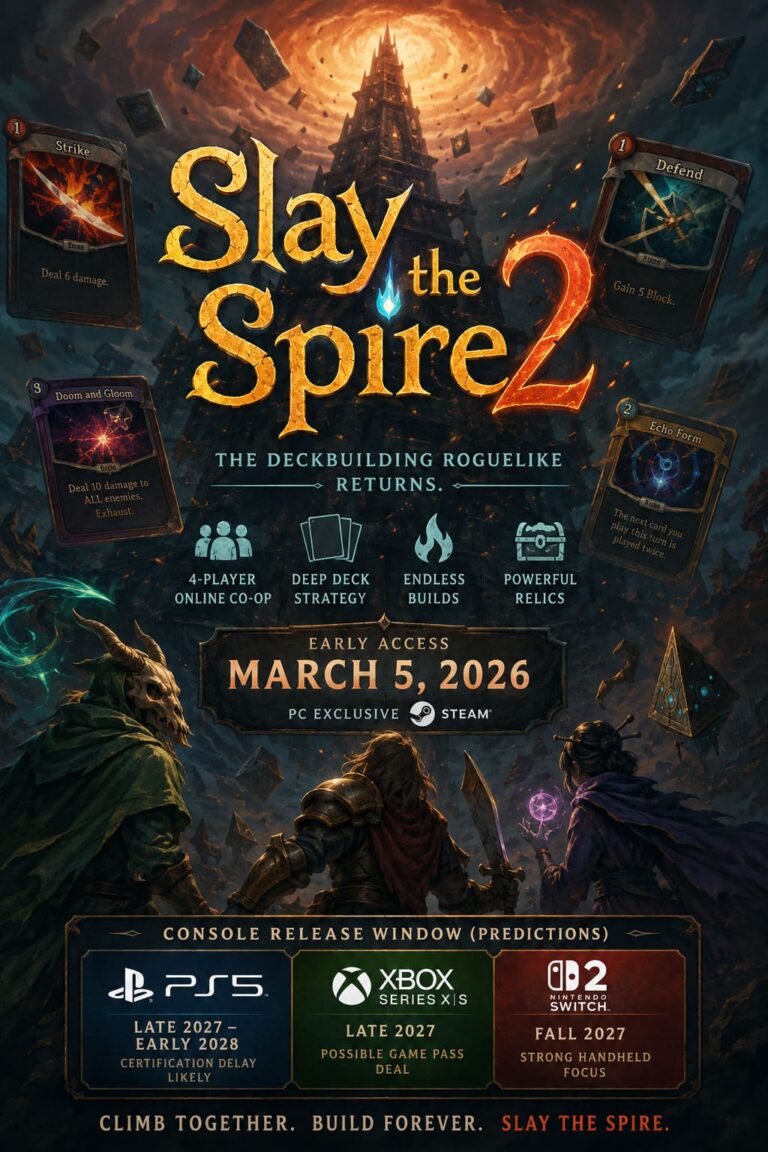
Slay the Spire 2 Co-Op Mode: First Impressions & Gameplay
When I first launched Slay the Spire 2 in co-op, I honestly expected a disaster. Not the fun kind of chaos, but the usual multiplayer roguelike problem where everything feels slowed down, messy, and disconnected from what made the original game special.
Instead, what I got was something completely different — a coordinated deckbuilding experience that feels like running a raid in a strategy RPG, except every player is actively shaping the same fight in real time.

As someone who streams strategy and roguelike games regularly, I rarely say this, but this mode doesn’t just add multiplayer — it fundamentally changes how you think about the game.
It creates tension, teamwork, and those unpredictable moments that turn into instant stream highlights.
Quest Cards in Slay the Spire 2: Risk, Rewards, and Meta Guide
First Impression: This Isn’t Just “Slay the Spire With Friends”
The biggest surprise is that co-op doesn’t dilute the experience. Instead, it amplifies it. You’re not just piloting your own deck anymore — you’re managing a shared tactical system where every decision influences three other players in real time.
There’s no downtime. No waiting your turn. Everyone acts simultaneously, which means every second of combat is active communication, reaction, and adjustment. If someone misplays or ends the turn early, the entire team feels it immediately.
And yes — that happens a lot.
Why It Works Better Than Expected
- All players act at the same time
- No turn-based waiting between teammates
- Deck synergy becomes a real-time puzzle
- Communication is constantly required
Lobby Setup and Structure
Setting up a run is straightforward but intentionally strict. One player hosts the session, and others join through invites. Characters can be duplicated, meaning you can run four identical builds if you want to experiment with extreme synergy.
One important detail is that the save file is tied to the host. This makes runs feel like committed campaigns rather than casual drop-in sessions. If someone leaves, the run essentially pauses until the group is complete again.
At first, this feels restrictive, but in practice it makes the experience more serious and cohesive.
The Map Phase: Strategy Meets Chaos
The map system is where group dynamics start to matter more than individual skill. Everyone sees the same map and votes on the next path. On top of that, players can draw directly on the map, marking elites, shops, and risky routes.
It sounds simple, but in practice it becomes a negotiation layer. Every decision affects the entire group.

What Makes the Map Phase Unique
- Shared progression through the Spire
- Voting-based movement system
- Freehand drawing for communication
- Random selection when consensus fails
When the group can’t agree, the game literally randomizes the path. That alone has caused some of the funniest and most stressful moments during my streams.
Combat System: Real-Time Deck Coordination
The most important design decision in co-op is simultaneous combat. All players draw and act at the same time. There is no sequential order between teammates.
Combat only progresses when everyone ends their turn, which creates constant pressure to communicate efficiently.
This turns fights into real-time coordination puzzles where timing matters as much as deck construction.
Why Combat Feels So Different
- All players act simultaneously
- Enemy effects apply globally
- Turn ends only when all players agree
- Card sequencing becomes critical
For example, applying Vulnerable at the wrong moment can reduce your team’s total damage output significantly. In contrast, perfect sequencing can erase enemies in a single synchronized burst.
Enemy Scaling: Brutal but Structured
Enemy scaling in multiplayer is aggressive, and it needs to be. With multiple decks acting at once, damage output skyrockets, so the game compensates with significantly higher health pools and stronger attacks.
The result is longer fights, but not necessarily harder ones — difficulty depends more on coordination than raw numbers.
| Players | Scaling | Experience |
|---|---|---|
| 1 | 1.0x | Classic gameplay |
| 2 | ~2.3x | Balanced co-op flow |
| 3 | ~3.2x | Requires coordination |
| 4 | ~4.0x+ | High-intensity fights |
What stands out is that coordination scales better than raw enemy stats. A well-synced team can melt bosses faster than expected, while a disorganized team struggles even with strong decks.

Natural Role Formation in Teams
One of the most interesting aspects is how roles emerge without being assigned. Players naturally fall into specific functions based on their deck choices and playstyle.
Common Team Roles
- Setup Player: Applies debuffs and prepares damage windows
- Burst DPS: Executes high-damage turns
- Scaling Engine: Builds long-term advantage
- Utility Support: Shields, saves, and stabilizes fights
This organic structure makes every run feel different depending on who you play with. No two teams behave the same way.
Strategic Depth and Communication
Co-op success depends heavily on communication. You cannot play optimally in silence. Even small miscommunications can lead to wasted turns or failed damage windows.
Core Strategic Rules
- Always communicate intent before playing key cards
- Balance early aggression and late scaling
- Do not over-stack slow setups across all players
- Coordinate relic and resource distribution
The most common mistake I see is teams building too defensively or too slowly. The game punishes lack of early tempo heavily.
What Makes Co-Op Actually Fun
The real strength of Slay the Spire 2 co-op isn’t just mechanics — it’s emergent storytelling. Every run creates moments that feel unscripted and memorable.
One player saving another with a perfectly timed potion. A coordinated burst deleting a boss in one turn. Or complete failure because someone accidentally ended the turn too early. These moments define the experience far more than raw optimization.
Final Thoughts: A Risk That Paid Off
Slay the Spire 2 co-op doesn’t try to be a casual multiplayer mode. It leans into complexity, coordination, and high-stakes decision-making. And surprisingly, it works.
It feels closer to a tactical raid system than a traditional roguelike. Every player matters, every turn matters, and every mistake is instantly visible to the entire group.
For me as a streamer, that’s exactly what makes it powerful. It creates real tension, real teamwork, and real stories worth sharing.
It’s not perfect, and it’s definitely not easy — but it’s one of the most interesting evolutions of the genre I’ve seen in years.