Desk Space Idle Spacefleet Clicker Guide: Strategy, Synergies, and Fleet Optimization
I’ve played more idle games than I’d like to admit. Most of them follow the same predictable formula: click for a while, unlock automation, prestige, repeat. Desk Space: Idle Spacefleet Clicker certainly shares some of those mechanics, but after spending hours building fleets and experimenting with different layouts, I realized this game is trying to be something much more interesting.
Instead of demanding your full attention every few minutes, it quietly lives on your desktop, growing alongside whatever you’re doing. It feels less like a traditional clicker and more like managing an autonomous civilization that occasionally asks for your guidance. That design alone makes it stand out in an overcrowded genre.
If you’re jumping into the game for the first time, here are the strategies that helped me avoid common mistakes and build a fleet that scales far into the late game.
Treat Your Desktop Like Mission Control
The first thing that surprised me wasn’t the mining or the combat—it was how naturally the game fits into a second monitor.

Pinning the window while working, watching videos, or browsing the internet feels exactly how an idle game should work. Your economy keeps moving even when you’re focused elsewhere, but don’t mistake that for “set it and forget it.”
The biggest difference between average and efficient progression comes from preparing your automation before you walk away.
Before leaving the game idle, always make sure you’ve:
- Upgraded your mining infrastructure.
- Balanced stations with ship production.
- Enabled every available automation queue.
- Checked defensive coverage.
- Optimized production bonuses.
Those five minutes of preparation often save several hours of inefficient income later.
The Biggest Beginner Mistake: Buying Too Many Ships
This trap catches almost everyone.
New players naturally assume that more mining ships equal more money. At first, that’s true—but only for a short while.
Eventually your processing stations become the bottleneck.
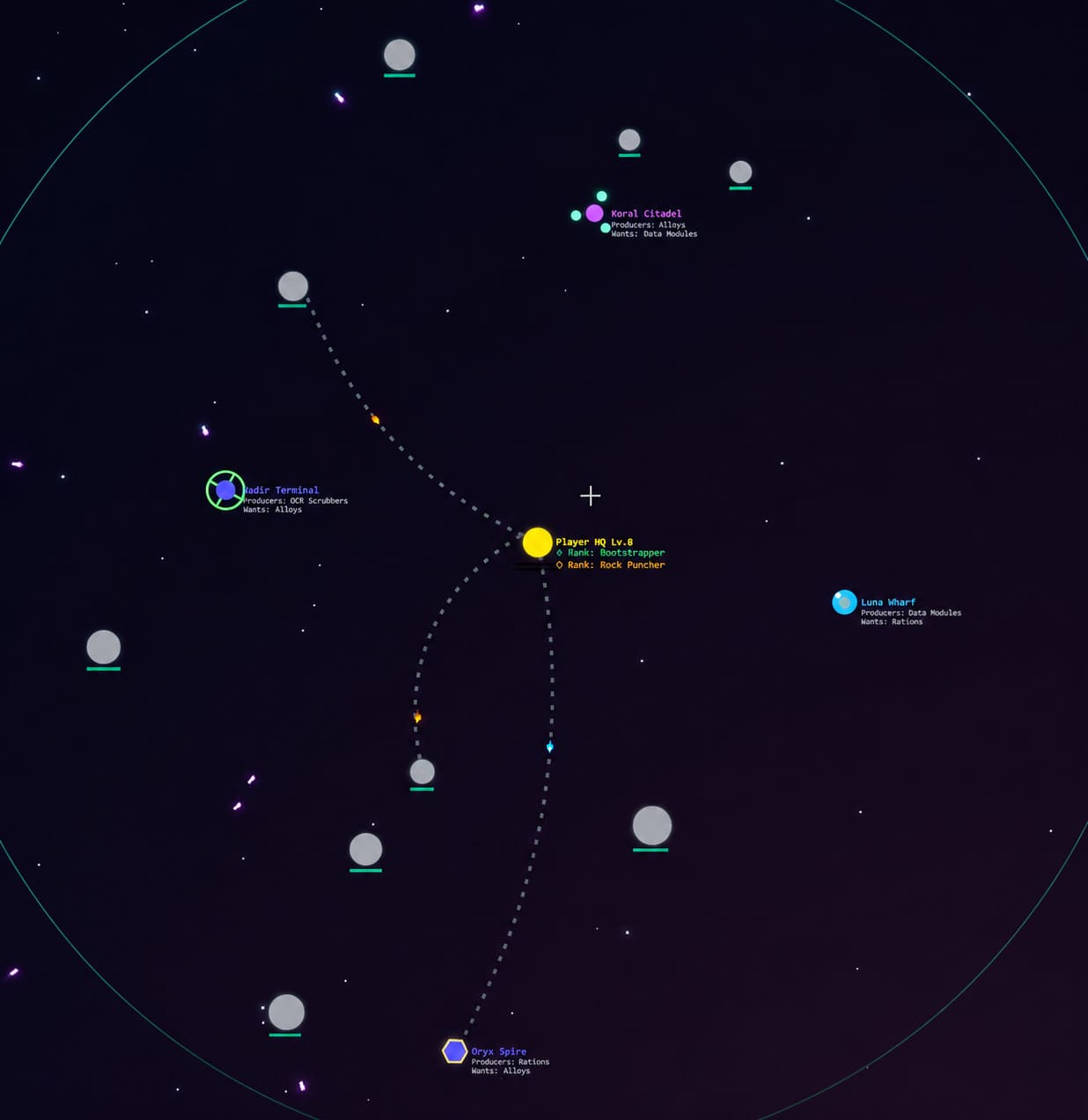
Imagine dozens of miners returning with valuable ore while your refineries struggle to process everything. Resources pile up, efficiency drops, and suddenly your expensive fleet isn’t generating the income you expected.
I found much better results by following a simple rule:
| Priority | Focus | Why It Matters |
|---|---|---|
| Early Game | Mining Ships | Build a reliable income source. |
| Mid Game | Stations | Increase processing capacity. |
| Mid-Late Game | Balanced Growth | Prevent production bottlenecks. |
| Late Game | Multipliers & Synergies | Massive long-term scaling. |
Whenever your income starts slowing down, don’t automatically purchase another ship.
Instead, ask yourself: Can my current stations actually keep up with production?
If the answer is no, upgrade infrastructure first.
Synergies Are Worth More Than Raw Numbers
One lesson became obvious after experimenting with different layouts.
A carefully planned base consistently outperformed a randomly upgraded one—even when the second base had significantly higher upgrade levels.
The reason is the synergy system.
Certain structures amplify each other, creating production chains that generate far more resources than isolated buildings ever could.
Some of my favorite optimization habits include:
- Position extractors next to compatible support modules.
- Cluster production bonuses instead of spreading them across the map.
- Keep elemental interactions working together instead of conflicting.
- Continuously adjust layouts after unlocking new technologies.
Once the Observatory becomes available, don’t ignore it.
Many players treat it as an optional upgrade, but manipulating cosmic conditions can dramatically increase production over long idle sessions.
Pirates Will Eventually Punish Greed
There’s a point where every empire becomes wealthy enough to attract unwanted attention.
Pirate attacks aren’t just random interruptions—they’re economic disasters if you’re underprepared.
I learned this the hard way after investing almost everything into mining while completely neglecting military upgrades.
Within minutes, damaged stations and intercepted cargo erased hours of progress.
Since then, I always dedicate part of my budget to defense.
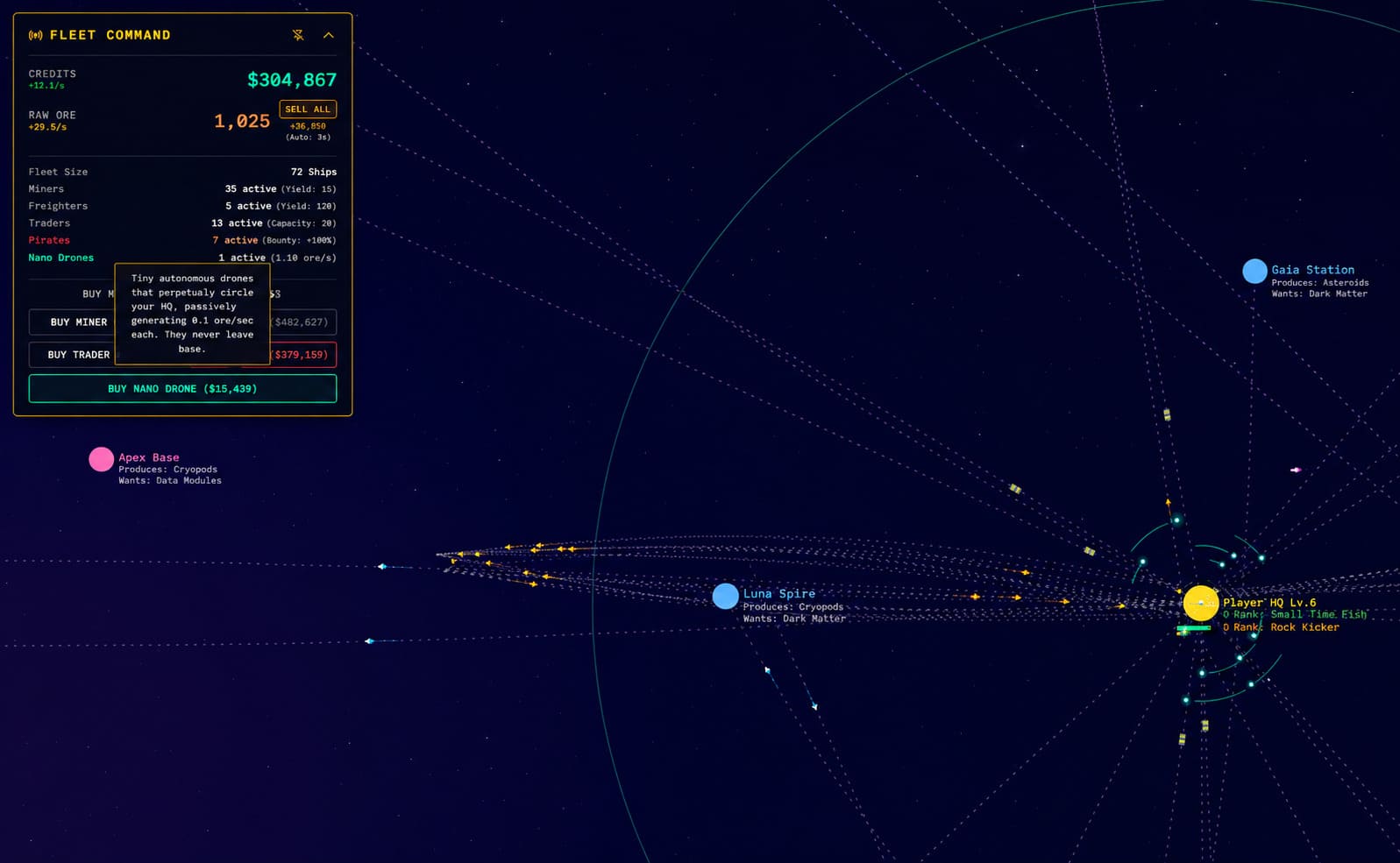
A healthy fleet should include:
- Mining vessels.
- Escort ships.
- Heavy combat units.
- Station turrets.
- Shield support.
Think of military spending as insurance.
It doesn’t directly generate profits, but it protects every credit you’ve already earned.
Progression Eventually Stops… And That’s Normal
Every idle game has a wall.
Desk Space is no exception.
Around the later sectors you’ll notice that upgrades become dramatically more expensive while income growth slows to a crawl.
Many players assume they’re doing something wrong.
Usually, they aren’t.
This is where the game encourages specialization instead of general upgrades.
Rather than increasing every statistic equally, begin building around a focused combat strategy.
The weapon combinations that worked best for me evolved roughly like this:
- One beam weapon supported by two laser cannons.
- Missile-focused builds with charging modules.
- Shield disruption combined with sustained beam damage for heavily armored enemies.
Different situations reward different setups, but specialized fleets consistently outperform “jack-of-all-trades” designs.
Reinforcement Is Not Losing Progress
Prestige systems often scare new players.
Resetting hours of work sounds terrible on paper.
In reality, Reinforcement is one of the most satisfying mechanics in Desk Space.
Yes, you’ll lose your temporary economy.
But what you gain lasts forever.
Permanent bonuses include stronger faction scaling, additional retrofits, long-term upgrades, and eventually the incredibly valuable Fleet system.
After my first Reinforcement I reached previous milestones much faster than before.
By the third cycle, early sectors almost felt like a tutorial.
If you’re hesitating because you don’t want to restart, don’t.
You’re investing in exponential growth rather than starting over.
The Fleet System Changes Everything
Once the Fleet menu opens, the game transforms from a simple incremental experience into something much deeper.
Unlike normal sector progress, Fleet upgrades survive future Reinforcements.
That completely changes your priorities.
Instead of thinking about today’s income, you’re investing in permanent expansion.
Every successful run strengthens future runs, creating a progression loop that becomes increasingly rewarding.
This is where the game really hooked me.
Each reset finally had a meaningful long-term purpose.
Crew Management Is More Important Than It Looks
Another system many players underestimate is the crew.
At first glance it feels secondary compared to mining or combat, but experienced players quickly realize just how powerful mastery bonuses become.
My early priorities were:
- Unlock additional Biosleeves as soon as possible.
- Focus experience bonuses before niche talents.
- Level one specialist deeply instead of spreading points everywhere.
- Retire highly developed crew members for permanent faction growth.
This approach noticeably accelerated progression compared to constantly switching between different crew builds.
Save Rare Crafting Materials
The Synth Matrix introduces another temptation.
You’ll finally have enough rare materials to craft powerful equipment, and it’s easy to spend them immediately.
Don’t.
Low-tier equipment becomes obsolete surprisingly fast.
Instead, stockpile valuable resources until high-end yellow components become available.
Those late-game modules provide significantly better long-term value and often fit directly into optimized elemental builds.
Patience pays off here.
My Personal Priorities for Fast Progress
If I were starting from scratch today, my roadmap would look like this:
- Establish stable mining income.
- Upgrade processing stations regularly.
- Build around production synergies.
- Invest in pirate defense early.
- Unlock Reinforcement as quickly as practical.
- Focus permanent Fleet progression.
- Develop crew masteries.
- Save rare crafting materials for endgame equipment.
Following this order creates a much smoother progression curve than simply purchasing whatever upgrade looks affordable.
How to Fix Supermarket Chaos Crash on Launch, Freezing, and Startup Black Screen Issues
Final Thoughts
Desk Space: Idle Spacefleet Clicker succeeds because it respects the player’s time.
It doesn’t constantly demand clicks or punish you for stepping away. Instead, it rewards careful planning, efficient layouts, and smart long-term decisions. That’s exactly what I want from an idle strategy game.
The systems gradually unfold into something far deeper than the game’s simple appearance suggests. Mining, station optimization, pirate defense, fleet composition, prestige mechanics, crew development, and crafting all connect into one satisfying progression loop where every decision matters.
If there’s one piece of advice I’d leave new commanders with, it’s this: don’t chase the biggest numbers immediately. Chase efficiency instead. A well-designed empire with balanced production and strong synergies will always outperform a chaotic fleet built only around expensive upgrades.
That’s the difference between merely surviving the galaxy—and quietly building an unstoppable interstellar powerhouse while your desktop keeps working for you.