Halloween The Game Perk Cards System Explained: Build the Ultimate Survivor or Killer Loadout
If you have spent any real time with asymmetrical horror games, you already know that the killer-versus-survivor formula is never just about who has the better reflexes. The moment progression systems, perks, upgrades, and character builds enter the picture, the game changes completely. Halloween: The Game looks like it wants to follow that same path, and honestly, I think that is one of the most interesting parts of IllFonic’s upcoming take on Haddonfield.
The premise is obviously familiar. Civilians are trying to survive while Michael Myers stalks them through the streets, houses, and dark corners of the town. But after looking beyond the slasher spectacle, the Perk Cards system is where the real long-term game appears to be hiding.
I’ve played enough multiplayer horror games to know that a perk system can either become the best part of the experience or turn into a boring collection of percentage buffs. Halloween: The Game seems to be aiming for something more meaningful. Your cards are supposed to influence how you approach a match, rather than simply making your character numerically stronger.
And that distinction matters.
Why Is Halloween The Game Banned In Australia? The Shocking Reason Behind the Michael Myers Controversy
What Are Perk Cards in Halloween: The Game?
Perk Cards are customizable modifiers that change specific aspects of your character during a match. They can improve certain abilities, speed up interactions, increase stealth potential, support teammates, or modify the way Michael Myers hunts his victims.
The important thing is that both sides have access to their own style of progression.
Civilians can build around things like:
- Stealth and evasion
- Objective completion
- Healing and support
- Item efficiency
- Team coordination
- Movement and escape
Michael, meanwhile, gets cards designed around his role as the hunter. His potential upgrades focus on tracking, mobility, pressure, environmental interaction, and improving the effectiveness of his supernatural-feeling Shape abilities.
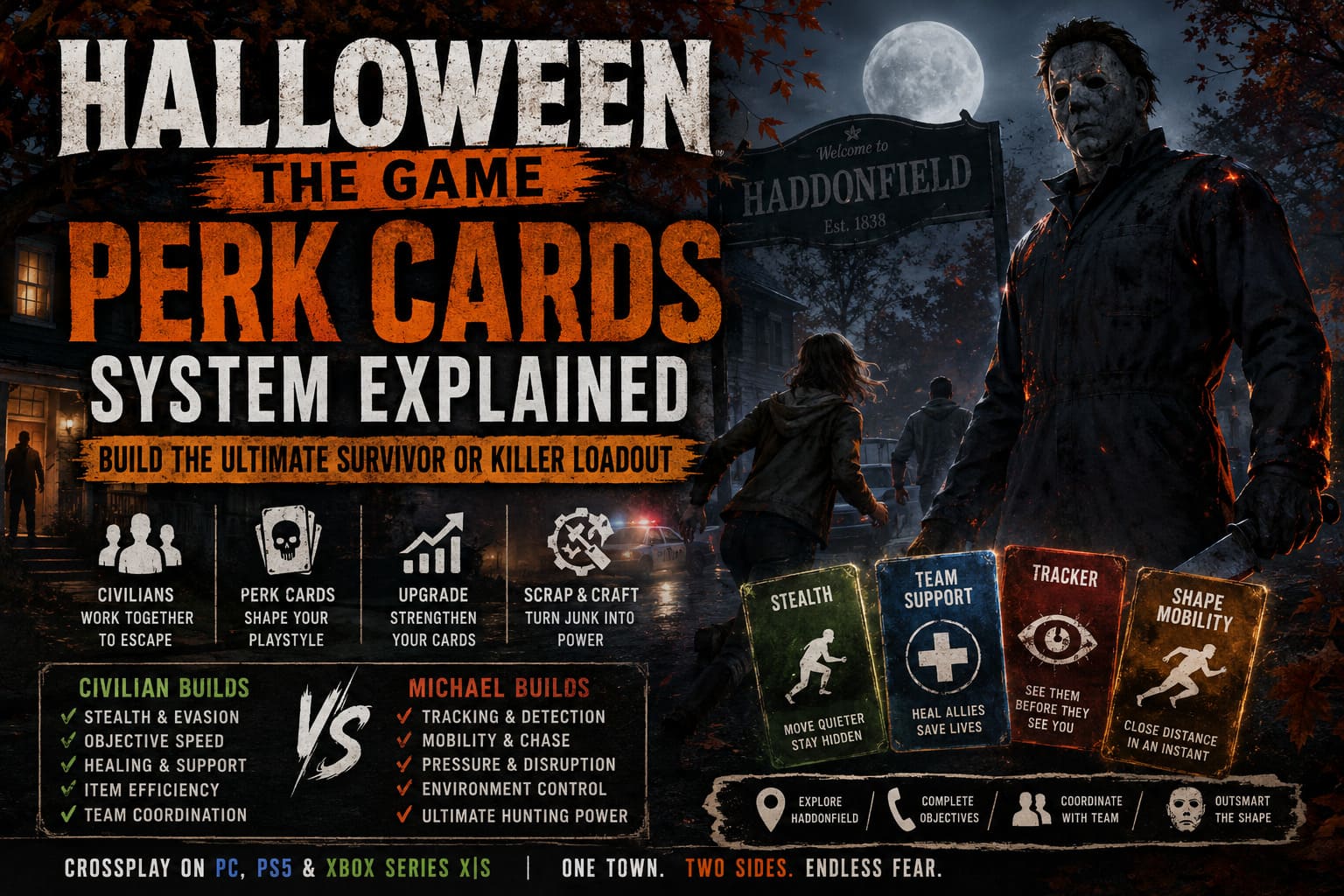
That gives the system a lot more potential than simply having a generic ‘5% faster’ perk slapped onto every character.
| Playstyle | Useful Perk Focus | Ideal For |
|---|---|---|
| Stealth Civilian | Noise reduction, evasion, hiding | Players who avoid direct encounters |
| Objective Civilian | Interaction and task speed | Aggressive objective players |
| Support Civilian | Healing and team bonuses | Coordinated squads |
| Tracker Michael | Detection and Killer Sense | Hunting hidden players |
| Mobility Michael | Shape movement improvements | Chase-focused players |
| Pressure Michael | Objective disruption | Players who enjoy controlling the map |
How Progression and Card Upgrades Work
One thing I particularly like about this kind of system is when the game gives you a reason to keep playing even after a terrible match.
Nobody likes getting eliminated five minutes into a horror match and feeling like the entire session was wasted. A good progression system should at least give you something to take away from that disaster. Halloween: The Game appears to connect match activity with character progression, giving players XP and currency for various actions.
For Civilians, that can include exploring points of interest, interacting with the environment, searching containers, working with local residents, and using telephones to contact authorities. Michael has a completely different list of activities, with stalking, tracking residents, destroying parts of the environment, and executing targets contributing to progression.
In other words, you are rewarded for playing your role, not simply for surviving until the final second.
That is a smart approach.
If you are playing Michael like a maniac and destroying everything in sight, your progression should reflect that. If you’re playing a Civilian who spends the entire match quietly solving objectives while keeping teammates alive, you should get rewarded for that style too.
The Collection System Could Become a Big Deal
Unlocking a card is only the beginning. The collection system allows players to upgrade cards, increasing their effectiveness as they invest resources into them.
This is where things could get seriously interesting once players start discovering combinations.
A card that looks mediocre at its base level might become much more valuable after several upgrades. Conversely, a perk that looks amazing on paper might not fit your preferred playstyle at all. That’s why I wouldn’t recommend blindly upgrading everything you unlock.
Pick a direction first. Then spend your resources.
The Scrap mechanic also gives players a way to deal with cards or components they simply don’t need. Instead of allowing unwanted duplicates to clog up your collection forever, you can break them down into crafting resources and redirect those materials toward the cards that actually matter to your build.
For players like me who hate having an inventory full of useless junk, that’s a welcome feature.
Civilian Perks: Surviving Michael Myers
Playing a Civilian sounds deceptively simple until you actually think about what your job involves.
You aren’t just running toward an exit.
You need to navigate Haddonfield, complete objectives, interact with residents, manage your surroundings, find useful items, and keep an eye on where Michael could appear next. Panic and poor positioning can turn a perfectly good escape attempt into a complete disaster.
This is where Civilian Perk Cards become particularly important.
Stealth and Evasion Builds
If you prefer playing the classic horror-movie victim who somehow manages to stay alive, stealth-focused cards are probably going to be your best friend.
Cards such as ‘Afraid of the Dark’ and similar utility perks can improve your ability to stay unnoticed or reduce the information Michael receives from your actions. Noise is especially important in a horror game because every unnecessary sound can potentially give the killer another clue.
I would personally build around stealth if playing with random teammates. You can’t always trust a squad of strangers to coordinate properly, so having the ability to disappear when everything goes sideways is incredibly valuable.
Objective Builds
Some players don’t care about sneaking around for ten minutes. They want to get things done.
An objective-focused build should concentrate on improving interactions such as lockpicking, telephone usage, environmental tasks, and other actions necessary to move the match toward an escape.
This type of player can be extremely valuable because someone has to actually make progress while everyone else is running around screaming.
The danger is obvious: speed doesn’t matter if Michael catches you before you finish the job.
That means objective builds work best when combined with good map awareness rather than pure aggression.
Support Builds
Then you have the team players.
Support-focused cards can improve healing, movement, or other benefits for nearby allies. In a coordinated squad, this could become one of the strongest archetypes because several small bonuses can snowball into a much stronger team.
A good support player isn’t necessarily the person with the most kills or objectives.
Sometimes it’s the player who keeps everyone alive for an extra 30 seconds.
In a game featuring Michael Myers, 30 seconds can feel like an entire lifetime.
Michael Myers Perks: Turning the Shape Into a Nightmare
Michael is obviously the character most people will want to experiment with.
The appeal isn’t just playing a famous horror villain. It’s the possibility of taking his core abilities and turning them into completely different hunting styles.
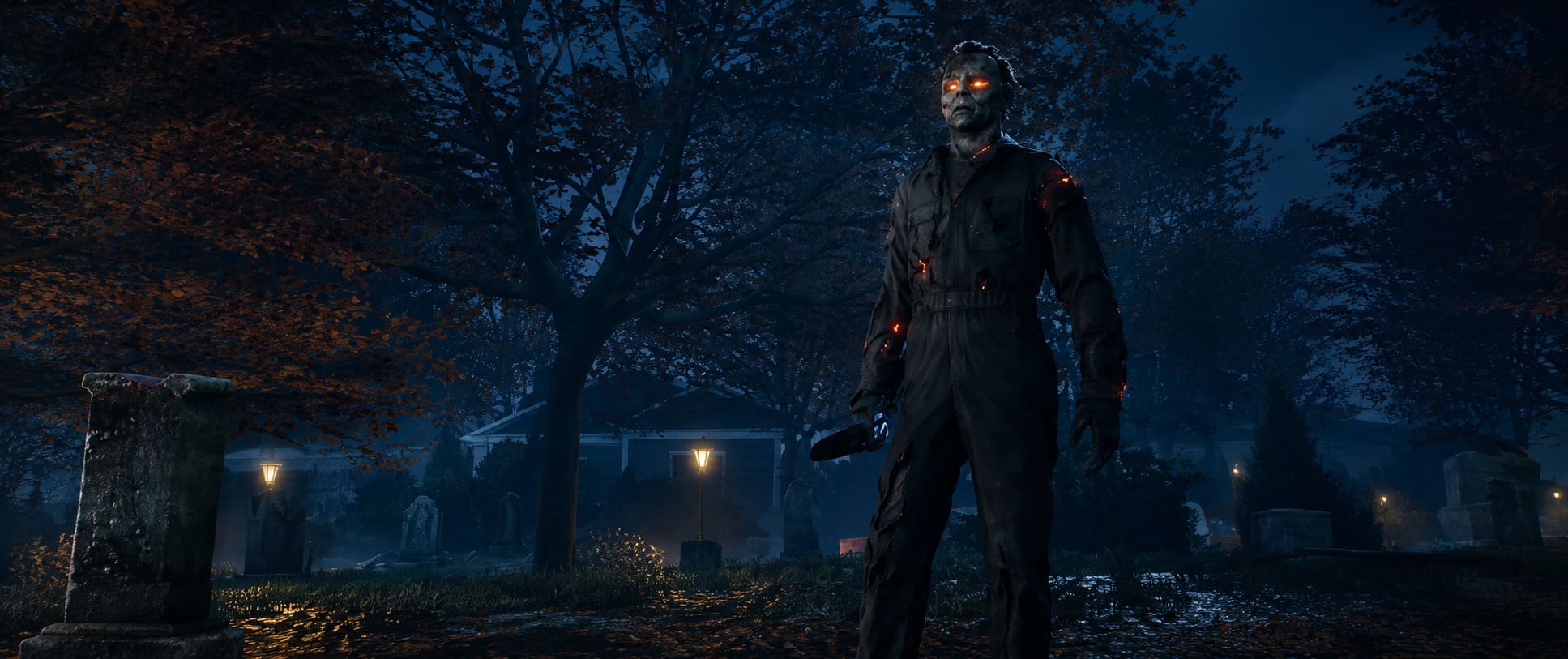
His toolkit includes abilities such as Killer Sense, Reality Tear, Detection Pulse, Blackout, Shape Dash, Shape Jump, and Shape Slip. Perk Cards can complement these tools by modifying their effectiveness or changing how aggressively Michael can use them.
Tracking and Detection
A detection-focused Michael is the nightmare for players who think hiding inside a closet makes them completely safe.
Cards that improve detection range, duration, or information gathering can help Michael locate Civilians who would otherwise disappear from his radar. This style is less about running after everyone and more about constantly knowing where the next victim might be.
Personally, I think this could be one of the most satisfying ways to play Michael.
There is something uniquely creepy about slowly narrowing down someone’s location instead of simply sprinting after them.
Mobility Builds
Mobility is where Michael can become genuinely terrifying.
Improving abilities such as Shape Dash and Shape Jump can potentially give him better chase opportunities and allow him to close distances that Civilians might normally consider safe.
A player who understands the map and combines mobility with good timing could create some absolutely brutal ambushes.
Imagine thinking you’ve finally escaped around a corner, only for Michael to suddenly appear where you thought he couldn’t possibly reach.
That’s the kind of nonsense I want from a Halloween game.
Pressure and Resource Denial
Another option is building Michael around disruption.
Instead of focusing purely on catching players, this type of loadout puts pressure on their objectives. Slowing interactions, disrupting telephone usage, or increasing punishment for players caught in exposed areas can make the entire map feel hostile.
This is especially useful against teams that stick too closely to objectives.
If everyone knows Michael is coming, they can prepare.
If Michael keeps making the environment itself feel unsafe, preparation becomes much harder.
Don’t Build a Jack-of-All-Trades Loadout
This is probably the biggest mistake new players will make.
They’ll unlock several cards, look at their bonuses, and create a completely balanced loadout with a little bit of everything.
Don’t.
Specialization is usually more interesting — and potentially much stronger — than trying to cover every situation.
If you want to play stealthily, commit to stealth. Stack cards that complement that approach. If you’re playing support, build around healing and team utility. If you’re playing Michael as an aggressive hunter, choose cards that strengthen tracking or mobility instead of wasting slots on bonuses that don’t contribute to your strategy.
The best loadout isn’t necessarily the one with the highest individual numbers.
It’s the one where every card helps the same game plan.
Use Single-Player to Learn Before Entering Online Matches
One of the more useful aspects of Halloween: The Game is its single-player campaign experience.
The campaign retells the events surrounding John Carpenter’s classic 1978 Halloween film, giving players an opportunity to explore the game’s world without immediately jumping into competitive matches.
I strongly recommend using this as a training ground.
Learn the streets. Memorize important locations. Figure out where you can move quickly and where you can get trapped. Experiment with Michael’s abilities and learn how different movement options interact with the environment.
Because once you enter online matchmaking, nobody is going to patiently wait while you figure out which button does what.
Build Around Your Squad
Crossplay support across PC, PlayStation 5, and Xbox Series X|S should make it easier to find teammates and build a regular group.
If you have friends who are also playing, don’t give everyone identical builds.
That’s one of the easiest ways to waste the potential of a perk system.
A squad could have one player specializing in objectives, another focused on support, and another using stealth or distraction. The idea isn’t to create a rigid MMO-style party composition, but simply to make sure everyone isn’t trying to perform the exact same job.
When Michael starts applying pressure, having different strengths can be the difference between an organized escape and four people running in completely different directions.
Final Verdict: The Perk System Could Make or Break Halloween: The Game
I’m much more interested in Halloween: The Game’s Perk Cards than I initially expected to be.
The slasher atmosphere, Michael Myers himself, and the Haddonfield setting will obviously attract horror fans. But those things only get you through the first few matches. A strong progression system is what can keep players coming back months later.
If IllFonic gets the balance right, Perk Cards could give every match its own personality. One Michael might play like a relentless tracker, while another focuses on mobility and ambushes. One Civilian could quietly complete objectives while another acts as the squad’s medic and rescuer.
That’s exactly what I want from an asymmetrical horror game.
Don’t chase the biggest number on a card. Build a character that actually feels like you. Experiment, scrap the junk, upgrade the cards that complement your strategy, and don’t be afraid to completely rebuild after discovering that your ‘perfect’ loadout gets you killed every single match.
Because when Michael Myers is standing at the end of the street, staring directly at you, a fancy perk description isn’t going to save you.
Your build, your map knowledge, and your ability to keep your head when everything goes wrong will.