Why Is Halloween The Game Banned In Australia? The Shocking Reason Behind the Michael Myers Controversy
If you told me a few years ago that an upcoming Halloween video game could get refused classification in Australia because of marijuana rather than the guy wandering around with a knife, I’d probably assume you were joking. Yet here we are. Halloween: The Game has landed in one of those wonderfully bizarre gaming controversies where the thing everyone expected to cause trouble apparently isn’t the thing causing trouble at all.
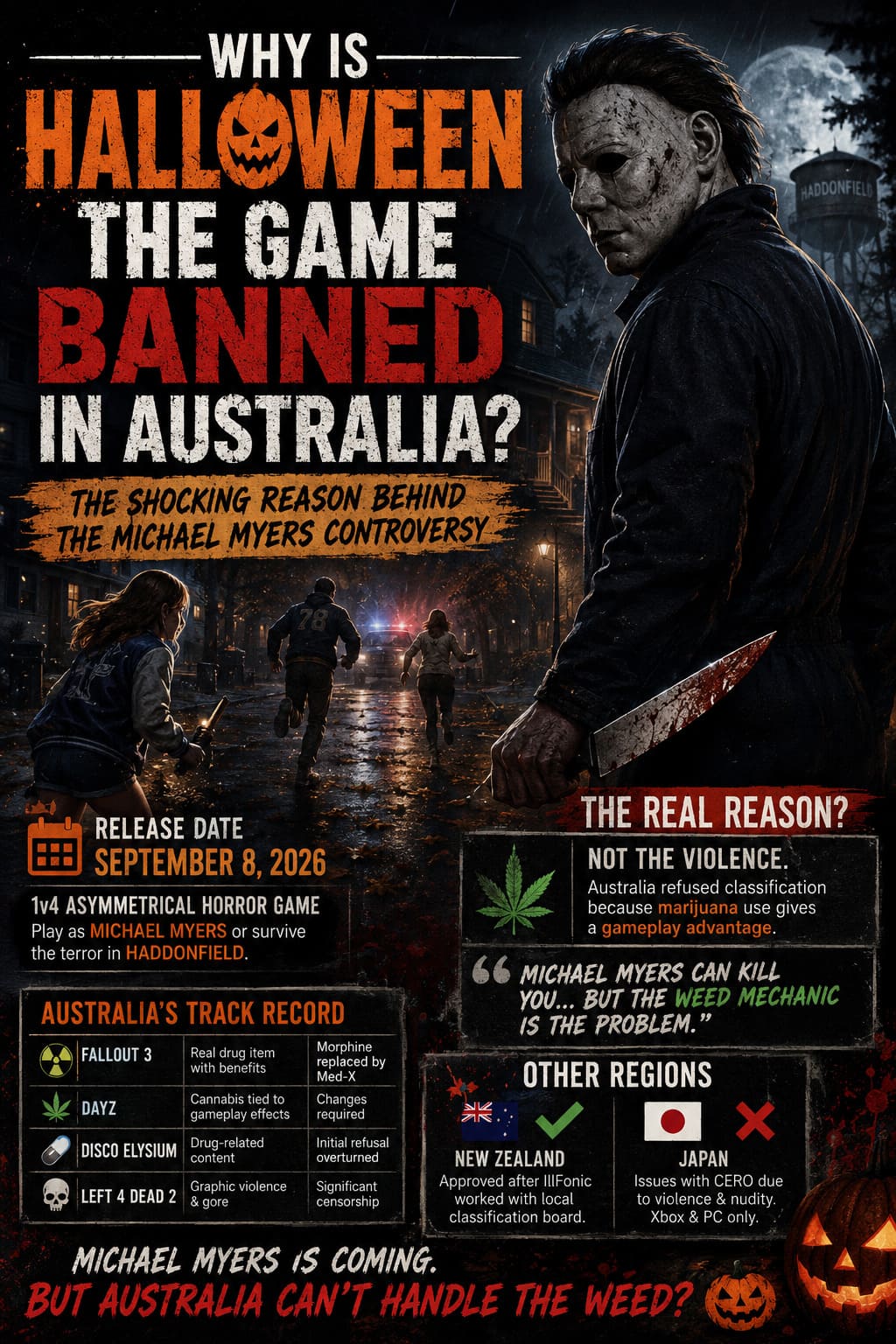
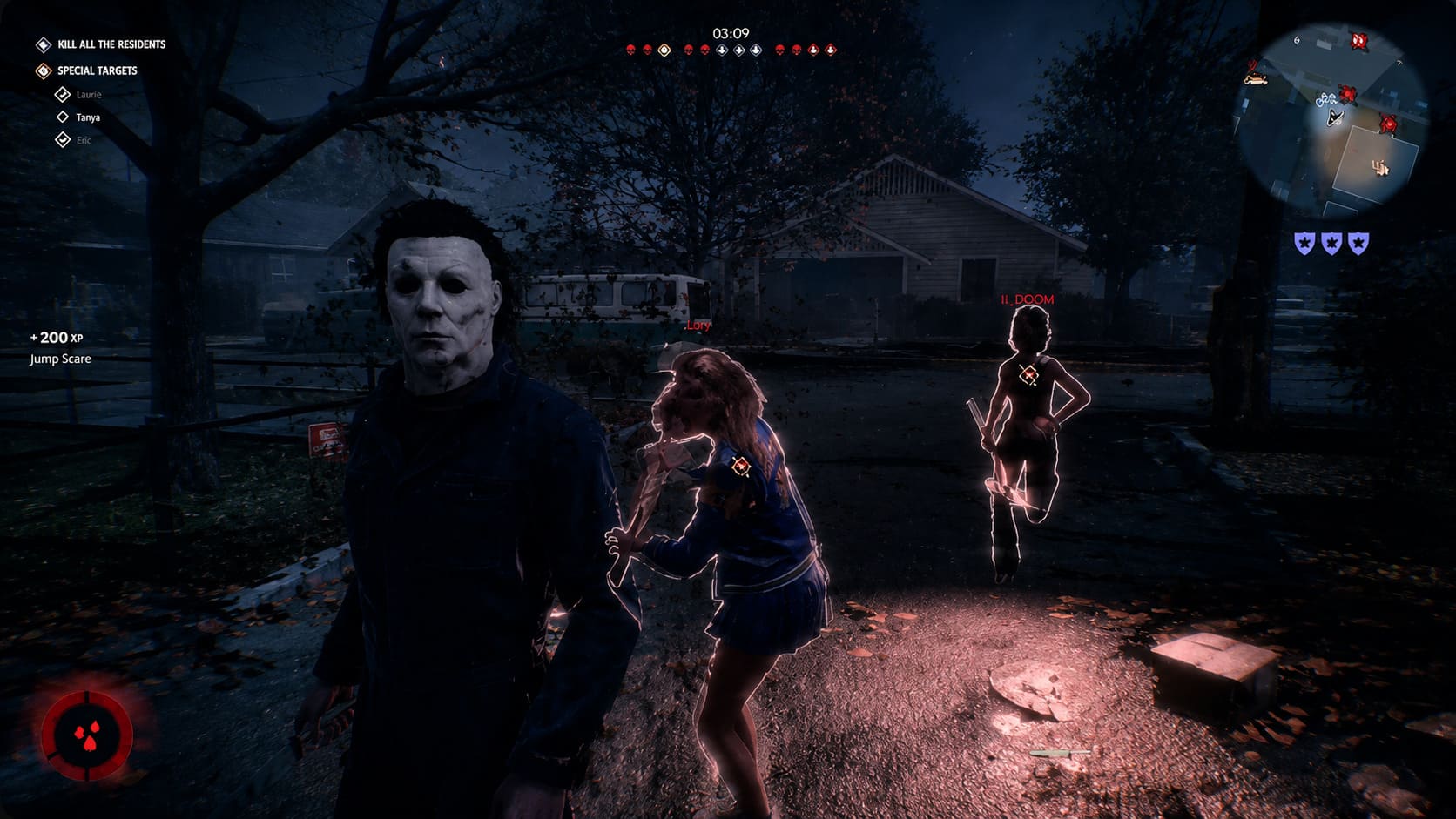
IllFonic’s upcoming asymmetrical horror game is scheduled to launch on September 8, 2026, bringing the world of John Carpenter’s Halloween into a 1v4 multiplayer format. Players will either step into the boots of Michael Myers and hunt survivors through Haddonfield or desperately try to stay alive as ordinary civilians. On paper, this is exactly the kind of game horror fans have been begging for: iconic locations, a legendary slasher, tense chases, and plenty of opportunities for things to go horribly wrong.
There’s just one problem for Australian players: the game has been refused classification in Australia.
And honestly, the reason is stranger than the ban itself.
Halloween The Game Nintendo Switch Release Date: Is Michael Myers Coming to Switch?
Why Is Halloween: The Game Banned in Australia?
The obvious assumption was violence.
Come on, this is Halloween. We’re talking about Michael Myers. The entire identity of the franchise revolves around stalking, murder and psychological terror. A multiplayer game based on that universe was never going to be mistaken for a cozy farming simulator.
That’s why the Australian decision caught so many people off guard.
According to the classification rules involved, the issue centers on drug use that provides a gameplay incentive or reward. The problem isn’t simply showing an illegal substance in a game. The important distinction is that using it can apparently provide a gameplay-related benefit.
That distinction matters enormously under Australia’s classification framework.
In Halloween: The Game, certain civilian characters can use marijuana, with the action apparently tied to gameplay effects such as helping manage fear or providing another temporary advantage. From a player’s perspective, that might sound like a tiny side mechanic buried underneath the much bigger horror experience.
From a classification perspective, however, it changes everything.
If the game depicts an illicit drug being used and connects that use directly to a positive gameplay outcome, the title can run into restrictions that prevent it from receiving an appropriate adult rating.
So yes, Michael Myers can apparently spend the night hunting people through Haddonfield, but the digital weed mechanic is the part that creates the classification nightmare.
That is the kind of sentence that sounds like satire until you actually start digging into the rules.
The Weirdest Part? The Violence Isn’t the Main Issue
As someone who has played more horror games than I probably should admit, I completely understand why people initially assumed gore would be the problem.
Modern horror games have become ridiculously graphic. We’ve gone from simply hearing a scream behind a closed door to watching characters get dismembered in increasingly elaborate ways. A game starring Michael Myers was never going to be timid about the subject matter.
But Australia’s classification system has historically treated different types of adult content very differently.
The interesting part here is that violent content isn’t automatically enough to trigger the same kind of classification problem as incentivized drug use.
That’s where the controversy comes from.
Gamers aren’t necessarily arguing that Australia should have no classification system. Most reasonable players understand why age ratings exist. The frustration comes from the perception that the rules can produce completely counterintuitive results.
Imagine playing as Michael Myers, chasing another player through a dark suburban street while they desperately try to escape.
The knife? Fine.
The murders? Part of the horror experience.
The terrifying serial killer? Obviously the central character.
But give a survivor a digital joint that provides a gameplay advantage?
Suddenly you’re looking at a classification crisis.
That contrast is exactly what has sent gaming communities into meltdown.
Australia Has Been Here Before
This isn’t some completely new problem invented specifically for Halloween: The Game. Australia has a long and complicated history when it comes to video game classification, particularly when drugs are involved.
One of the most famous examples is Fallout 3.
Bethesda’s post-apocalyptic RPG originally included morphine as an item that could provide gameplay benefits. Because morphine is a real-world controlled substance, the game ran into Australia’s classification requirements. Bethesda eventually replaced it with the fictional drug Med-X, a change that later became part of the game’s worldwide version.
That case became a classic example of how a tiny piece of terminology can have surprisingly large consequences for a global release.
Other games have experienced similar headaches.
| Game | Classification Issue | Result |
|---|---|---|
| Fallout 3 | Real-world drug with gameplay benefits | Morphine replaced by Med-X |
| DayZ | Cannabis connected to gameplay effects | Changes required for classification |
| Disco Elysium | Drug-related content | Initial refusal later overturned |
| Left 4 Dead 2 | Graphic violence and gore | Significant censorship before release |
Looking through gaming history, you start to see a pattern. Developers can spend millions creating enormous worlds, complex combat systems and cinematic stories, only to discover that one small interactive mechanic can become a regional release blocker.
That’s got to be a nightmare during development.
Why This Is a Bigger Problem for Developers Than Players Realize
From the outside, the obvious solution seems simple: remove the marijuana mechanic.
Problem solved, right?
Not necessarily.
Game development is interconnected. A mechanic that looks completely optional to players might be connected to character progression, balancing, animation systems, AI behavior, tutorials or other gameplay elements.
More importantly, developers don’t necessarily want to create radically different versions of the same game for different countries.
For an asymmetrical multiplayer title like Halloween: The Game, that becomes even more complicated. You want players across different regions to have the same systems, the same balance and the same experience.
Imagine one version allowing a survivor to use a particular ability while another regional build doesn’t. Now you’ve introduced another balancing variable that developers need to maintain.
For a competitive multiplayer game, regional gameplay differences are a genuine headache.
What About New Zealand?
The situation initially caused concern beyond Australia, particularly for players in neighboring New Zealand.
However, New Zealand operates under its own classification framework, meaning an Australian refusal doesn’t automatically translate into an identical outcome there.
IllFonic has reportedly worked with New Zealand’s classification authorities, allowing the game to proceed there despite the Australian situation.
That’s an important distinction because gamers often lump the two markets together simply because they’re geographically close. From a publisher’s perspective, though, Australia and New Zealand aren’t interchangeable markets when it comes to classification law.
For New Zealand horror fans, that’s obviously good news.
For Australian players, not so much.
Japan Has Its Own Halloween Problem
Australia isn’t the only region where Halloween: The Game has encountered classification trouble.
Japan has also presented IllFonic with a significant challenge, although for a completely different reason.
The PlayStation 5 version reportedly ran into issues with CERO, Japan’s game-rating organization, because of the game’s graphic violence and partial nudity. Rather than radically changing the experience to fit the Japanese PlayStation release requirements, IllFonic chose a different route.
The game is expected to use a different platform strategy in Japan, with Xbox Series X/S and PC serving as the available options.
It’s a fascinating reminder that releasing a modern horror game worldwide isn’t simply a matter of pressing one big “publish” button.
Every market has its own rules.
Every platform has its own requirements.
And sometimes a developer has to decide whether changing the game is worth it.
The Community Reaction Is Exactly What You’d Expect
The internet has predictably gone into full gamer mode over this story.
The dominant reaction has been a mixture of confusion, frustration and plenty of jokes. And honestly, I can’t blame people for laughing at the absurdity of the situation.
The basic argument floating around gaming communities is easy to understand: how can a game about Michael Myers brutally hunting civilians be considered acceptable while a comparatively minor drug mechanic becomes the reason the entire game can’t be sold?
There is a legitimate debate hiding underneath all the memes.
Age ratings are supposed to communicate mature content and help keep inappropriate games away from children. But modern video games are interactive, complicated pieces of entertainment, and classification systems sometimes struggle with mechanics that don’t fit neatly into traditional categories.
A movie can show someone smoking marijuana.
A game can show someone smoking marijuana.
But once the player is rewarded mechanically for doing it, the classification conversation changes.
That’s where the situation becomes genuinely interesting rather than merely ridiculous.
Will IllFonic Censor the Australian Version?
This is the question Australian horror fans really care about.
The easiest solution would be to remove or modify the drug-related mechanic and submit the game again. We’ve seen major publishers do exactly that in the past.
But IllFonic doesn’t appear particularly eager to compromise the game’s intended design.
And from a gamer perspective, I understand that position.
If you’re making a game based on a legendary horror property, you want the experience to feel authentic. Cutting systems out of the game for one territory can create a strange Frankenstein version that technically passes classification but no longer represents the original design.
Of course, the business argument goes the other way.
Australia is a significant gaming market. Publishers don’t like leaving money on the table, especially when a relatively small gameplay adjustment could potentially solve the problem.
So I wouldn’t completely rule out a revised Australian release in the future.
For now, though, Australian players appear to be stuck on the outside looking in.
What This Means for Halloween Fans
The whole situation is frustrating, but it doesn’t seem to have damaged the overall excitement surrounding the game.
A new Halloween game has been a dream scenario for horror fans for years. The opportunity to actually play as Michael Myers in a dedicated asymmetrical multiplayer experience is incredibly appealing, particularly for anyone who grew up watching slasher movies and playing games like Dead by Daylight.
What makes Halloween: The Game interesting to me is that it isn’t simply another horror game with a famous license slapped onto it. The concept has the potential to capture the particular tension that made Carpenter’s original movie so memorable.
Michael doesn’t need to sprint around like a superhero.
He doesn’t need ridiculous supernatural abilities every five seconds.
Sometimes the scariest thing is simply knowing he’s somewhere nearby.
If IllFonic gets that feeling right, the game could have something special.
My Take: It’s Absurd, But There’s a Real Debate Here
I’m not going to pretend the Australian decision makes no sense from a legal standpoint. Classification boards have rules, and developers know that those rules exist.
What I do think is fascinating is how dramatically the controversy changes once you understand the exact mechanic involved.
This isn’t really a story about Australia banning a violent Halloween game.
It’s a story about how one small interactive drug mechanic can have more impact on a game’s availability than its entire collection of slasher violence.
And that’s why gamers are talking about it.
As a longtime player, I’d much rather see developers and classification boards find a practical compromise than have an entire audience lose access to a game over one optional system. If the mechanic can be changed without damaging the balance or identity of the game, that seems like the obvious path.
Until then, Halloween: The Game remains one of the strangest upcoming horror releases on the calendar.
Michael Myers is coming to Haddonfield on September 8, 2026.
For most players, that’s something to get excited about.
For Australian players, the first question isn’t going to be “Where is Michael?”
It’s going to be:
“Wait… was it really the weed mechanic?”
And somehow, that’s the most Halloween gaming controversy imaginable.