Halloween The Game Role Based Matchmaking: How IllFonic Fixes Asymmetrical Queue Times
There’s one thing every asymmetrical horror fan knows all too well: waiting to play the killer can sometimes feel like the real horror game. You boot up, queue for your favorite role, grab a drink, check your phone, come back, and somehow you’re still staring at the matchmaking screen. That problem has followed the genre for years, and with Halloween: The Game approaching its September 8, 2026 digital launch, IllFonic is taking a surprisingly direct swing at it.
The studio’s answer is a role-based matchmaking system designed around a simple idea: stop pretending every player wants the same thing. If you want to play Michael Myers, you should be able to say so. If you would rather survive in Haddonfield with a group of civilians, that should be an option too. And if you simply want to get into a match without caring which side you play, there’s a queue for that as well.
Having played plenty of asymmetrical multiplayer games over the years, I’m genuinely interested in this approach. Matchmaking rarely gets the same attention as combat systems, maps, or progression, but it can make or break a multiplayer horror game. A brilliant slasher game is useless if players spend half their evening staring at a queue timer.
Halloween The Game Perk Cards System Explained: Build the Ultimate Survivor or Killer Loadout
Why Asymmetrical Horror Games Struggle With Matchmaking
The basic 1v4 format sounds simple on paper. One player controls the killer, while four others take on the role of survivors or civilians. The problem starts when everyone decides they want to be the one doing the killing.
We’ve seen versions of this problem in games such as Dead by Daylight, Friday the 13th: The Game, and The Texas Chain Saw Massacre. Playing the monster is naturally attractive. Who wouldn’t rather stalk four terrified players than spend the entire match wondering whether something is hiding behind the next door?
That creates an ugly mathematical problem. You might have enough players online to create several matches, but if most of them are sitting in the killer queue, there simply aren’t enough people volunteering for the opposing side.
There’s another problem, too: forced role randomization.
Random assignment sounds fair, but it can be terrible for player retention. Imagine queuing specifically because you want Michael Myers, only to get thrown into the civilian team. If you leave immediately, you’re annoyed. If several other players do the same thing, the lobby collapses. Nobody wins.
IllFonic appears to be trying to attack both problems instead of simply hoping the player population will sort everything out naturally.
How Halloween: The Game Role-Based Matchmaking Works
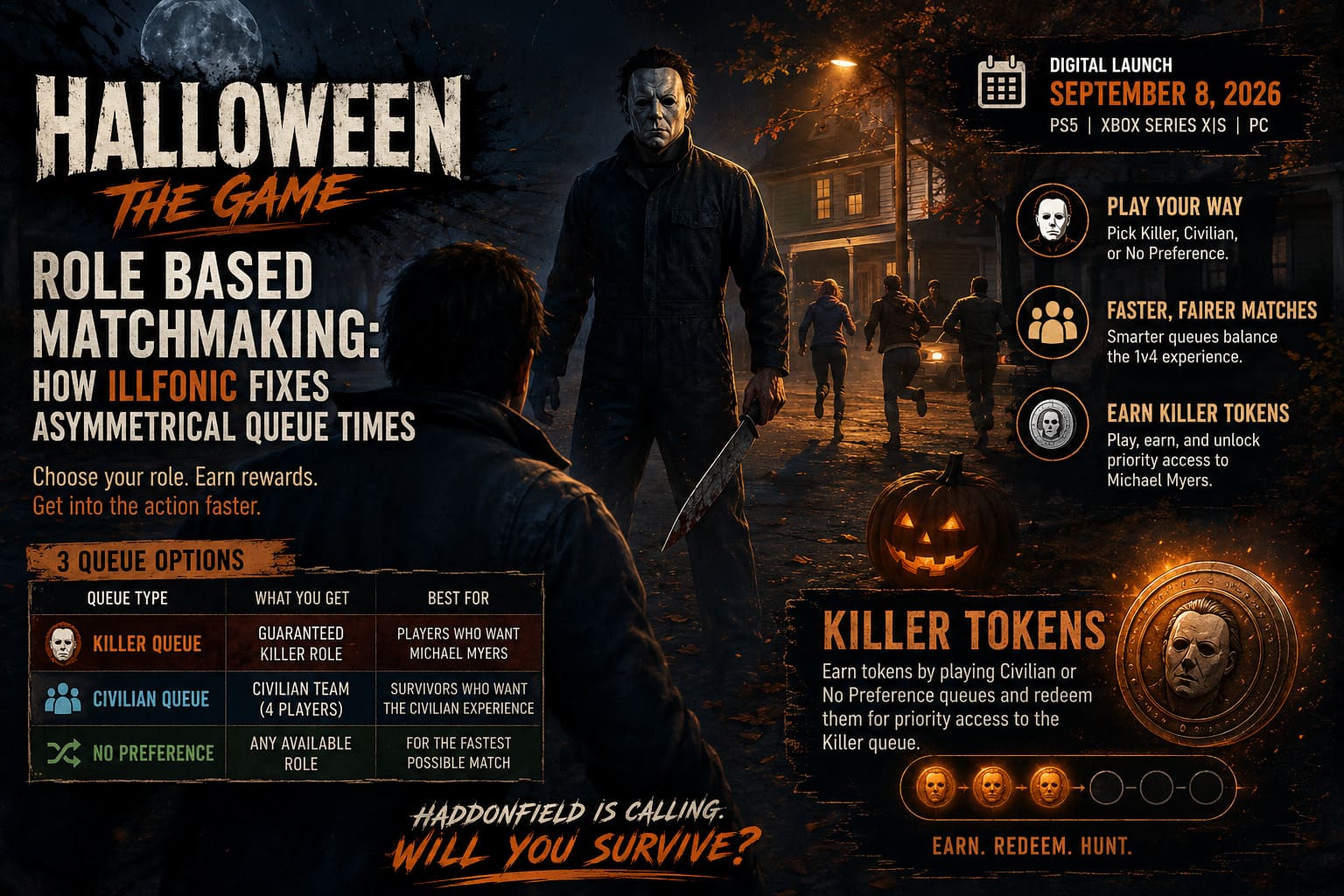
The system revolves around three different matchmaking choices. That might sound basic, but the important part is what happens before the game actually builds a lobby.
| Queue Type | What You Get | Best For |
|---|---|---|
| Killer Queue | Guaranteed killer role | Players who specifically want Michael Myers |
| Civilian Queue | Civilian team | Players who want the survivor experience |
| No Preference | Any available role | Players who want the fastest possible match |
The Killer Queue is obviously going to be the most interesting one. Pick it and you know you’re entering the matchmaking pool specifically to play Michael Myers. The catch is obvious: if thousands of players have exactly the same idea, the queue can still become long.
That’s where the rest of the system becomes important.
The Civilian Queue gives players a dedicated path into the four-player side of the match. Instead of forcing people into a role they don’t want, it creates a pool of players who are actively volunteering to fill those positions.
Then there’s the No Preference Queue, which I personally think could become the unsung hero of the whole system. Players who don’t care whether they’re hunting or hiding can effectively act as the flexible workforce of matchmaking. If the algorithm needs another civilian, you can fill that spot. If it needs a killer, you’re potentially available for that too.
For a game dependent on maintaining a healthy 1v4 population, that flexibility is incredibly valuable.
Killer Tokens Are the Really Clever Part
The role queues are useful, but Killer Tokens are where IllFonic’s matchmaking strategy gets much more interesting.
The concept is straightforward. Players earn tokens by participating in matches, particularly when playing Civilian or No Preference roles. Those tokens can then be used to gain priority access to the Killer Queue.
At first glance, this might sound like a simple reward system. I think it’s more important than that.
Imagine you desperately want to play Michael Myers. You could sit in the killer queue and potentially wait. Or you could play a few matches on the civilian side, earn tokens, and eventually receive priority access to the role you actually want.
That creates a matchmaking loop where helping the overall player population eventually helps you personally.
And honestly, that’s exactly the kind of incentive asymmetrical games need.
Instead of telling players, “Sorry, nobody wants to play civilian, so you’re waiting,” the system effectively says, “Help keep the game moving and we’ll reward you for it.”
That difference matters.
Will Killer Tokens Actually Solve Long Queues?
This is the part I’m watching closely.
No token system can magically create players who aren’t online. If the game’s population crashes months after launch, even the smartest matchmaking algorithm is going to struggle. But during the early months, when the player base is healthy, this could make the distribution of roles considerably smoother.
There’s also a psychological advantage.
Players generally hate feeling that they’re being punished for wanting to play their favorite character. If the game simply gives Michael Myers an enormous queue timer, players may eventually stop trying. If it gives them a clear path toward priority access, the wait feels more like progression.
That’s a huge difference in perception.
It reminds me of the better progression systems in other multiplayer games: the grind isn’t necessarily fun by itself, but when you understand exactly why you’re doing it and what you’re getting afterward, you’re much more willing to participate.
Private Matches Give Friends More Freedom
Thankfully, IllFonic isn’t applying these restrictions everywhere.
Private matches allow groups of friends to decide their own rules. Players can assign roles manually or randomize them if they want something more chaotic.
That’s exactly how it should work.
If I have four friends sitting in Discord and one person desperately wants to play Michael Myers, there’s no reason for matchmaking rules to get in the way. Private lobbies are supposed to be the place where players can experiment, mess around, and create their own horror scenarios.
It also gives the community room to create its own traditions. Some groups will probably assign the killer manually every round. Others might use random selection and accept whatever nightmare scenario the game produces.
Progression Gives Public Matches Another Purpose
IllFonic is also tying public matchmaking into character progression and customization.
Playing matches can unlock visual customization for Michael Myers and the civilian characters, giving players another reason to keep participating even when they’re not playing their preferred role.
This is important because the best matchmaking incentives don’t feel like chores. If I’m playing civilian because I need Killer Tokens and I’m unlocking something cool at the same time, the experience feels productive rather than like I’m being forced to do community service before I’m allowed to play the character I actually want.
Players who purchase higher-tier editions also have access to additional cosmetic content, including the iconic Laurie Strode-inspired Final Girl outfit mentioned in the game’s promotional material.
For a horror fan, cosmetics tied to recognizable Halloween imagery are an obvious attraction. The challenge will be making sure progression feels rewarding without turning the system into an exhausting grind.
The Global Launch Could Be More Complicated
The September 8 launch is expected to bring Halloween: The Game to PlayStation 5, Xbox Series X|S, and PC, with Steam and Epic Games Store versions planned.
But the worldwide rollout isn’t completely straightforward.
The game has faced classification problems in Australia, where the Australian Classification Board reportedly refused classification because of content involving a controlled substance used as an in-game power-up. That affects availability in Australia and New Zealand.
Japan is also facing its own complications. The PlayStation 5 digital release has reportedly been canceled there because of issues surrounding violence and nudity classifications, while PC and Xbox versions are expected to remain available on September 9.
Those regional differences aren’t directly connected to matchmaking, but they matter because asymmetrical multiplayer lives and dies by population density. The more fragmented the player base becomes across regions and platforms, the more pressure matchmaking can experience.
That makes IllFonic’s queue design even more important.
My Biggest Concern: The System Needs a Healthy Player Base
As someone who has spent way too many hours with multiplayer games, I’ve learned that matchmaking systems can look fantastic on paper and still fall apart once the launch hype disappears.
The first few weeks should be relatively easy. Everyone wants to experience Haddonfield, everyone wants to see Michael Myers in action, and content creators will be flooding YouTube with matches.
The real test comes later.
Can IllFonic keep civilian players interested? Are Killer Tokens generous enough to feel rewarding without becoming meaningless? Will No Preference players actually have an impact on queue times? And perhaps most importantly, will players still have a reason to return after the novelty wears off?
Those are the questions I’ll be watching.
Final Verdict: This Is the Right Problem to Solve
I’m cautiously optimistic about IllFonic’s approach.
The studio isn’t pretending that asymmetrical matchmaking is a solved problem. Instead, it is building the system around the reality that players have strong preferences, especially when the killer is an iconic character like Michael Myers.
The three queue types make the experience more transparent. The No Preference option provides flexibility. Killer Tokens give players a reason to help fill less popular roles. Private matches remove unnecessary restrictions for friend groups.
None of this guarantees perfect matchmaking, but it feels like a system designed by developers who understand how these games actually behave once real players get their hands on them.
And that’s what makes Halloween: The Game interesting to me beyond the license itself. The Michael Myers fantasy is obviously the headline attraction, but a great asymmetrical horror game needs more than a famous killer and a recognizable map.
It needs players to keep finding matches.
If IllFonic gets that part right, Haddonfield could become a genuinely nasty multiplayer playground rather than another horror game remembered mainly for its launch hype. And personally, I’d much rather spend my evening hearing Michael’s footsteps behind me than watching a matchmaking spinner.