Zad Archery Beginner Guide: Best Tips, Tricks, and Progression Strategy (2026)
I’ve played my fair share of idle games, clickers, incremental RPGs, and those strange little projects that somehow turn “I’ll play for ten minutes” into a three-hour session. Zad Archery immediately gave me that feeling. It looks simple at first: you have a bow, enemies keep coming, you shoot them, collect loot, upgrade your character, and repeat.
But after spending time thinking about how the different systems fit together, it becomes obvious that Zad Archery is not really about shooting enemies as fast as possible. It’s about building a character that gets stronger while you’re playing and while you’re away.
That distinction is important.
If you are just starting Zad Archery in 2026, you can easily waste resources chasing the biggest damage number or crafting every shiny item you find. I’d actually recommend doing almost the opposite. Build a foundation first, improve your farming efficiency, and let the bigger numbers come naturally.
Here’s how I would approach the game as a new player.
The First Hours: Don’t Chase Damage Too Early
The opening hours of Zad Archery can be slightly deceptive. You see your damage increasing and naturally want to put every available upgrade into attack power.
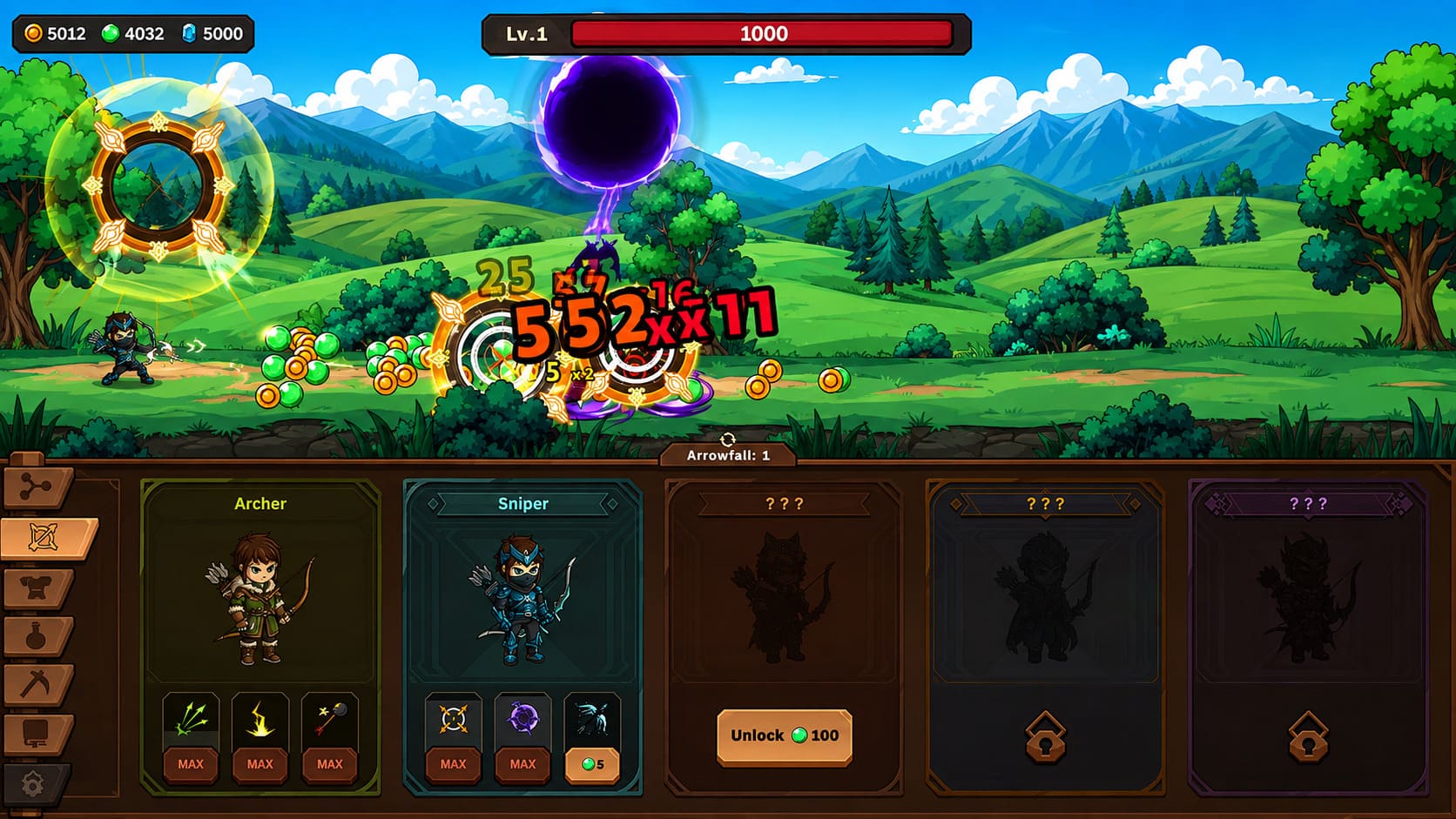
I understand the temptation. Watching your archer go from doing tiny amounts of damage to deleting enemies in a few hits is satisfying.
However, raw damage isn’t always the best early-game investment.
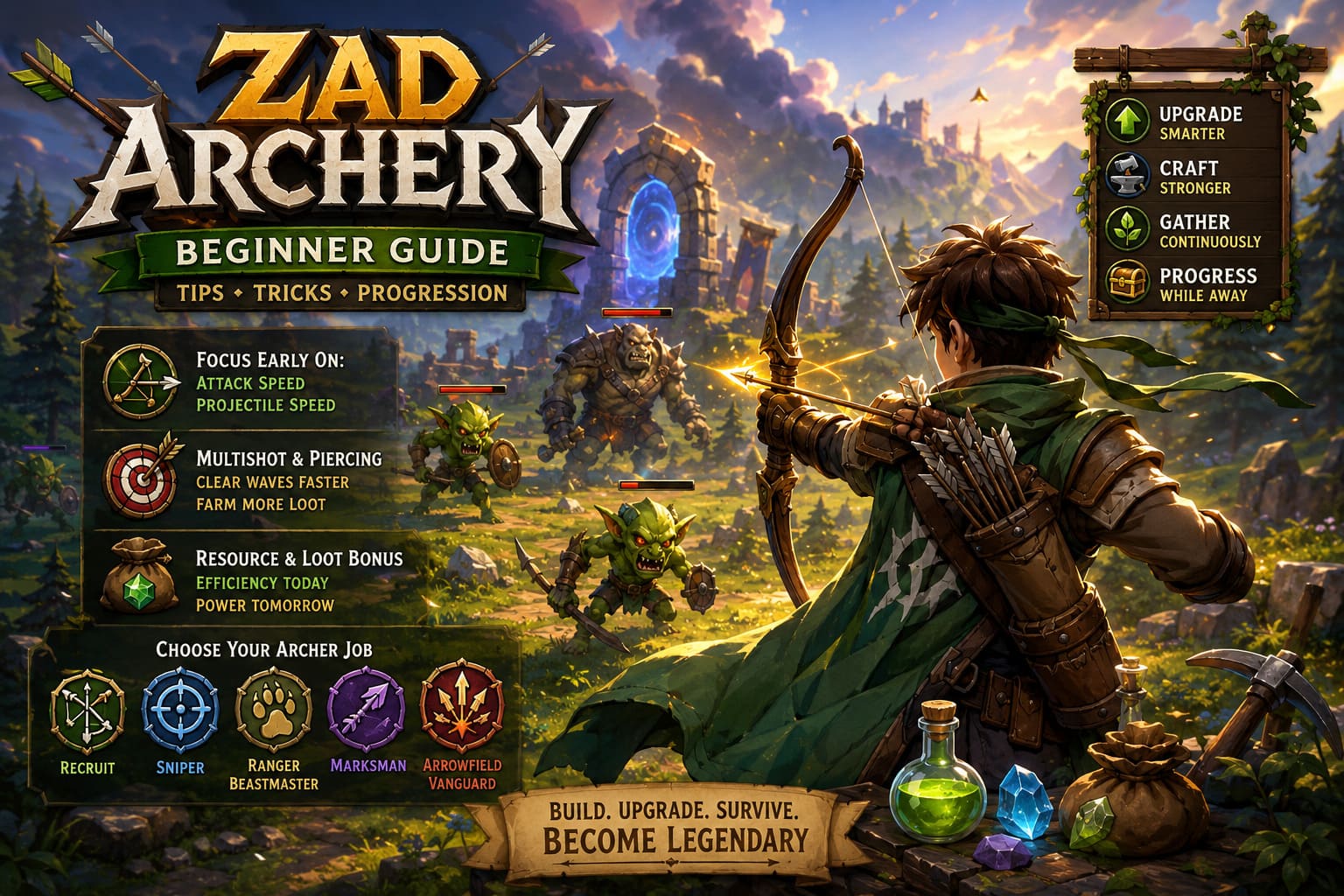
For me, attack speed is one of the most valuable stats during the beginning of a run. Killing an enemy slightly faster isn’t just about increasing DPS. Faster attacks mean faster wave clearing, faster loot generation, and fewer situations where enemies have time to pile up around your character.
Projectile speed also deserves attention. There’s nothing more annoying than having enough theoretical damage to kill something but watching your arrows take forever to reach the target.
So my early priority would look something like this:
- Attack speed and fire rate
- Projectile speed
- Multishot
- Piercing
- Resource and loot bonuses
- Pure damage upgrades
This isn’t a rigid rule. If the game throws an amazing damage upgrade at you, obviously take it. But as a general Zad Archery beginner strategy, I prefer upgrades that improve the entire farming process rather than one isolated number.
The Skill Tree: Think About Efficiency, Not Just Power
The skill tree is probably one of the systems that can overwhelm new players. There are a lot of nodes, and when you first look at it, you may feel like you’re supposed to calculate every possible route before spending a single point.
I wouldn’t.
One thing I like about the design is that the tree encourages experimentation. You don’t need to create a perfect build from the first five minutes of your playthrough.
Early on, I would focus on anything that makes basic combat smoother.
Multishot Changes the Feel of Combat
Once your basic attack speed is comfortable, Multishot becomes extremely attractive.
The reason is simple: enemies don’t politely stand in a single-file line waiting to die. Eventually, you’re dealing with groups, and hitting several targets with one attack becomes much more valuable than adding a small amount of single-target damage.
Piercing works beautifully alongside this idea.
When enemies start stacking together, a piercing projectile can effectively turn one arrow into a miniature crowd-control tool. This is where the combat starts feeling much more interesting than a typical idle game.
Instead of asking, “How much damage does my bow do?” I start asking, “How efficiently can my build process an entire wave?”
That is a much better question.
Don’t Ignore Resource Bonuses
This is one of those things that doesn’t feel exciting when you buy it.
A damage upgrade immediately gives you a bigger number. A resource bonus just sits there quietly doing its job.
But incremental games are all about compounding advantages.
If a resource or drop-rate upgrade helps you acquire materials faster, that means you can craft sooner. Better crafting leads to stronger gear. Stronger gear lets you clear harder content. Harder content gives you better rewards.
Suddenly that boring-looking utility upgrade has contributed to almost everything you do.
I would rather have a slightly weaker character with excellent farming efficiency than a powerful character that takes forever to generate resources.
That philosophy becomes even more important later.
Choosing Your Archer Job
The Archer Jobs system is where Zad Archery starts giving you some real personality.
Different jobs push you toward different playstyles, and I wouldn’t recommend choosing purely based on whichever description sounds strongest. Think about how you actually like playing.
| Job | Main Strength | Best For | My Take |
|---|---|---|---|
| Recruit | Balanced gameplay | New players | Great starting point |
| Sniper | Single-target damage | Bosses | Powerful but positioning matters |
| Ranger / Beastmaster | Sustained farming | Idle players | Probably my comfort pick |
| Marksman | Critical damage | Optimized gear | Gets better with investment |
| Arrowfield Vanguard | AoE clearing | Large waves | Excellent farming specialist |
Recruit
The basic Archer is exactly what you would expect: straightforward and forgiving.
I’d use this stage to learn the systems rather than trying to create some complicated meta build. Experiment with crafting, gathering, skill upgrades, and movement.
Sniper
The Sniper is where things become more dangerous — and more fun.
The single-target potential is excellent, particularly when you’re fighting tougher enemies or bosses. But there is a catch: positioning can matter a lot.
If your character gets too close to dangerous spawn areas, all that impressive ranged damage won’t save you from being surrounded.
If you enjoy active gameplay and don’t mind paying attention, I think Sniper is one of the more satisfying jobs.
Ranger / Beastmaster
This is the job I’d recommend to someone who wants to enjoy the idle side of Zad Archery.
Sustained attacks and companion mechanics make the playstyle feel safer and more relaxed. It’s particularly attractive if you want to leave the game running and come back to meaningful progress.
Honestly, sometimes that’s exactly what I want from an idle RPG.
Marksman
Marksman becomes much more interesting once your equipment starts supporting critical hits.
I wouldn’t rush into this job simply because “crit = big numbers.” A critical-focused setup works much better when your gear already has the stats to support it.
Once everything starts lining up, though, the damage can get ridiculous.
Arrowfield Vanguard
If your favorite part of the game is watching an entire screen disappear, this is probably the job for you.
The AoE focus makes it especially useful when farming large numbers of enemies and common materials. It’s less about carefully eliminating one powerful target and more about turning entire waves into loot.
And yes, that’s incredibly satisfying.
Crafting Is Not Optional Forever
One mistake I see players making in games like this is treating crafting as a side activity.
It isn’t.
Eventually, random drops alone aren’t going to give you the exact combination of stats your build wants. That’s where crafting becomes important.
When crafting bows and armor, I’d pay attention to combinations rather than obsessing over a single perfect stat.
For an early character, useful combinations can include:
- Attack power + attack speed
- Damage + critical chance
- Survivability + sustain
- Job-specific offensive bonuses
Don’t become emotionally attached to mediocre gear just because you spent materials making it.
If an item has poor rolls and doesn’t fit your build, dismantling it and recovering some resources is often the better decision.
Inventory space is valuable, but crafting materials are valuable too. Learn to recycle bad results instead of hoarding everything.
Mining and Herbing: Keep Them Working
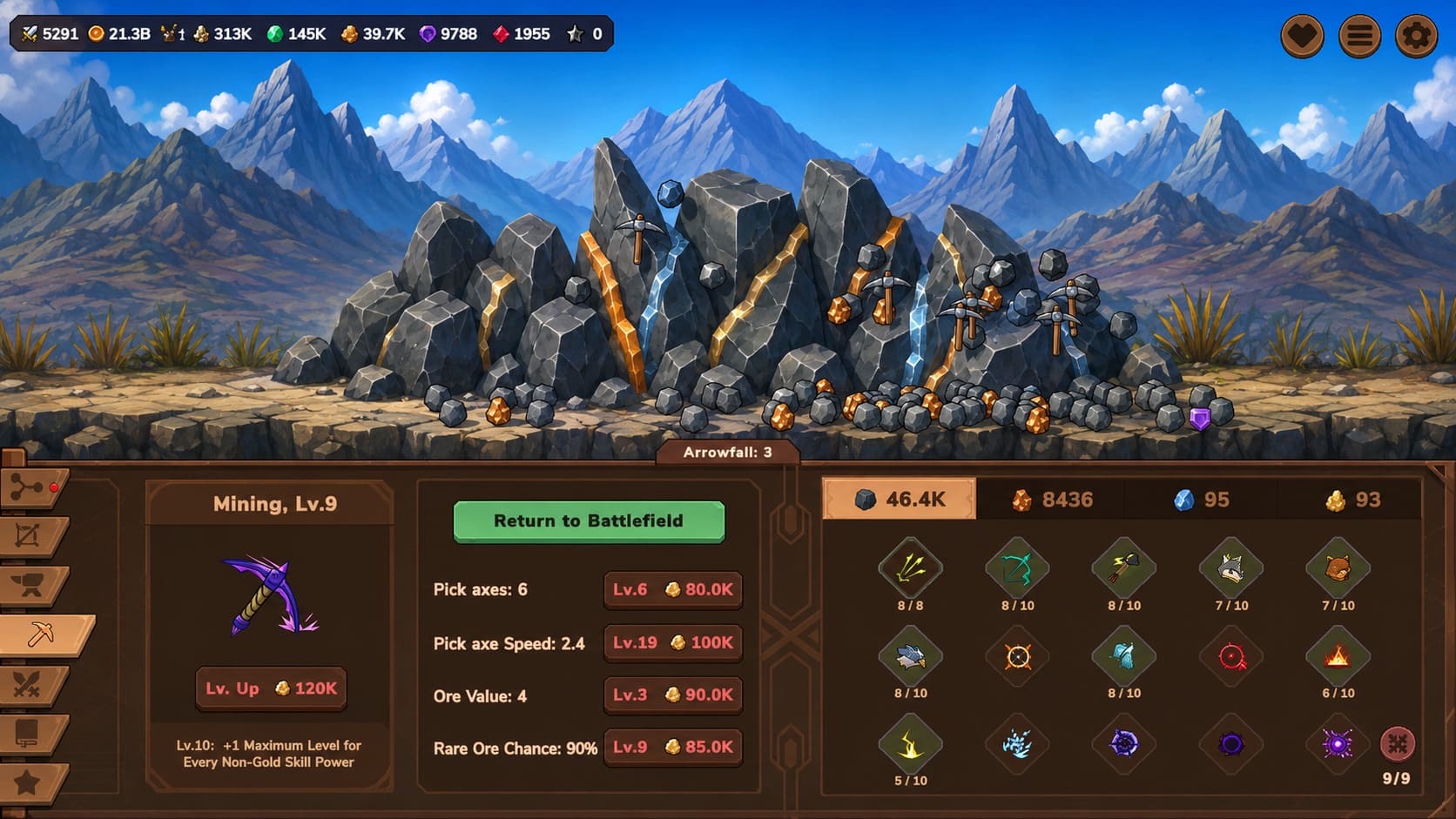
The gathering professions might be the least glamorous part of Zad Archery, but they’re incredibly important for long-term progression.
Mining feeds your crafting pipeline with ores and other useful materials. Herbing supports alchemy and gives you access to ingredients that become increasingly useful as your character grows.
My biggest advice here is simple:
Don’t let your gathering systems sit idle for no reason.
If there’s an automated option available, use it. If you’re going offline, prepare your professions first.
This is one of the easiest ways to turn idle time into actual progression.
Alchemy: Save Your Best Stuff for Walls
Potions are another system that players can easily misuse.
You don’t necessarily need to consume your strongest consumables every time you encounter an ordinary wave. I’d rather save the good stuff for moments when I’m genuinely stuck.
Bosses and difficult portal stages are exactly where temporary boosts can make a meaningful difference.
If you’ve reached a point where you’re surviving comfortably but missing the damage requirement, don’t immediately assume you need to spend hours farming.
Sometimes the answer is simply:
better equipment + appropriate potion buffs + a better combat setup.
That’s one of the things I enjoy about games with layered progression. A wall isn’t always solved by grinding another ten levels.
Movement and Aggro Can Make or Break a Run
This is probably my biggest gameplay complaint — and also something new players should learn quickly.
Your archer doesn’t always behave exactly like you’d expect.
There are situations where movement and enemy positioning can create problems, especially when your character gets too close to dangerous areas. A build that looks fantastic on paper can suddenly feel terrible if enemies collapse on you faster than you can clear them.
Slows, freezes, movement-control abilities, and smart positioning can therefore be surprisingly valuable.
Sometimes reducing enemy movement slightly is more useful than adding another small percentage of damage.
That’s not the kind of advice you’ll notice from a basic stat sheet, but it matters when you’re actually playing.
When You Hit a Wall, Don’t Just Grind
Every incremental game eventually reaches the “why did my progress suddenly stop?” moment.
Zad Archery is no different.
When progression slows dramatically, my first instinct would not be to leave the character farming overnight and hope for the best.
Instead, check these things:
- Is my equipment outdated?
- Am I using the right Archer Job?
- Are my skill-tree points supporting my current playstyle?
- Are my gathering professions running?
- Am I ignoring crafting or alchemy?
- Could I farm an easier area more efficiently?
This last point is especially important.
Sometimes farming content that you clear quickly is more profitable than struggling through content that barely moves forward. Efficiency beats difficulty when you’re farming.
Active vs. Idle: Build for How You Actually Play
This is where I think Zad Archery has a nice advantage over many incremental games.
You don’t have to play it one particular way.
If I’m actively playing, I want something engaging. I’d rather manually manage positioning, activate skills, and squeeze every bit of efficiency out of a run.
If I’m doing something else, I want a build that can survive and generate resources without constant supervision.
That’s why I wouldn’t blindly copy someone else’s “best build.”
The best Zad Archery build for you depends on whether you’re sitting at your PC actively playing or checking the game every few hours.
Tyr Matchmaking Fix: How to Lower Long PvP Queue Times in 2026
My Final Beginner Strategy
If I were starting Zad Archery from scratch today, I’d keep the overall plan pretty simple.
First, I’d make the early combat feel smooth with attack speed, projectile speed, Multishot, and Piercing. Then I’d start investing more seriously into resource generation and gear.
I’d experiment with the Archer Jobs instead of immediately locking myself into one. Ranger/Beastmaster would probably be my choice for relaxed farming, while Sniper or Marksman would be more appealing when I wanted an active, damage-focused session.
At the same time, I’d keep mining and herbing running constantly, craft whenever I had enough materials, and save powerful alchemy consumables for genuine progression walls.
Most importantly, I wouldn’t obsess over having a perfect build.
The fun of Zad Archery is watching a mediocre little archer gradually turn into something completely absurd. One day you’re struggling with a wave, and a few upgrades later you’re deleting entire groups before they can even reach you.
That’s the loop that keeps me coming back.
And if you’re just getting started in 2026, my best advice is surprisingly simple: don’t rush the biggest numbers. Build efficiency first, experiment often, and let the numbers become ridiculous naturally.