The Blood of Dawnwalker Vampire Powers Guide: Claws and Night Abilities List
There are plenty of dark fantasy RPGs that let you play as something supernatural. Very few, however, make that transformation feel like it fundamentally changes the way you approach the entire game.
That is what makes The Blood of Dawnwalker so interesting to me.
As someone who spends far too many hours experimenting with RPG builds, testing combat systems, and deliberately choosing the most dangerous-looking skill on a progression tree just to see what happens, Coen’s vampire gameplay immediately stands out. The nighttime transformation isn’t simply a cosmetic switch or a temporary combat buff. It represents a completely different side of the character.
During the day, Coen is human. At night, he becomes something far more dangerous.
His weapons change. His movement changes. His healing changes. Even the rhythm of combat becomes more aggressive.
This guide covers the best vampire powers in The Blood of Dawnwalker, how Coen’s deadly claws work, and why the Vrakhiri skill tree could become one of the most important progression systems for players who want to embrace the full nocturnal predator playstyle.
Why Vampire Combat Feels So Different
The Blood of Dawnwalker places a huge emphasis on Coen’s dual nature.
During daylight hours, combat revolves around more traditional RPG mechanics. Sword fighting, defensive positioning, careful timing, and other human abilities define how encounters play out.

But when darkness arrives, the rules change.
Coen’s conventional weapons are replaced by his retractable vampiric claws, and that transformation creates a much more direct and brutal combat style.
Personally, this is the part of the game I find most exciting. Sword combat can be tactical and satisfying, but there is something incredibly appealing about abandoning conventional weapons entirely and becoming a supernatural predator.
Instead of carefully maintaining distance, nighttime combat encourages players to get dangerously close.
The claws are built around:
- Fast close-range attacks
- Aggressive pressure against enemy guards
- Blood collection and feeding
- High-speed supernatural mobility
- Powerful executions and finishers
The result is a combat system that should reward players who are willing to stay on the offensive.
And honestly, that is exactly how vampire combat should feel.
You shouldn’t feel like a slightly stronger human holding a sword. You should feel like the enemy suddenly has a serious problem because the sun went down.
Understanding Claw Combat and Activation Charges
One of the most important things to understand about the vampire side of The Blood of Dawnwalker is that simply spamming claw attacks isn’t necessarily the whole strategy.
The game uses a directional combat system, meaning positioning and timing matter when attacking or defending. Players can use accessibility options that simplify certain mechanics, but mastering the standard combat system should provide much greater control.
When fighting with claws, Coen can build momentum through successful combat actions.
This includes landing attacks, defending effectively, and pulling off well-timed parries.
Those actions contribute toward Activation Charges, an important resource used for stronger vampire abilities and devastating finishers.
The basic combat loop looks something like this:
Attack → Pressure the enemy → Break their defense → Build charges → Use a powerful ability → Feed or finish the target
That loop sounds simple on paper, but it creates a much more aggressive rhythm than traditional sword fighting.
Claws also appear particularly useful against defensive opponents. Heavy attacks can pressure guards and help create openings against enemies hiding behind armor or shields.
Once the defense breaks, that’s when Coen becomes truly dangerous.
The Best Vampire Powers in The Blood of Dawnwalker
The Vrakhiri progression branch focuses on Coen’s supernatural abilities, combining brutal melee combat with mobility, crowd control, feeding, and high-damage attacks.
Below are the vampire powers that stand out the most.
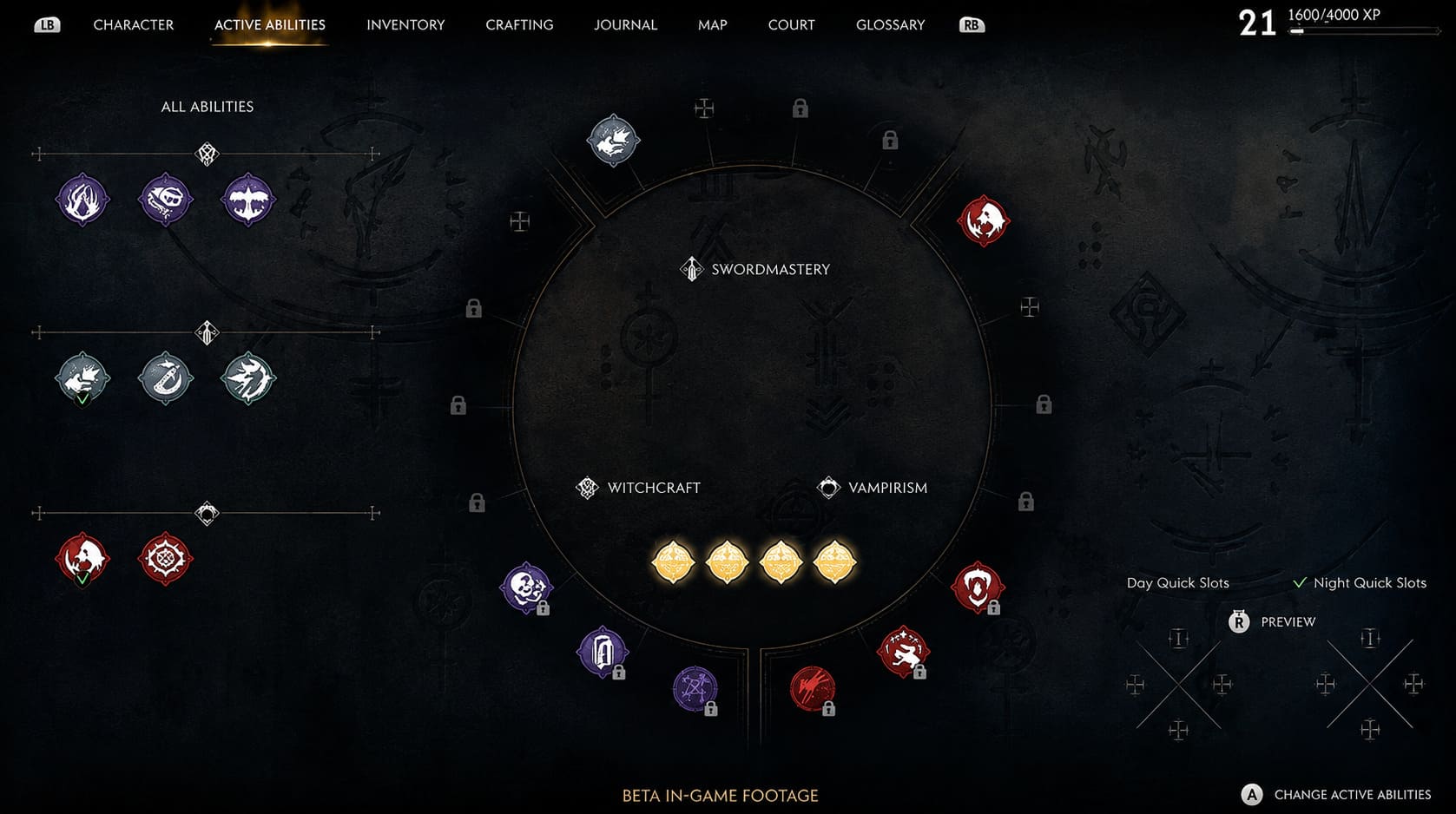
| Ability | Type | Best Use |
|---|---|---|
| Artery Attack | Finisher | Eliminating staggered enemies |
| Shadowstep | Mobility | Dodging and repositioning |
| Clawride | Traversal | Reaching vertical locations |
| Planeshift | Advanced Movement | Escaping or closing distance |
| Blood Surge | AoE Ultimate | Destroying groups of enemies |
| Feral Mind | Crowd Control | Turning enemies against each other |
| Vampiric Feeding | Sustenance | Restoring health during combat |
1. Artery Attack – The Ultimate Claw Execution
If you’re the kind of player who loves finishing moves, Artery Attack will probably be one of your favorite vampire abilities.
This is a powerful execution technique designed for enemies who have already been weakened, staggered, or completely exhausted.
When the opportunity appears, Coen launches into a devastating attack using his claws to target a vulnerable opponent.
Against weaker enemies, the ability can function as a brutally efficient finishing move. More powerful targets and bosses won’t disappear quite so easily, but the attack can still deliver serious damage and leave them suffering from bleeding effects.
The important thing here is resource management.
Artery Attack requires fully prepared Activation Charges, so wasting those charges carelessly could leave you without a finisher when a dangerous enemy finally becomes vulnerable.
My advice? Don’t immediately spend your charges just because you can.
Wait for the moment when an elite enemy is staggered and then turn that opening into something memorable.
2. Shadowstep – My Pick for One of the Most Important Vampire Skills
If there is one ability I expect to become essential for players who enjoy aggressive builds, it’s Shadowstep.
Mobility is everything in action RPG combat.
Being able to instantly reposition can completely change an encounter, especially when you’re surrounded by multiple enemies or dealing with dangerous ranged attacks.
Shadowstep allows Coen to rapidly move through the environment and reposition during combat.
You can use it to:
- Escape incoming attacks
- Cross dangerous gaps
- Reach elevated areas
- Move behind enemies
- Close distance against ranged opponents
The combat potential is what makes it particularly exciting.
A perfectly timed Shadowstep could allow Coen to evade an attack and immediately appear in a stronger position for a devastating claw combination.
That kind of mobility is exactly why I think nighttime gameplay may become the preferred playstyle for many players.
3. Clawride – The Ability That Changes Exploration
Not every powerful vampire skill is designed to kill something.
Clawride focuses on movement and environmental traversal, allowing Coen to use his hardened claws to scale surfaces that would normally be inaccessible.
Castle walls, cliffs, defensive structures, and other vertical environments suddenly become opportunities rather than obstacles.
This is one of those abilities that could have a massive impact outside combat.
I always love RPG abilities that change how you look at the world. Once you unlock a new traversal mechanic, you start revisiting locations and asking yourself:
“Wait… can I get up there now?”
That is exactly the kind of exploration loop Clawride seems designed to create.
A fortified enemy camp that appears impossible to infiltrate from the front may suddenly have an entirely different solution once Coen can climb the walls at night.
4. Planeshift – Advanced Supernatural Movement
Planeshift takes vampire mobility even further.
Rather than simply moving quickly, this ability allows Coen to temporarily shift beyond normal physical limitations and rapidly travel forward.
It’s especially useful when dealing with large distances or crowded encounters.
Imagine being surrounded by enemies while archers continue firing from the backline. Instead of slowly fighting through everyone in front of you, Planeshift gives you a way to rapidly break through the chaos.
Then the archers learn why standing far away from a vampire isn’t always enough.
Planeshift looks like the kind of skill that experienced players will use constantly because movement is often more valuable than raw damage.
Blood Surge – The High-Risk Vampire Ultimate
Now we’re getting to the fun stuff.

Blood Surge is easily one of the most dramatic abilities in the vampire toolkit.
The power uses Coen’s supernatural curse to unleash devastating area damage against nearby enemies.
However, there is a serious cost.
Blood Surge consumes Activation Charges and a significant portion of Coen’s health, making it a classic high-risk, high-reward ability.
That creates an interesting tactical decision.
You can destroy a group of enemies, but afterward, you’re potentially left vulnerable.
This is where the vampire gameplay loop becomes especially satisfying.
The ideal strategy is to unleash Blood Surge and then immediately return to aggressive claw combat and Vampiric Feeding.
In other words:
Spend health → Destroy enemies → Attack aggressively → Drink blood → Recover
That sounds like pure vampire gameplay to me.
Feral Mind – Let Your Enemies Kill Each Other
Sometimes the smartest way to win a fight is not to fight everyone yourself.
Feral Mind is a crowd-control ability that affects nearby enemies and disrupts their behavior.
Affected opponents can lose control and become a threat to the people around them.
This can be incredibly useful when Coen is surrounded by large patrol groups.
Instead of trying to survive attacks from every direction, you can create chaos and allow the enemy formation to collapse.
I’ve always enjoyed abilities like this in RPGs because they give players options beyond simply increasing damage numbers.
Sometimes the most powerful ability isn’t the one that deals the biggest hit.
Sometimes it’s the one that turns a difficult fight into complete chaos.
Vampiric Feeding – The Heart of Nighttime Survival
One of the biggest differences between human and vampire gameplay is healing.
During the day, Coen depends more heavily on traditional resources and consumables.
At night, the solution is much more direct.
Find blood. Take it. Survive.
Vampiric Feeding allows Coen to restore his health by draining suitable targets after creating an opening.
This makes aggressive combat essential.
If you’re injured, retreating may not always be the best answer. Sometimes the best option is to become even more aggressive, stagger an enemy, and feed.
That creates a fantastic risk-and-reward system.
The more effectively you fight, the easier it becomes to sustain yourself.
Best Passive Perks for a Claw Build
The Vrakhiri tree also contains passive abilities that improve Coen’s vampire performance.
Two perks are particularly important for players focused on claw combat.
Crimson Rush
Crimson Rush rewards players who can stay healthy.
The higher Coen’s health remains, the stronger his offensive potential becomes.
This creates an interesting build philosophy.
You want to remain aggressive enough to maintain momentum, but disciplined enough to avoid taking unnecessary damage.
It should work particularly well with players who master directional defense and use feeding efficiently.
Vampiric Savagery
Vampiric Savagery is perfect for players who hate losing momentum.
When an enemy interrupts or successfully resists Coen’s attack chain, this perk helps the vampire respond with increased aggression and offensive power.
Instead of allowing the enemy to completely reset the fight, Coen can potentially strike back with even greater force.
For an aggressive claw build, this is exactly the kind of passive perk I’d prioritize.
The Blood of Dawnwalker Time Resource Mechanics: Complete Skill Tree Guide
Can You Combine Human and Vampire Skills?
Yes, and this is where character progression becomes especially interesting.
The Blood of Dawnwalker doesn’t appear to force players into a single rigid archetype.
You don’t necessarily have to choose between being a swordsman or a vampire.
You can build around both.
A hybrid character could use daytime combat perks to improve defensive performance and resource generation while investing in powerful nighttime abilities for devastating vampire encounters.
That flexibility is something I personally appreciate in RPGs.
I don’t enjoy spending dozens of hours building a character only to discover that half the progression system is permanently irrelevant.
The best builds often come from experimenting.
Maybe you prefer maximum claw damage.
Maybe you want supernatural mobility.
Maybe you want to combine defensive sword skills with devastating nighttime finishers.
The important thing is that the system gives you room to experiment.
The Blood of Dawnwalker Combat Guide: 10 Essential Tips to Master the Blade and Cursed Magic
Final Thoughts: Why the Vampire Powers Could Define the Game
The Blood of Dawnwalker has a lot of interesting ideas, but the contrast between daytime humanity and nighttime vampirism may be its most important feature.
During the day, you’re forced to think like a human survivor.
At night, you’re allowed to become the nightmare.
The combination of claws, executions, teleportation, wall climbing, blood feeding, crowd control, and powerful AoE abilities gives the Vrakhiri progression system enormous potential.
For me, Shadowstep and Artery Attack are the abilities I’m most excited about, while Blood Surge looks like the ultimate skill for players who enjoy taking massive risks for spectacular results.
The real strength of the system, though, is how these powers work together.
Movement creates openings.
Claws generate pressure.
Pressure creates staggers.
Staggers create feeding opportunities and executions.
Blood restores health.
And that health can potentially be spent again on even more destructive abilities.
That is a proper gameplay loop.
If the final game delivers on the potential of these mechanics, the Vrakhiri vampire skill tree could become one of the most satisfying supernatural progression systems in a modern action RPG.
And honestly? When the sun goes down in Vale Sangora, I already know which side of Coen I’m going to enjoy playing the most.
The human can handle the daylight. The vampire can have the night.