Voidling Bound Elemental Matchups Guide — A Gamer’s Honest Breakdown of Tactics Counters and Late-Game Strategy
Voidling Bound is one of those games that quietly takes over your time if you enjoy creature collectors mixed with fast third-person shooter combat. I went in expecting something casual, but ended up deep in late-night builds, testing elemental setups like my survival depended on it.
This is not a game where you can rely on one favorite Voidling and brute force your way through everything. That works early on, but later missions force you to understand elemental matchups or you simply hit a wall.
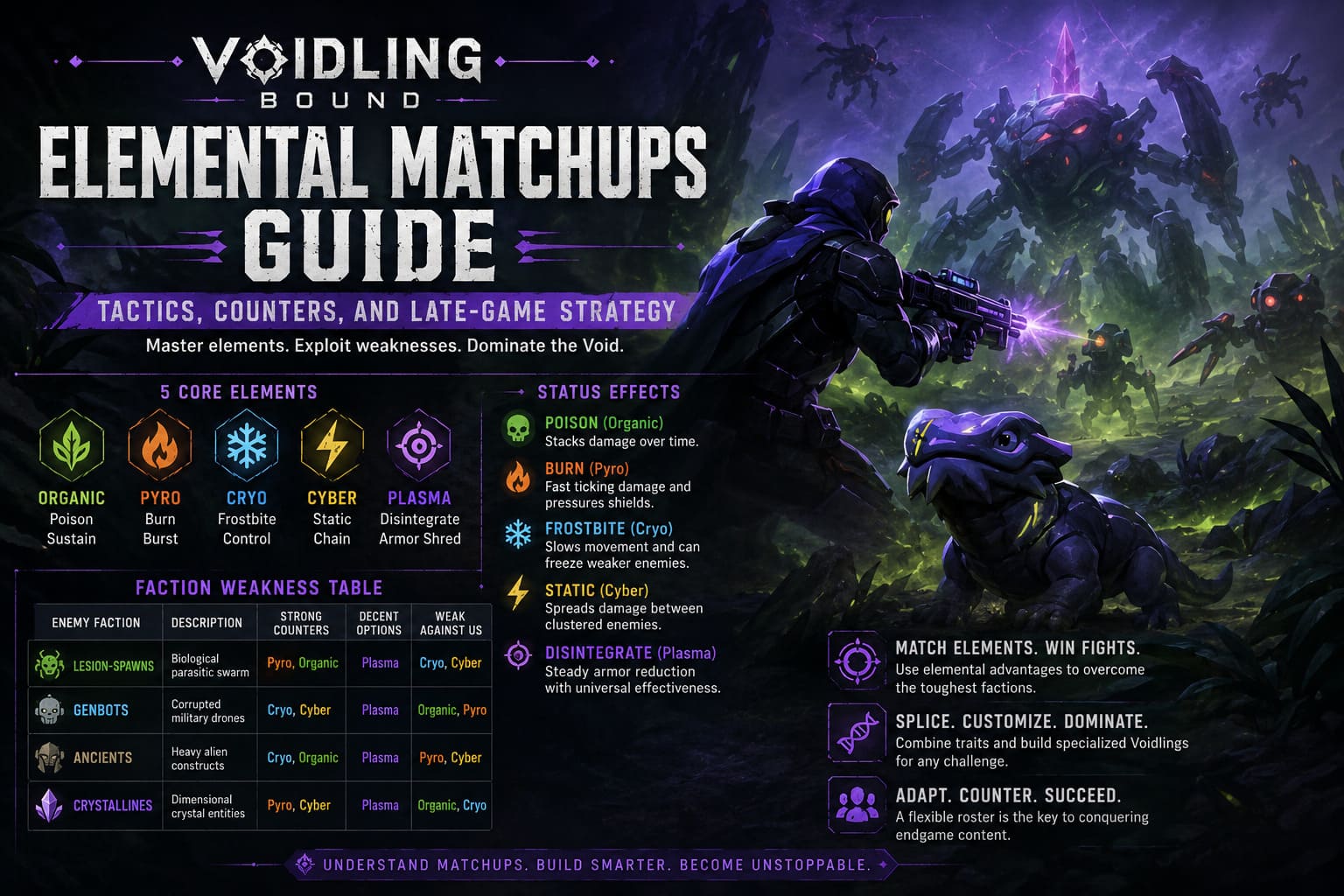
This guide is a personal breakdown based on real gameplay experience, focusing on how factions behave, what elements actually matter, and how to build squads that don’t fall apart in endgame content.
Voidling Bound Abyss Guide — Unlocking the Endgame and Voidling Boss Like a Veteran Player
Why Elemental Matchups Matter
At first, the elemental system in Voidling Bound feels like flavor. You see fire effects, poison ticks, lightning chains, and assume it is just visual variety. Then difficulty increases and suddenly damage numbers stop working in your favor.
The game heavily rewards preparation. If your elemental type does not match enemy weaknesses, you are effectively fighting with reduced efficiency no matter how strong your Voidling is.
This is where many players stall, because raw stats alone are not enough anymore.
Core Elements and Combat Identity
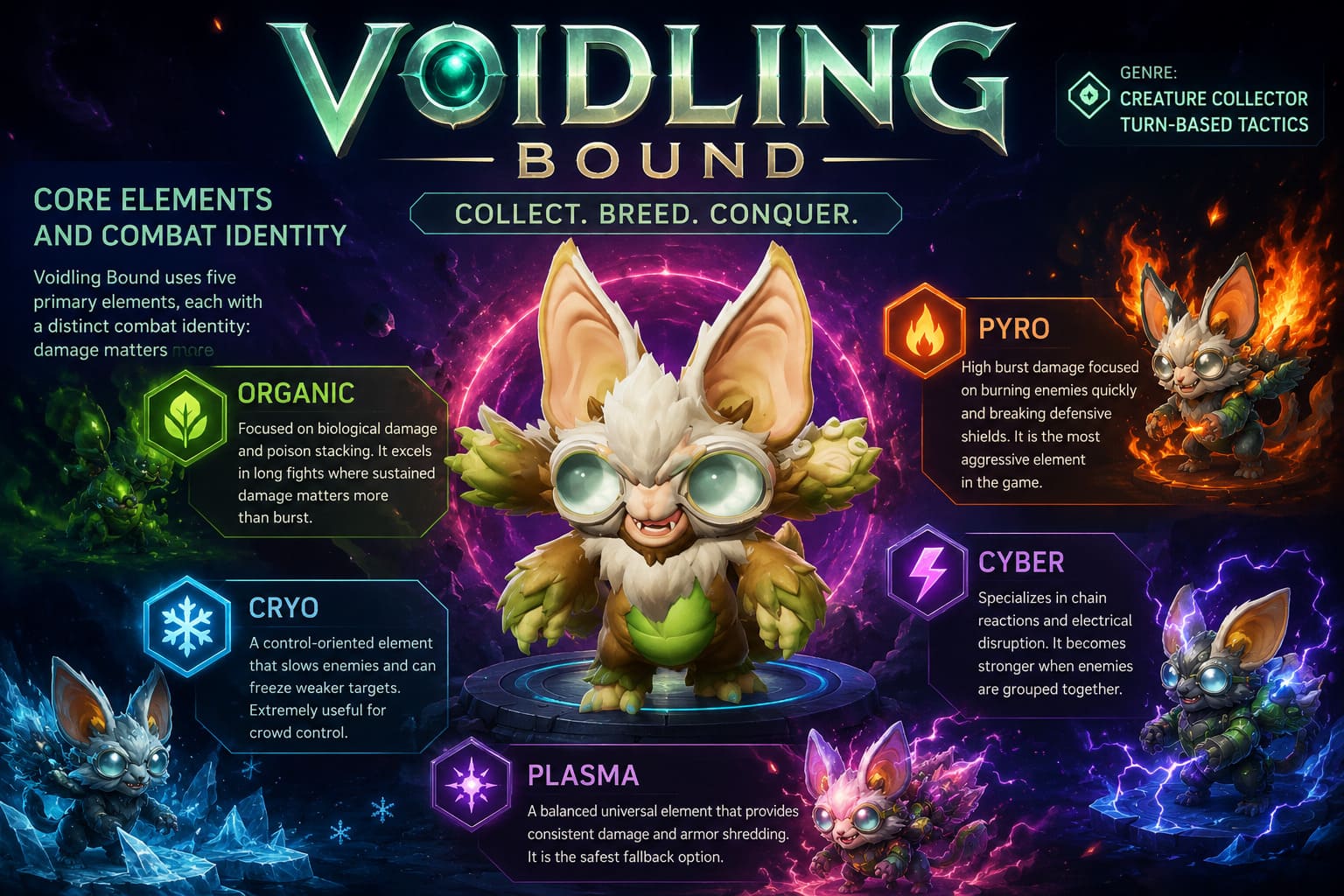
Voidling Bound uses five primary elements, each with a distinct combat identity:
Organic
Focused on biological damage and poison stacking. It excels in long fights where sustained damage matters more than burst.
Pyro
High burst damage focused on burning enemies quickly and breaking defensive shields. It is the most aggressive element in the game.
Cryo
A control-oriented element that slows enemies and can freeze weaker targets. Extremely useful for crowd control.
Cyber
Specializes in chain reactions and electrical disruption. It becomes stronger when enemies are grouped together.
Plasma
A balanced universal element that provides consistent damage and armor shredding. It is the safest fallback option.
Status Effects Overview
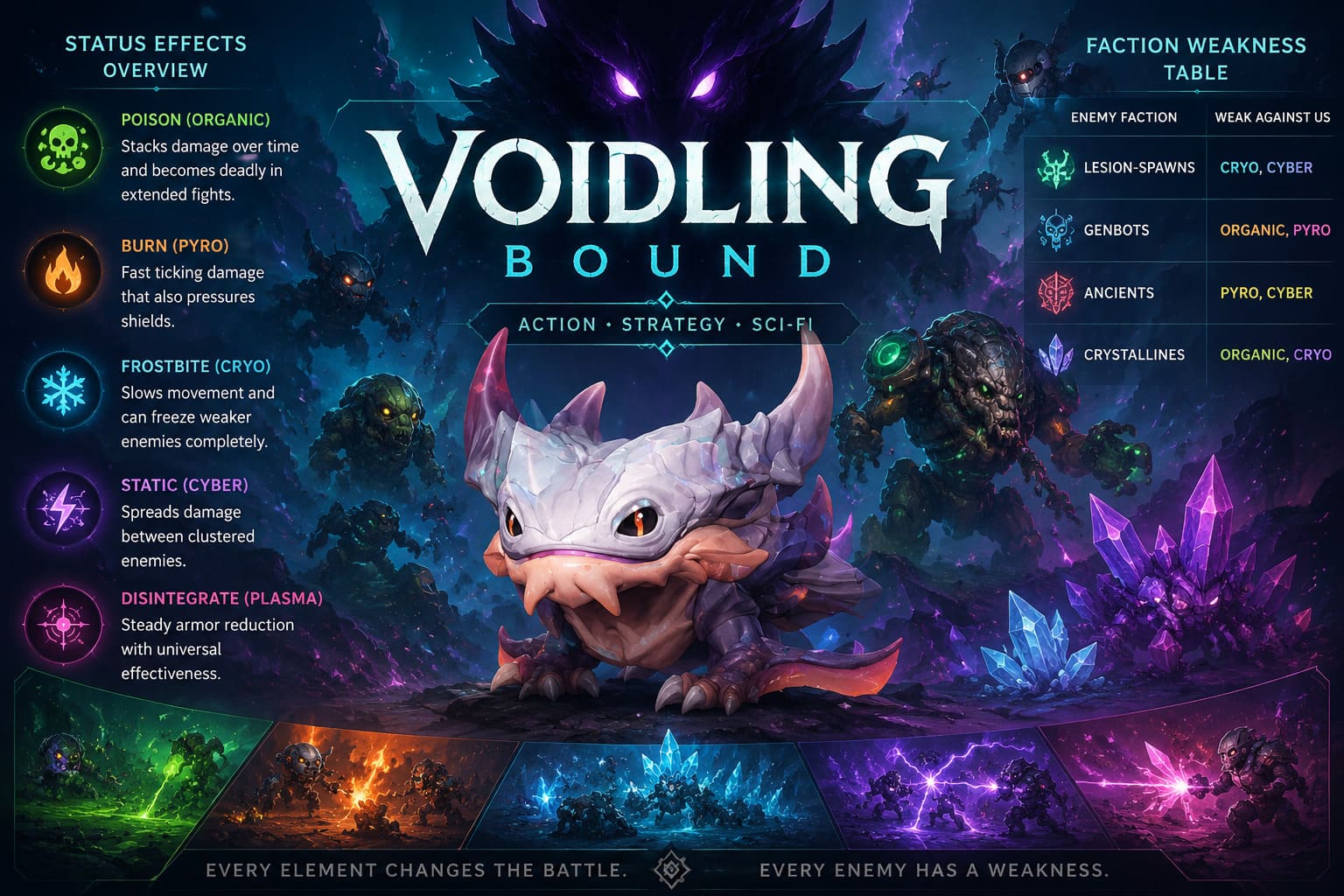
Each element applies a unique status effect that changes combat flow:
Poison (Organic): stacks damage over time and becomes deadly in extended fights.
Burn (Pyro): fast ticking damage that also pressures shields.
Frostbite (Cryo): slows movement and can freeze weaker enemies completely.
Static (Cyber): spreads damage between clustered enemies.
Disintegrate (Plasma): steady armor reduction with universal effectiveness.
Faction Weakness Table
| Enemy Faction | Description | Strong Counters | Decent Options | Weak Against Us |
|---|---|---|---|---|
| Lesion-Spawns | Biological parasitic swarm | Pyro, Organic | Plasma | Cryo, Cyber |
| GenBots | Corrupted military drones | Cryo, Cyber | Plasma | Organic, Pyro |
| Ancients | Heavy alien constructs | Cryo, Organic | Plasma | Pyro, Cyber |
| Crystallines | Dimensional crystal entities | Pyro, Cyber | Plasma | Organic, Cryo |
Faction Combat Behavior Breakdown
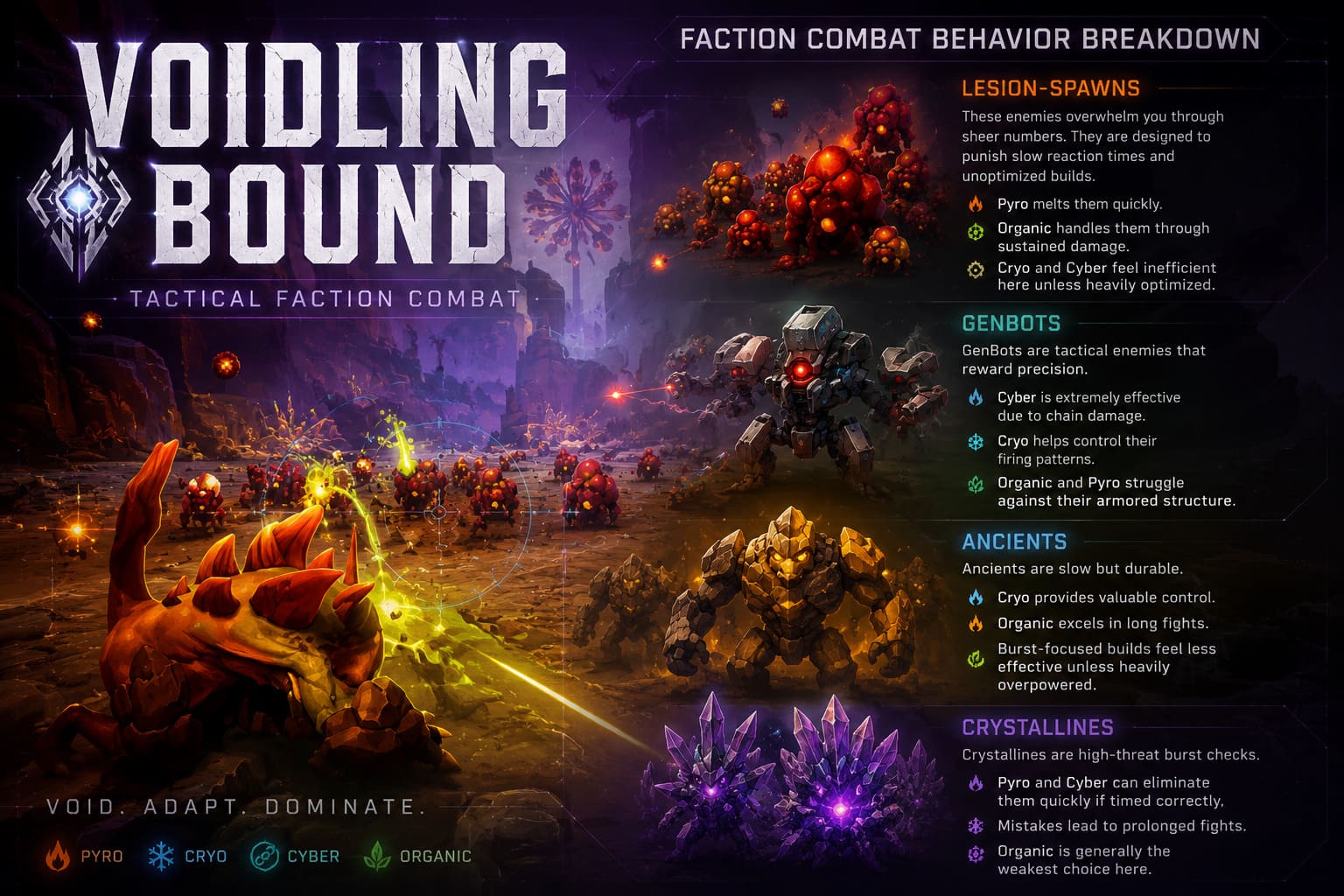
Lesion-Spawns
These enemies overwhelm you through sheer numbers. They are designed to punish slow reaction times and unoptimized builds. Pyro melts them quickly, while Organic handles them through sustained damage. Cryo and Cyber feel inefficient here unless heavily optimized.
GenBots
GenBots are tactical enemies that reward precision. Cyber is extremely effective due to chain damage, while Cryo helps control their firing patterns. Organic and Pyro struggle against their armored structure.
Ancients
Ancients are slow but durable. Cryo provides valuable control, and Organic excels in long fights. Burst-focused builds feel less effective unless heavily overpowered.
Crystallines
Crystallines are high-threat burst checks. Pyro and Cyber can eliminate them quickly if timed correctly, but mistakes lead to prolonged fights. Organic is generally the weakest choice here.
Splicing and Late Game Build Freedom
Once Splicing becomes available, the entire game shifts from simple matchup logic to full build customization. You can override elemental alignments and combine traits across species, creating highly specialized Voidlings.
This is where most of the depth comes from. Instead of relying on general-purpose creatures, you begin building dedicated counters for specific factions.
Example approach:
- – Cyber specialist for GenBots
- – Pyro burst unit for Crystallines
- – Organic sustain build for bosses
Personal Loadout Strategy
After many hours of experimentation, a flexible roster becomes far more effective than a single “main” Voidling. The game clearly rewards adaptation over attachment.
My preferred setup includes:
- – Pyro Voidling for swarm clearing
- – Cryo Voidling for crowd control missions
- – Cyber Voidling for drone-heavy encounters
- – Organic Voidling for endurance fights
- – Plasma hybrid as a universal fallback
Final Thoughts
Voidling Bound is at its best when you fully engage with its elemental system instead of ignoring it. Early on, it feels optional, but in later stages it becomes the core of progression.
Once you start building around faction weaknesses instead of personal favorites, the entire game becomes smoother, faster, and far more satisfying.
The biggest lesson is simple: ignoring elemental matchups in Voidling Bound is the fastest way to make the game unnecessarily hard.