The God Slayer Steam Release Date: Rumors, Trailers, and What We Know So Far
Pathea Games is about to do something I honestly didn’t expect from the studio behind My Time at Portia and My Time at Sandrock. Instead of another colorful life sim packed with farming, crafting, and relationship quests, the developers are building The God Slayer, a dark action RPG about a man hunting down literal gods in a sprawling oriental steampunk world.
And yeah, the contrast is wild.
The more gameplay Pathea has shown, the harder it has become to treat The God Slayer as just another promising Chinese action game. There is fast martial-arts combat, elemental manipulation, enormous vertical environments, political factions, airships, industrial machinery, and a revenge story that gets surprisingly brutal. For PC players, though, there is one question sitting above everything else: when is The God Slayer coming to Steam?
Is Genigods Nezha a PlayStation Exclusive? Release Platforms and Rumors Explained
The God Slayer Steam Release Date: What We Know
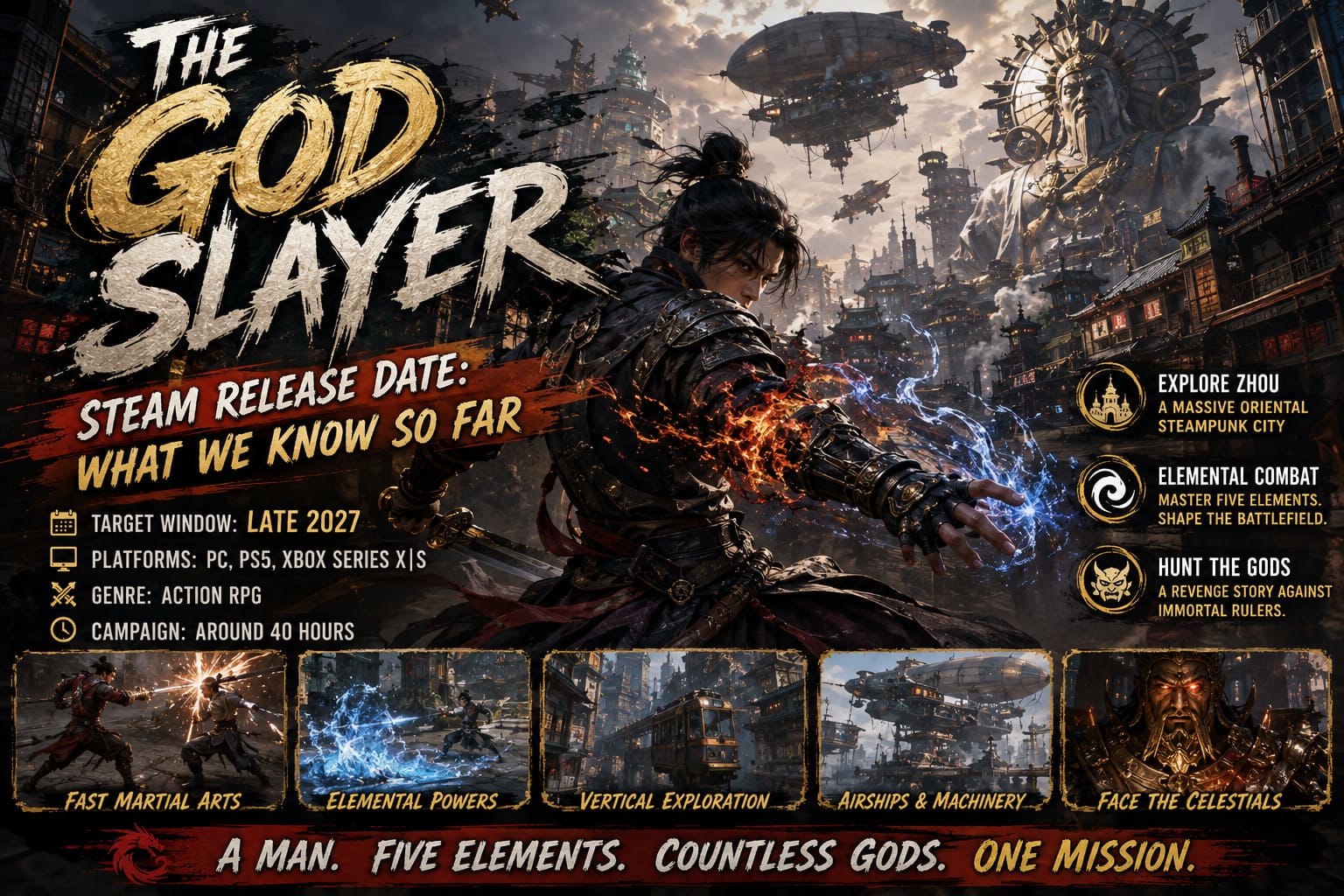
At the moment, The God Slayer does not have a confirmed Steam release date. The Steam listing continues to use a TBA-style release status, meaning Pathea has not locked in a specific launch day or month for PC players.
The current target points toward late 2027, although that should be treated as a development target rather than a guaranteed date. A game this ambitious can easily move its launch window if the developers need additional time for optimization, world-building, combat balancing, or technical polish.
| Release Detail | Current Information |
|---|---|
| Game | The God Slayer |
| Developer | Pathea Games |
| Steam Release | TBA |
| Target Window | Late 2027 |
| Platforms | PC, PlayStation 5, Xbox Series X/S |
| PC Stores | Steam, Epic Games Store |
| Genre | Action RPG |
| Expected Campaign | Around 40 Hours |
If Pathea manages to maintain its current development schedule, a more precise release window could arrive during 2026 or closer to the final production phase. I wouldn’t be shocked if the game eventually slips into early 2028, either. Honestly, I’d rather wait a few extra months than get a massive open-world action RPG that launches with busted performance and half-finished systems.
From PlayStation China Hero Project to Multiplatform RPG
The history of The God Slayer is actually pretty interesting.
Pathea originally revealed the project in 2023 through Sony Interactive Entertainment’s PlayStation China Hero Project, a program created to support Chinese developers working on ambitious games aimed at international audiences. That announcement immediately put the game on the radar of PlayStation fans, and for a while it was easy to assume that The God Slayer might remain closely tied to Sony’s ecosystem.
Things changed as development continued.
Pathea eventually confirmed that The God Slayer would not be restricted to PlayStation. The game is planned for PlayStation 5, Xbox Series X, Xbox Series S, and PC, with PC players able to access it through Steam and the Epic Games Store.
For anyone who primarily plays on PC, this is obviously fantastic news. The Steam presence also gives players a direct way to follow development and add the game to their wishlist.
Zhou Is One of the Most Interesting Parts of the Game
If you’ve watched the longer gameplay footage, you probably noticed that The God Slayer isn’t trying to create another generic fantasy kingdom.
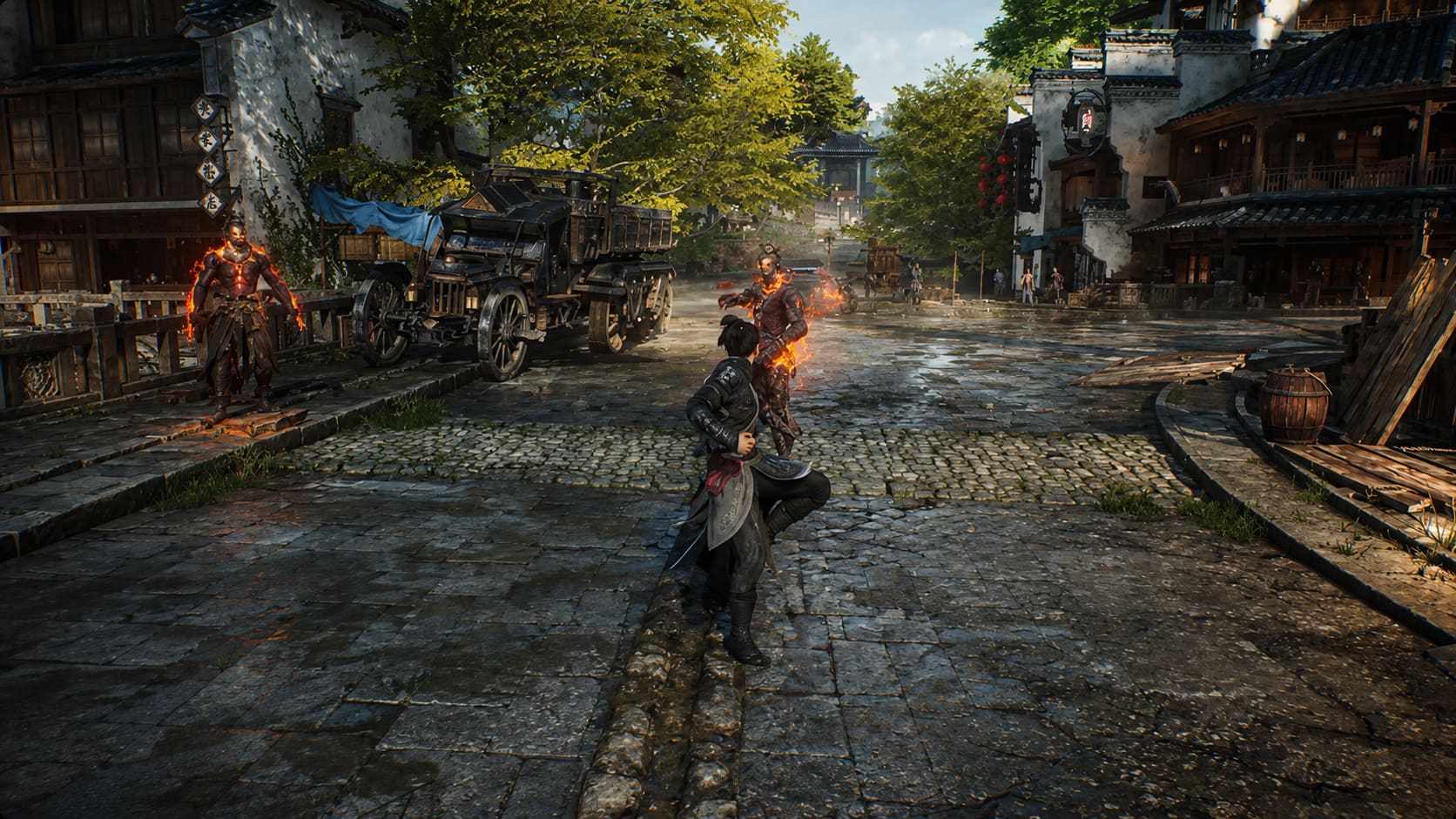
The game’s main setting is the capital of the Zhou Kingdom, a massive city inspired in part by the dense vertical architecture associated with places such as Chongqing. The result is an unusual mix of ancient Chinese visual design and aggressive industrial technology.
Imagine traditional buildings stacked across gigantic vertical districts while monorails, airships, steamboats, factories, and steam-powered vehicles move through the same environment.
That’s the kind of setting that immediately grabs me.
The city isn’t just there to look pretty in screenshots, either. Pathea is building a society divided sharply by wealth and political power. The elite live surrounded by advanced technology and comfort, while ordinary people work in polluted industrial areas under increasingly oppressive conditions.
That social structure should give the world much more personality than the usual open-world setup where every NPC exists purely to hand the player another quest.
A World Controlled by Gods
The story goes far beyond a simple revenge fantasy.
Players take control of Chen, a powerful Elemancer whose life is destroyed during a catastrophic event known as the God Fall. The Celestials, god-like beings who have ruled humanity for generations, are responsible for the disaster.
The basic idea behind the world’s mythology is surprisingly dark.
Humans naturally produce a form of life energy called Qi throughout their lives. When people die, that energy is transferred to the Celestials, allowing these divine rulers to maintain their immortality and power.
Eventually, humanity discovers that Qi can be controlled instead of simply being surrendered to the gods.
Those capable of manipulating this energy become known as Elemancers.
Naturally, the Celestials aren’t exactly thrilled about humanity discovering a way to challenge their monopoly over supernatural power.
The result is the God Fall, an event that devastates the Zhou Kingdom and leaves Chen with almost nothing. His response is pretty straightforward: if gods can destroy his world, he’s going to find a way to kill them.
That’s the kind of premise I can get behind.
The Elemental Combat Could Be the Real Star
The combat system is where The God Slayer starts looking genuinely dangerous for the competition.
Pathea is combining traditional martial arts with elemental abilities, giving Chen access to five major elements:
- Fire
- Water
- Earth
- Metal
- Wood
What interests me isn’t simply having five different magic types. It’s the way these elements are supposed to interact with the environment and with each other.
Fire can burn wooden objects and enemies, while water can extinguish flames. Water combined with heat can create steam that changes visibility and battlefield conditions. Players can also manipulate environmental states to create openings, freeze targets, or chain attacks together.
That gives combat the potential to become much more than memorizing which button activates which spell.
The best action RPGs make you think about positioning, timing, enemy behavior, and resource management simultaneously. If Pathea can make its elemental interactions feel as natural during a chaotic fight as they look in trailers, The God Slayer could have one of the more distinctive combat systems in the genre.
Martial Arts, Mobility, and Brutal Finishers
The character movement is another thing that immediately caught my attention.
Chen doesn’t simply stand in front of enemies and trade hits. Gameplay footage shows fast movement, acrobatic attacks, elemental techniques, and cinematic finishing moves that make combat feel much more aggressive than anything associated with Pathea’s previous games.
There are obvious comparisons to games such as Black Myth: Wukong, especially when looking at the general presentation and martial-arts-inspired combat. Some players have also compared the elemental manipulation to Avatar: The Last Airbender and The Legend of Korra.
I understand those comparisons, but The God Slayer has enough of its own ideas that I’m not convinced it should be dismissed as a combination of other games.
The real test will be whether the combat still feels satisfying after ten, twenty, or thirty hours. Looking cool in a nine-minute gameplay showcase is easy. Building a combat system that remains fun after hundreds of enemy encounters is considerably harder.
A Large World With More Than Fighting
Pathea isn’t positioning The God Slayer as a pure combat corridor.
The Zhou capital is designed as a huge interconnected environment where vertical exploration is a major part of the experience. Players should be able to move through different layers of the city while encountering factions, industrial zones, wealthy districts, transportation systems, and areas affected by the political struggle.
There is also a significant social component.
Chen will reportedly need to build relationships, trade favors, influence officials, and deal with powerful factions to navigate the city. That could create some much-needed variety between combat sequences.
I’m particularly curious about this part because it could determine whether the world feels genuinely alive or simply functions as a giant combat arena decorated with NPCs.
How Long Will The God Slayer Be?
Pathea has indicated that the core narrative is expected to provide approximately 40 hours of gameplay.
For an action RPG, that sounds like a reasonable target.
I’m personally much more interested in a focused 40-hour campaign with memorable locations, strong boss fights, and meaningful story missions than a 100-hour map filled with copy-pasted objectives.
If the optional exploration, side activities, faction interactions, and combat challenges add additional time naturally, that’s even better. The danger with modern open-world games is padding, and hopefully Pathea avoids the temptation to fill Zhou with dozens of repetitive errands simply to inflate the playtime counter.
What PC Players Should Expect
One area where PC gamers are already watching closely is performance.
The current Steam information indicates that the game is being built for 64-bit systems and Windows 11, with 16 GB of RAM listed as the minimum and 32 GB recommended. More specific CPU and GPU requirements can still change as development and optimization continue.
That’s important because The God Slayer is visually demanding. The huge city environments, dense geometry, effects-heavy combat, elemental interactions, and modern lighting systems could put serious pressure on mid-range hardware.
I wouldn’t start upgrading a PC specifically for this game yet. Until Pathea publishes final system requirements and the game gets closer to launch, there’s simply too much room for those numbers to change.
Why The God Slayer Has My Attention
There are plenty of upcoming action RPGs competing for attention, so The God Slayer needs something more than pretty graphics.
Fortunately, it has an identity.
The combination of Chinese-inspired mythology, steampunk technology, vertical city exploration, elemental martial arts, political factions, and an anti-god revenge story gives the project a personality that is immediately recognizable.
The biggest question is execution.
Pathea is moving from cozy simulation games into a genre where players expect extremely responsive combat, convincing animation, detailed environments, strong storytelling, and rock-solid performance. That’s a huge jump, and there is no guarantee that every system will land perfectly.
But that’s also what makes the project exciting.
The God Slayer Steam Release Date: Final Verdict
The God Slayer is currently targeting a late 2027 release, but there is no confirmed Steam launch date yet. PC players can expect the game on Steam and the Epic Games Store, alongside PlayStation 5 and Xbox Series X/S versions.
For me, the biggest selling point isn’t even the flashy combat. It’s the world. A gigantic industrial Chinese metropolis ruled by immortal gods, divided by class, filled with machines and supernatural energy, is an absurdly good setting for an action RPG.
If Pathea can make the elemental combat as flexible as the trailers suggest and keep the open world from becoming another checklist simulator, The God Slayer could become one of the more surprising action RPGs of 2027.
The wait is long, but this is one Steam wishlist I’m keeping an eye on.