Star Wars Zero Company Buy or Skip? Full Game Overview, Review & Verdict (2026)
There are plenty of Star Wars games I can play for a few hours and then forget about. Star Wars Zero Company isn’t one of them.
After spending serious time with Bit Reactor’s turn-based strategy game, I came away with a pretty simple opinion: this is one of the most interesting Star Wars games in years, but it isn’t nearly as friendly as the trailers might suggest. It wants you to think fast, accept ugly losses, and take risks instead of hiding behind cover for half an hour.
That won’t work for everyone.
Developed by Bit Reactor with Respawn Entertainment and Lucasfilm Games, Star Wars Zero Company takes the franchise into turn-based tactical territory with a completely original campaign set during the final period of the Clone Wars. It launched on August 27, 2026, for PC, PlayStation 5, and Xbox Series X/S, with pricing at $49.99 on PC and $59.99 on consoles.
And yes, the XCOM comparisons are unavoidable.
But after playing it, I don’t think calling this “Star Wars XCOM” does the game any favors. Zero Company has its own personality, especially when it comes to combat pacing, squad relationships, and the way its campaign forces you to make uncomfortable decisions.
A Different Kind of Star Wars Story
The first thing I appreciate about Zero Company is what it doesn’t do.
There is no Jedi protagonist carrying the entire story. No lightsaber is constantly shoved into the foreground to remind you that you’re playing Star Wars. Instead, the game follows Hawks, a former Galactic Republic officer who ends up leading an unconventional squad made up of mercenaries, bounty hunters, outcasts, aliens, and droids.
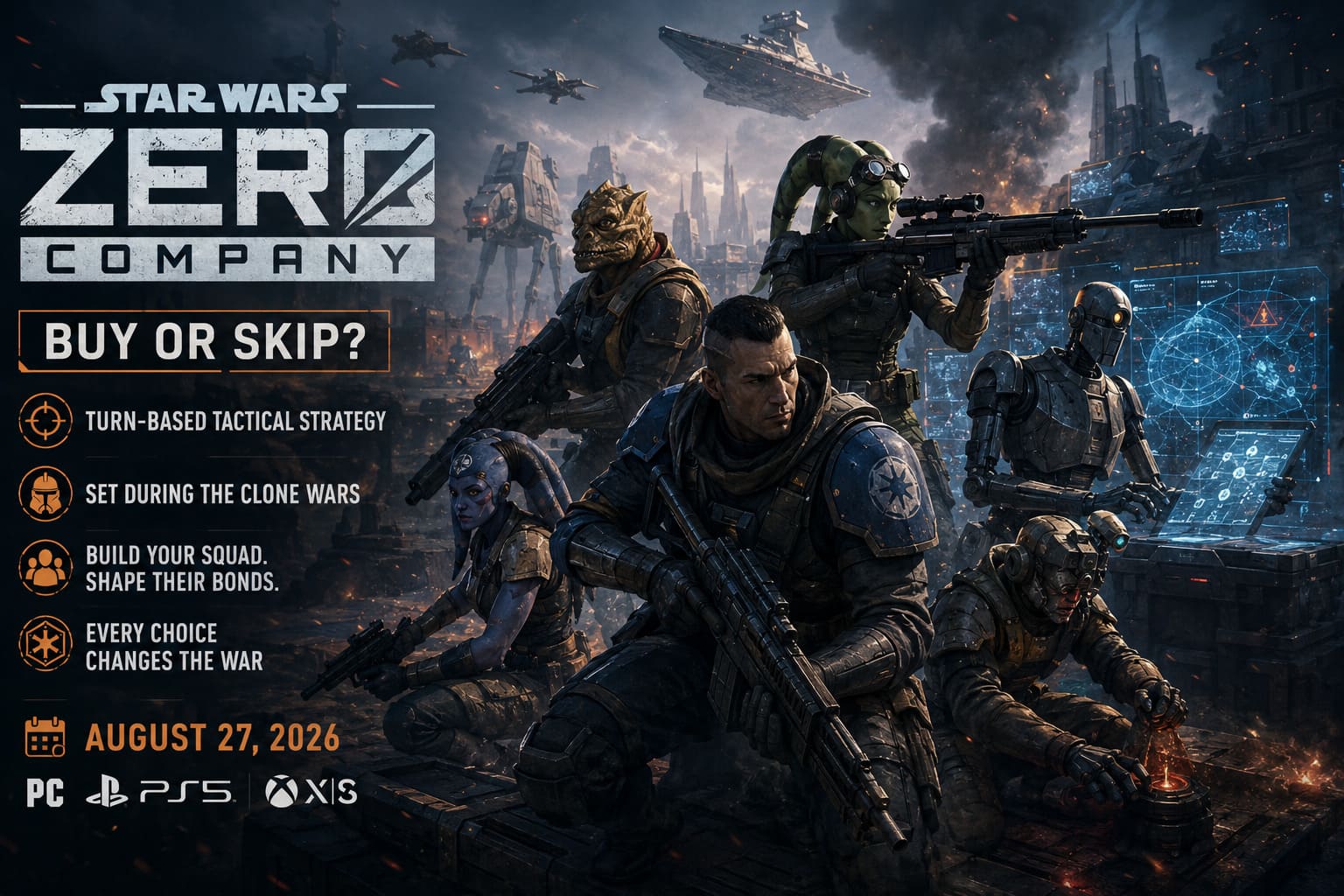
That’s a much better fit for a tactical game.
The Clone Wars have always been full of stories happening away from the main Jedi narrative, and Zero Company finally takes advantage of that space. The campaign feels dirtier and more grounded. These aren’t unstoppable heroes. They’re people trying to survive a war that has already gone far beyond their control.
The major threat is the Infinite Coil, a mysterious faction connected to the terrifying shadow plague. The infection gives affected enemies unpredictable abilities, which also gives the campaign a useful excuse to throw strange tactical problems at the player.
I particularly like the tone here. It feels closer to the darker side of modern Star Wars than the colorful battlefield spectacle of the movies. There is a western flavor to the writing, with characters who don’t necessarily trust each other and alliances that can fall apart when things get ugly.
Combat Is Faster, Meaner, and Less Forgiving Than You Expect
If you’ve played XCOM, Gears Tactics, or Warhammer 40,000: Chaos Gate, you’ll understand the basic language immediately.
Move. Take cover. Flank. Attack. Manage resources. Try not to get your favorite character killed.
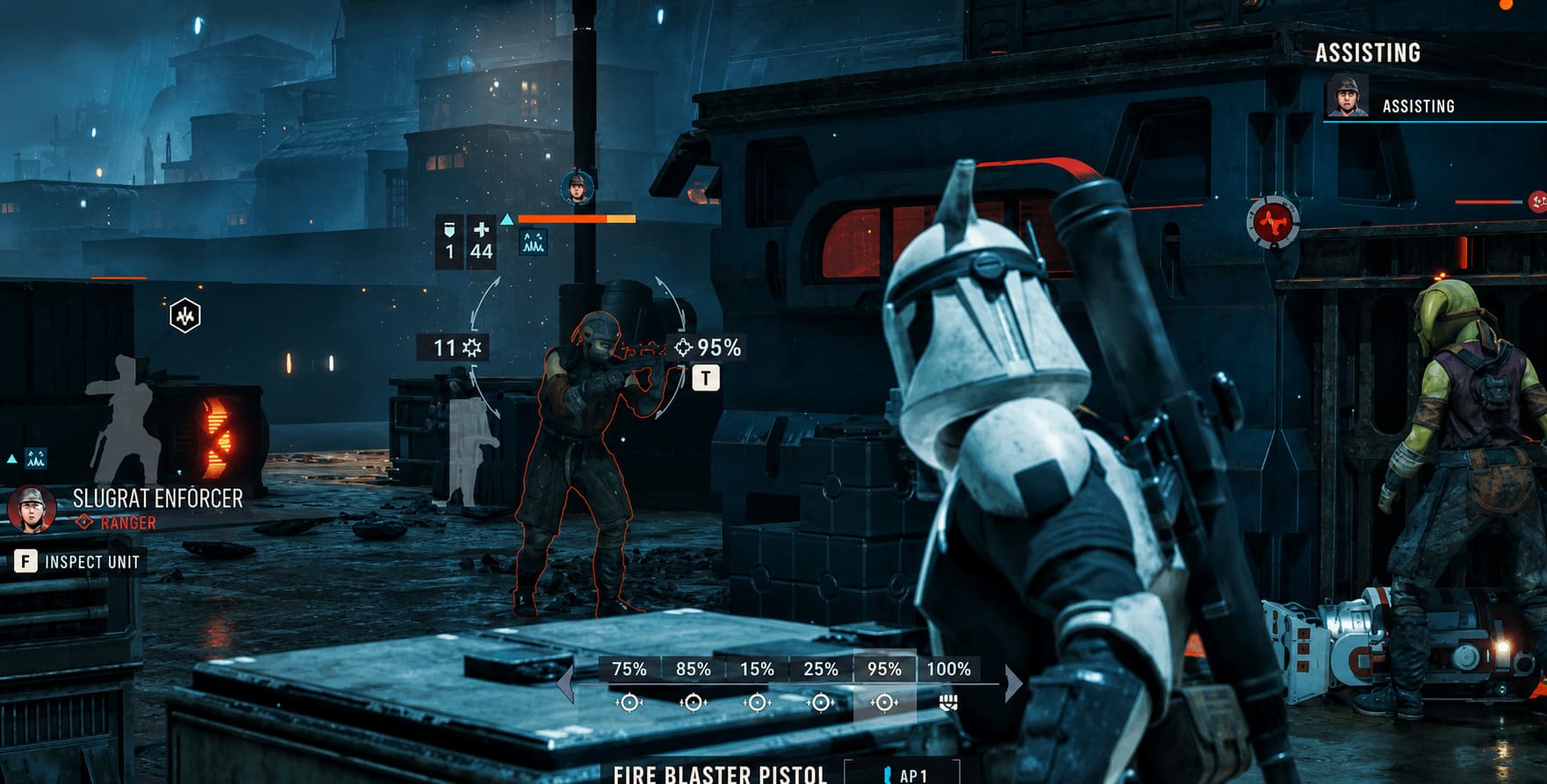
The big difference is the three-Action-Point system.
Every operative gets three AP during their turn, and that extra point changes the rhythm of combat considerably. A normal move might cost one point, while a longer sprint can eat two. Weapons, abilities, equipment, and tactical skills compete for those same resources.
That sounds like a small adjustment on paper.
It isn’t.
Three AP gives you more freedom to improvise, but the game expects you to use that freedom aggressively. Some abilities and tactical bonuses can even refund AP when you pull off specific kills or combinations. When everything lines up, you can suddenly turn one successful flank into an entire chain of actions.
Those are the moments where Zero Company really clicks.
Stop Playing Like a Turtle
I learned this lesson the hard way.
My first instinct was to play defensively. Find cover, establish firing positions, use Overwatch, and slowly grind the enemy down.
Zero Company basically told me to stop being a coward.
Its maps are generally compact, with encounters designed around movement and close-range pressure. Destructible cover makes static defensive positions unreliable. A barrier that looked perfectly safe one turn can disappear under concentrated blaster fire, leaving an operative completely exposed.
That creates a combat loop where positioning matters more than simply finding the biggest piece of cover.
And the damage model makes mistakes hurt.
Characters aren’t bullet sponges. Leaving someone exposed can result in devastating damage, sometimes enough to completely derail a mission. High percentage shots aren’t guaranteed either, which means the classic tactical-game nightmare remains alive and well.
You can have a 90% chance to hit.
You can miss.
And suddenly you’re staring at the screen wondering why you ever trusted mathematics.
The Den Gives the Campaign Some Real Strategic Weight
Combat missions are only half the experience.
Between operations, you return to The Den, which acts as your central headquarters. This is where you manage your squad, resources, progression, recruitment, and the broader campaign.
The strategic layer is where I think Zero Company separates itself from a simple mission-to-mission tactical game.
The galaxy map presents multiple opportunities, but you can’t comfortably collect everything. Missions have different timers, rewards, and strategic consequences. Choosing one operation means potentially allowing another to disappear.
That pressure is important.
You’re not simply asking, “Which mission gives me the best loot?”
You’re asking, “What can I afford to ignore?”
That distinction makes the campaign feel much more alive.
| Feature | What It Adds |
|---|---|
| Dynamic Mission Map | Forces meaningful choices between competing objectives |
| The Den | Central hub for squad and campaign management |
| Randomized Operations | Adds variation between playthroughs |
| Squad Bonds | Creates stronger tactical and narrative relationships |
| Character Progression | Lets operatives specialize into distinct combat roles |
Squad Bonds Are More Than a Friendship Meter
One of my favorite systems is the relationship mechanic between squad members.
Operatives who repeatedly fight together can develop Bonds, unlocking shared abilities and passive bonuses. These relationships aren’t just cosmetic. They can directly affect combat through coordinated actions, defensive responses, and tactical buffs.
But the system has a nasty little twist.
If one member of a bonded pair dies or suffers a serious injury, the surviving partner can be affected by the loss.
That’s exactly the kind of mechanic I want from a tactical RPG.
It makes characters feel less disposable.
And that can be a problem when the game decides to kill one.
I’ve played plenty of strategy games where losing a soldier means opening the recruitment menu and hiring another one. Zero Company does a better job of making losses feel personal. When you’ve customized an operative, developed their personality, watched them build a relationship with another squad member, and then watched that entire dynamic collapse because of one disastrous mission, the campaign suddenly feels much more personal.
Character Creation Is Surprisingly Deep
For a game built around tactical combat, Zero Company gives you a lot of control over your squad.
You can customize members of your team with different Star Wars species and visual characteristics, including:
- Humans
- Twi’leks
- Togruta
- Weequay
- Tactical and military droids
Facial details, armor, body proportions, scars, and other cosmetic elements help make your operatives feel like your own creations rather than generic units.
Then there are personality options.
Different behavioral profiles and voice choices can influence how characters interact during missions and story scenes. The result isn’t quite a full-blown RPG character system, but it goes well beyond choosing a helmet color and calling it customization.
Classes also provide a meaningful progression path.
You can build specialists around long-range damage, stealth, close-quarters combat, explosives, support abilities, and other tactical roles. The important part is that these choices affect how you actually approach missions.
That’s what good progression should do.
The Presentation Is Easily One of Its Biggest Strengths
From a visual perspective, Zero Company looks fantastic.
The environments have a strong cinematic quality, while blaster impacts, smoke, explosions, and destructible objects make combat feel much more physical than many traditional turn-based games.
The camera work also deserves credit. Combat transitions and cinematic moments give important attacks more impact without completely turning the game into an action title.
The sound design is equally strong. The orchestral score carries the unmistakable Star Wars atmosphere, while weapon effects and battlefield audio give the encounters enough punch to keep them from feeling like miniature board-game battles.
This is a big-budget tactical game, and it looks like one.
PC Performance Is the One Area I Wouldn’t Ignore
Here’s where my enthusiasm becomes more cautious.
On modern gaming PCs, Zero Company can look excellent. On older or mid-range hardware, however, the performance requirements become much harder to swallow.
Large effects, destruction, lighting, and busy combat scenes can push hardware surprisingly hard. Frame-rate drops aren’t necessarily constant, but demanding encounters can expose the game’s optimization problems.
Console players have a somewhat easier time. PlayStation 5 and Xbox Series X target around 60 FPS with dynamic resolution, although particularly chaotic scenes can still cause occasional drops. PS5 Pro support also offers improved image quality and more advanced visual effects.
Steam Deck? I’d Wait.
This is probably my biggest hardware warning.
If your main gaming machine is a Steam Deck, I would not buy Zero Company specifically for handheld play right now.
The game’s demanding rendering workload can result in roughly 20–25 FPS in its current state, and the tactical interface doesn’t always translate comfortably to a small display. Reading menus and battlefield information is a much bigger deal in a strategy game than it is in a simple action title.
For me, stable readability matters almost as much as frame rate in this genre.
A tactical game that runs poorly is frustrating.
A tactical game where you can’t comfortably read the UI is worse.
The Good and the Bad
What I Love
- Excellent Clone Wars setting that focuses on characters outside the usual Jedi spotlight.
- Three-AP combat system encourages creative and aggressive tactics.
- Strong squad customization gives your operatives genuine personality.
- Bond mechanics make relationships matter during actual gameplay.
- Dynamic campaign structure gives you difficult strategic choices.
- Fantastic presentation with strong visuals, audio, and cinematic direction.
What Holds It Back
- Combat can be brutally unforgiving, especially when bad RNG compounds an otherwise solid tactical plan.
- PC optimization needs work on weaker and older hardware.
- Steam Deck performance is difficult to recommend at launch.
- Some missions can suffer from pathfinding problems, UI glitches, or occasional technical issues.
- The long-term replay value doesn’t quite reach the absurd modding potential of something like XCOM 2.
So, Should You Buy Star Wars Zero Company?
For me, the answer is yes — with one important condition.
You need to actually like tactical strategy games.
If you enjoy XCOM, Gears Tactics, or similar turn-based systems, Zero Company is an easy recommendation. The Star Wars setting isn’t simply wallpaper slapped onto a familiar combat system. The developers have built a campaign around the universe’s less explored corners, and that gives the story a refreshing identity.
The combat is aggressive. The campaign constantly asks you to make choices. Your squad members can become characters you genuinely care about.
And then the game can punish you for caring about them.
That’s good strategy design.
If you’re coming from traditional action-focused Star Wars games and expect something relaxed, though, I’d be more careful. Zero Company isn’t a casual Star Wars adventure. It can be cruel, especially when your tactical plan collapses because of one unlucky shot or one bad positioning decision.
I’d also wait for a sale if you’re playing on weaker PC hardware. Performance patches could change that recommendation over time, and there’s little reason to suffer through poor frame rates when the game is fundamentally about precise decision-making.
Resonance A Plague Tale Legacy Combat Guide: How to Parry and Defect Perfect Counter Mechanics
Final Verdict
Star Wars Zero Company is one of my favorite surprises of 2026. It doesn’t reinvent turn-based tactics, and I don’t think it needs to. Instead, it takes familiar ideas, pushes the pace, wraps them in an unusually grounded Star Wars story, and gives the player enough squad customization to create memorable disasters of their own.
That’s the part I’ll remember.
Not the graphics. Not the explosions.
The squad member who survived three missions with one health bar, became best friends with my sniper, and then died because I thought a 90% shot was “basically guaranteed.”
That’s Star Wars Zero Company at its best.
Buy it if: you love tactical RPGs, XCOM-style combat, squad management, and Star Wars lore.
Wait if: you’re on weaker PC hardware, want Steam Deck support, or hate punishing RNG.
My verdict: Buy — 8.7/10.
It isn’t flawless. But when Zero Company gets everything working at once, it delivers exactly what I want from a modern Star Wars strategy game: tense battles, memorable characters, meaningful decisions, and just enough cruelty to make every victory feel earned.