Silent Dunes Meta Guide — Stealth Trampler Build in SAND: Raiders of Sophie for Solo Extraction Survival
The deserts of Sophie don’t feel like a battlefield at first glance. They look almost peaceful in that ruined-post-empire kind of way, like someone drained the ocean and left behind a graveyard of steel and sand. But anyone who’s actually spent time in SAND: Raiders of Sophie knows better. This is not a place for sightseeing. It’s a place where hesitation gets you scanned, tracked, and erased by squads that were already waiting for you before you loaded in.
What makes things worse—or better, depending on your appetite for chaos—is the Trampler. Your walking fortress is everything: transport, weapon platform, loot vault, and sometimes your coffin. After dozens of hours in the current meta, one truth keeps repeating itself in the dunes: loud builds die young. The real survivors are not the biggest guns, but the quietest machines.
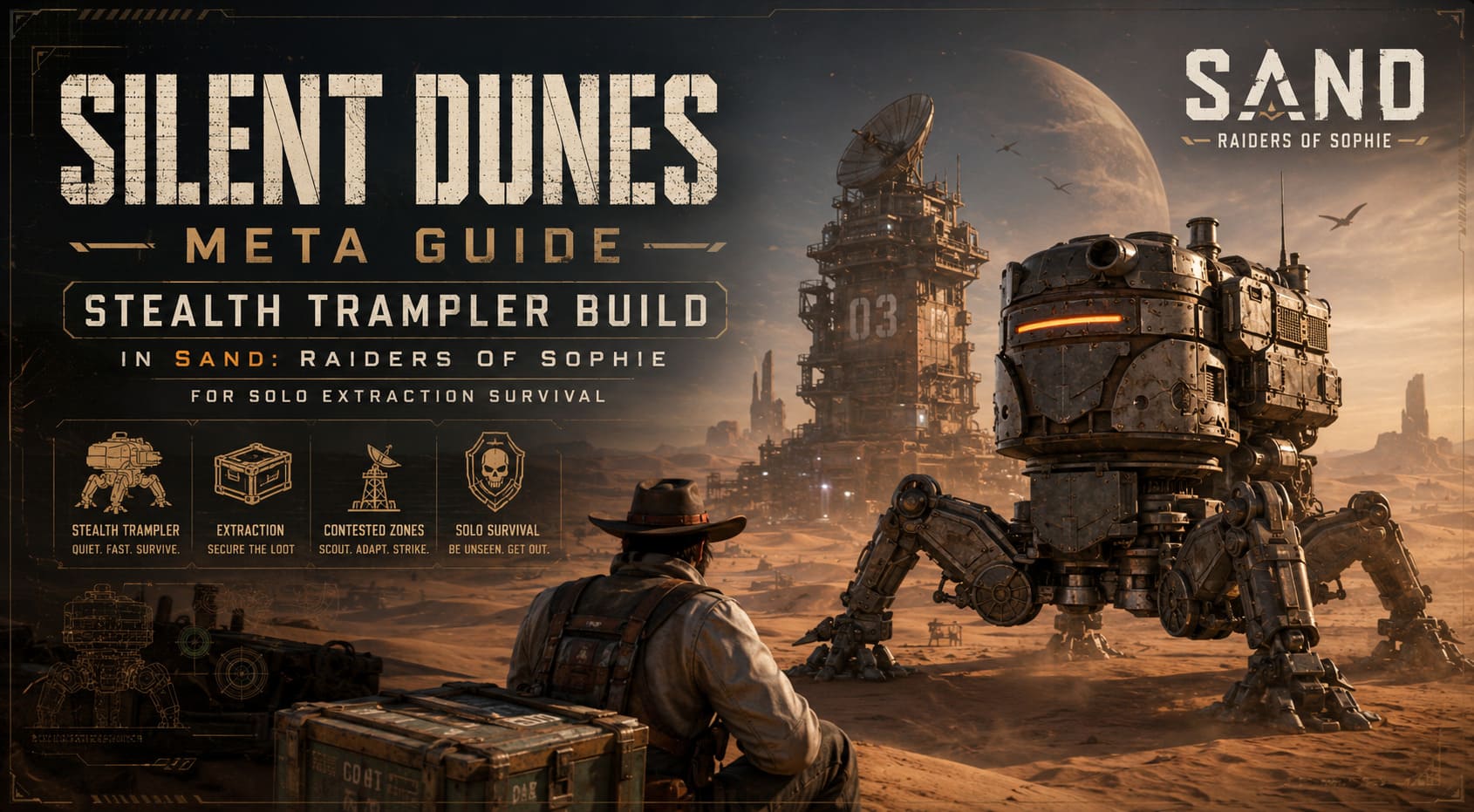
That’s where the Stealth Trampler concept stops being a niche experiment and becomes a proper extraction philosophy. This isn’t about running away. It’s about never being seen in the first place, slipping through the desert like a rumor with legs.
Iron Dreadnought Meta Guide: Heavy Fortress Trampler Build in SAND Raiders of Sophie
The Philosophy Behind a Stealth Trampler Build
Most players early on fall into the same trap: bigger armor, heavier cannons, more everything. It feels safe, almost logical. Until you realize weight is a spotlight. Every extra plate increases engine strain, every heavy module leaves a longer dust signature, and every unnecessary turret silhouette turns your mech into a moving landmark visible from half the map.
A stealth-focused Trampler flips that mindset entirely. Instead of asking “How much damage can I take?”, you start asking “How little attention can I generate while still surviving a worst-case ambush?”
The core pillars are simple but brutally effective:
- Low thermal and acoustic profile through efficient engine selection
- Internalized survival systems to prevent cascade destruction
- Compact vertical design to avoid becoming a skyline target
- Controlled visibility combat zones instead of open engagement doctrine
The end goal isn’t invincibility. It’s irrelevance. In Sophie, being ignored is often stronger than being feared.
Essential Modules That Define the Stealth Meta
Before even thinking about layout efficiency, you need the right components. A stealth Trampler is only as quiet as its weakest system, and one poorly placed module can turn your silent runner into a clanking beacon.
Compact Reactor & Shielded Engine Core
This is your heartbeat. You don’t want maximum output—you want stability under pressure. A lower-tier high-efficiency engine actually performs better for stealth because it reduces heat spikes and audible strain. The trick is shielding it indirectly, not stacking armor directly on it but using structural buffers like cargo frames.
Deep-Core Cargo Containment
Loot is why you’re out here, and losing it because someone clipped your outer hull is unacceptable. Cargo modules must sit behind at least one physical barrier layer. Think of it as emotional damage control: if they breach the outer shell, your real valuables still sleep safely inside.
Hidden Crew Survival Compartment
This is where most builds fail catastrophically. Exposed respawn systems are basically an invitation for boarding teams. If your crew quarters go down, your entire run collapses. Keep them centralized, buried, and surrounded by non-explosive buffer modules.
Low-Signature Corner Weapon Mounts
Forget giant center turrets screaming “shoot me first.” Stealth builds rely on distributed firepower. Corner-mounted guns give enough defensive control without turning your silhouette into a walking fortress advertisement.

Three-Level Stealth Trampler Blueprint
Lower Level — Core Stability and Engine Discipline
Your pilot control seat should sit forward with clean visibility, nothing obstructing sightlines. Behind it, movement corridors must stay tight and efficient, avoiding unnecessary open space that only adds vulnerability.
The engine and reactor sit toward the rear, wrapped in structural frames and cargo buffers rather than pure armor stacking. If someone is already hitting your core systems directly, the design has already failed, so the goal is to delay that scenario as long as possible through layered obstruction.
Middle Level — Survival Core and Logistics Layer
This is your nervous system and most important safety layer. Crew survival systems must be centralized and protected by surrounding non-critical modules that absorb damage first.
Storage, ammo, and repair supplies are distributed here to reduce risky external movement. Every second spent outside your internal structure during combat is a second closer to losing the run.
Minimizing external doors is essential. Every additional entry point is a predictable breach path for organized squads, and Sophie players absolutely exploit predictable architecture.
Upper Level — Silence, Scouting, and Controlled Violence
The top deck should remain intentionally restrained in design. Overbuilding here turns your Trampler into a visual beacon visible across dunes, which is exactly what stealth builds are designed to avoid.
Corner-mounted cannons provide flexible response angles without creating a towering silhouette. A compact scouting platform sits centrally, acting as your extraction awareness hub when approaching contested towers.
Operational Habits That Matter More Than Modules
A perfect build still fails in careless hands. Stealth success depends heavily on behavioral discipline during traversal and extraction phases.
Night movement should always minimize visibility tools like external lighting. In addition, the park-and-scout approach is critical: instead of driving into danger zones, you position your Trampler behind terrain and proceed on foot for reconnaissance.
Movement rhythm also matters. Constant speed creates predictable tracking patterns, while varied pacing disrupts long-range enemy estimation and reduces the chance of interception.
Why the Stealth Meta Is Winning Right Now
The current ecosystem in SAND: Raiders of Sophie has evolved quickly. Early chaotic engagements have given way to coordinated squad hunting and improved zone control tactics. In this environment, loud mechs become liabilities rather than power symbols.
Stealth builds thrive because they refuse to participate in direct confrontation unless absolutely necessary. They convert combat into an optional scenario rather than a forced outcome. That shift in control is what defines high-level extraction gameplay right now.
Conclusion
The Stealth Trampler is not about avoiding gameplay—it is about redefining it. Instead of dominating through force, you dominate through absence, precision, and timing. In the dunes of Sophie, survival belongs to those who understand when silence is stronger than firepower.
Master the structure, respect the terrain, and let other players announce themselves while you quietly leave with everything worth taking.