Master the Skies: Ultimate Cobra Strike Inertia Flight Controls Guide
Cobra Strike is not the kind of helicopter combat game where you simply push forward, lock targets, and expect the aircraft to magically follow your commands. After spending countless hours flying missions, crashing into mountains, missing missile launches, and slowly learning the hidden rhythm of the flight system, one thing becomes obvious: this game rewards pilots who understand physics.
The biggest difference between a beginner and an experienced Cobra Strike pilot is the ability to control inertia. Your helicopter has weight, momentum, and delayed reactions. Every movement creates a chain reaction, and every mistake can send your expensive attack machine straight into enemy fire or the nearest piece of terrain.
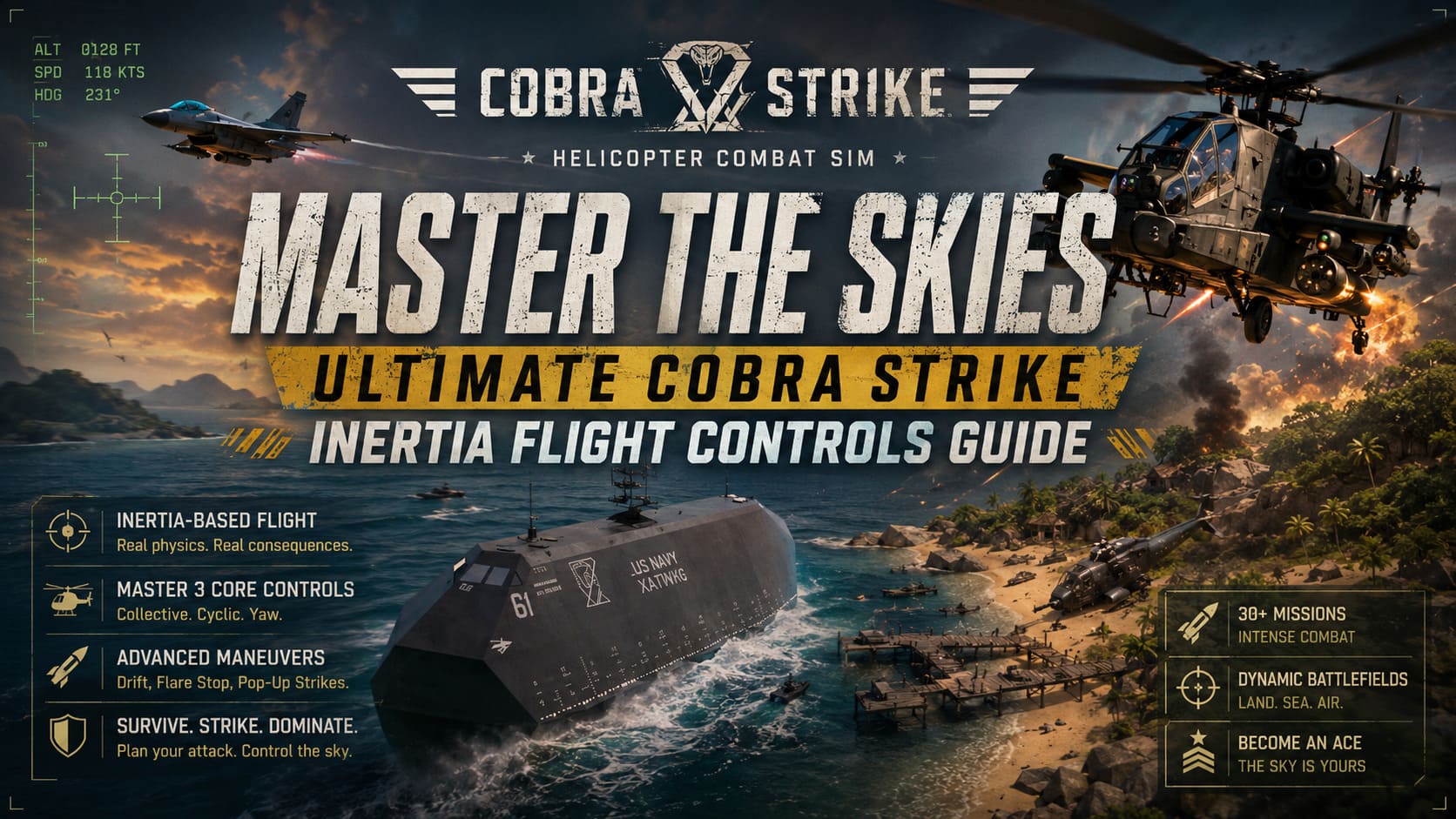
The retro-inspired design gives Cobra Strike a unique identity. It captures the feeling of classic helicopter strike games while adding a surprisingly deep physics-based flight model. You are not just controlling a helicopter; you are managing speed, momentum, positioning, and battlefield awareness at the same time.
Cobra Strike Steam Deck Compatibility: Can You Play It Handheld?
Understanding Cobra Strike’s Inertia Flight System
Many players enter Cobra Strike expecting traditional arcade controls. They push the stick forward, release it, and expect the helicopter to instantly stabilize. That approach usually ends with a crash.
The helicopter in Cobra Strike behaves like a heavy combat machine. When you accelerate, your aircraft builds momentum. When you turn, the helicopter carries its movement through the air. When you attempt to stop, you must actively fight against the energy you created.
This makes every flight decision important. You are not only choosing where to move; you are predicting where your helicopter will be several seconds later.
A skilled pilot constantly manages:
- Current speed — understanding how much forward momentum your helicopter currently has.
- Rotor power — controlling how quickly you gain or lose altitude.
- Positioning — predicting where your movement will carry you during combat.
- Enemy threats — preparing escape routes before attacking.
At first, inertia feels like a limitation. After mastering it, you realize it becomes one of your strongest weapons because it allows advanced movement techniques impossible with simple arcade controls.
The Three Core Flight Controls Every Cobra Strike Pilot Must Master
To become a reliable helicopter ace, you need complete control over three major systems: the collective, cyclic, and yaw controls. These mechanics work together, and understanding their relationship is the foundation of advanced combat flying.
| Control System | Main Function | Combat Usage |
|---|---|---|
| Collective | Controls vertical lift and altitude | Quick climbs, missile avoidance, terrain attacks |
| Cyclic | Controls pitch and roll movement | Turning, drifting, momentum control |
| Yaw Controls | Controls helicopter rotation | Aiming weapons while maintaining movement |
Collective: Controlling Vertical Momentum
The collective controls how much lift your helicopter produces. Increasing it gives you altitude, while lowering it reduces lift and allows you to descend.
The important detail is that Cobra Strike does not make these changes instantly. The helicopter has weight, and that weight creates a delay between your input and the aircraft response.
Experienced pilots use this delay to their advantage. Dropping collective at the right moment can help you avoid incoming missiles or disappear behind terrain. Increasing collective can create powerful surprise attacks where you suddenly rise above cover, fire, and immediately retreat.

Cyclic: The Heart of Momentum Control
The cyclic is where most new players struggle because it directly affects the helicopter’s movement direction. Pushing forward creates speed, but releasing the input does not remove that momentum.
If you want to slow down, you must counter your own movement. Pulling back redirects the helicopter’s energy instead of instantly stopping it.
The best pilots do not fight the aircraft. They learn its behavior and make small corrections before problems appear.
Yaw Control: Separating Movement From Aim
One of Cobra Strike’s most satisfying mechanics is the ability to separate your movement direction from your aiming direction.
Your helicopter can continue sliding forward while rotating toward enemies. This allows you to attack targets while maintaining speed and avoiding becoming an easy target for anti-air defenses.
This technique turns your helicopter from a simple flying vehicle into a highly mobile weapons platform.
Advanced Cobra Strike Helicopter Maneuvers
1. Inertial Drift Attack
The inertial drift is one of the most important combat techniques in Cobra Strike. It allows you to maintain movement while keeping your weapons aimed at ground targets.
Begin by approaching the target area with speed. Slightly roll your helicopter away from your flight path while using yaw controls to rotate your nose toward the enemy.
The result is a controlled sideways slide where your helicopter continues moving while your weapons remain focused on the target.
This technique works extremely well against:
- Armored vehicle groups
- Enemy convoys
- Static defense positions
- Anti-air installations
The first attempts may feel chaotic. Your helicopter might drift too far or your aim may become unstable. After enough practice, however, the inertial drift becomes one of the most powerful tools available to experienced pilots.
2. Power Flare Emergency Brake
Every Cobra Strike player eventually creates the same problem: approaching a target area too quickly with no time to turn.
The power flare stop is your emergency solution. Pull the cyclic backward aggressively while increasing collective power. The helicopter raises its nose and uses the rotor system as an aerodynamic brake.
This technique removes forward momentum rapidly and can save you from hitting buildings, mountains, or enemy positions.
The timing is everything. Pull too aggressively and you may lose control. Recover too slowly and your helicopter can begin drifting backward into danger.
3. Low Altitude Pop-Up Missile Strike
Smart Cobra Strike pilots rarely attack heavily defended targets by flying directly toward them. Enemy radar and missile systems are designed to punish predictable movement.
The better approach is using terrain as protection.
Hide behind hills, buildings, or natural cover. Build vertical lift with the collective, rise above the obstacle, lock your target, launch your missiles, and immediately drop back into safety.
The entire attack should happen quickly. Enemy defenses should only have a few seconds to react before you disappear.
Best Controller Settings for Cobra Strike Flight Controls
While Cobra Strike can be played with keyboard and mouse, analog controls provide a much smoother experience. The inertia system depends heavily on small adjustments, and a gamepad or HOTAS setup gives you better control over those movements.
| Setting | Recommended Option |
|---|---|
| Stick Deadzone | 5-10% |
| Sensitivity | Linear or Slight Exponential |
| Collective Control | Analog Axis |
| Aiming Controls | Separate From Flight Movement |
A small deadzone prevents unwanted movement while keeping your controls responsive. A slightly exponential sensitivity curve is often preferred because it allows precise adjustments around the center while still providing aggressive movement when needed.
Common Beginner Mistakes in Cobra Strike
Even experienced gamers from other flight games can struggle when they first enter Cobra Strike. The physics system demands patience and practice.
- Overcorrecting movement: Large sudden inputs often create bigger problems instead of solving them.
- Ignoring momentum: Your helicopter keeps moving even after you stop giving input.
- Flying too aggressively at low altitude: Low-level flight is powerful but leaves little room for mistakes.
- Attacking without an escape plan: Every strike should include a safe exit route.
The best pilots are not always the fastest pilots. They are the ones who understand exactly what their helicopter will do before it happens.
Final Tips From a Veteran Cobra Strike Pilot
Mastering Cobra Strike’s inertia flight system requires time, patience, and plenty of failed attempts. The first few hours may feel frustrating because the helicopter seems unpredictable.
The breakthrough happens when you stop trying to control the helicopter like an arcade machine and start treating it like a real combat aircraft.
Watch your speed. Feel your momentum. Make smaller corrections. Think ahead.
Once the controls finally click, Cobra Strike becomes an entirely different experience. The helicopter stops feeling like a difficult machine and starts feeling like an extension of your instincts.
Sliding past enemy defenses, rotating your gunship sideways, firing rockets while maintaining movement, and escaping before missiles arrive creates some of the most satisfying moments in the game.
Cobra Strike rewards pilots who respect its physics. Learn the inertia, control your momentum, and the battlefield becomes your sky.