Last Pirates: Die Together Gameplay Guide and PC System Requirements (2026)
There are plenty of co-op horror games that understand the basic formula: throw four players into a horrible place, give them a simple job, add monsters, and wait for somebody to panic.
Last Pirates: Die Together takes that formula and basically throws it overboard.
RetroStyle Games’ upcoming multiplayer extraction horror game is built around treasure hunting, cursed islands, ridiculous physics, and pirates whose arms look like they were designed by somebody who had absolutely no interest in human anatomy. The result is a game that seems less interested in making you feel like a hardened pirate and much more interested in making you watch your best friend accidentally launch himself into a wall while carrying half the team’s loot.
The game is scheduled to enter Steam Early Access on August 18, 2026, and its pitch is refreshingly simple. Get onto an island. Grab valuable stuff. Stay alive. Get back to the ship. Repeat.
Sounds easy.
It isn’t.
The real challenge comes from the combination of hostile creatures, environmental traps, limited time, physical objects, and the game’s deliberately ridiculous movement system. When four players are trying to escape with a mountain of treasure while their elastic arms are colliding with everything in sight, even the simplest objective can turn into a complete disaster.
What Is Last Pirates: Die Together?
At its core, Last Pirates: Die Together is a four-player online co-op extraction horror game with a heavy dose of physics-driven comedy.
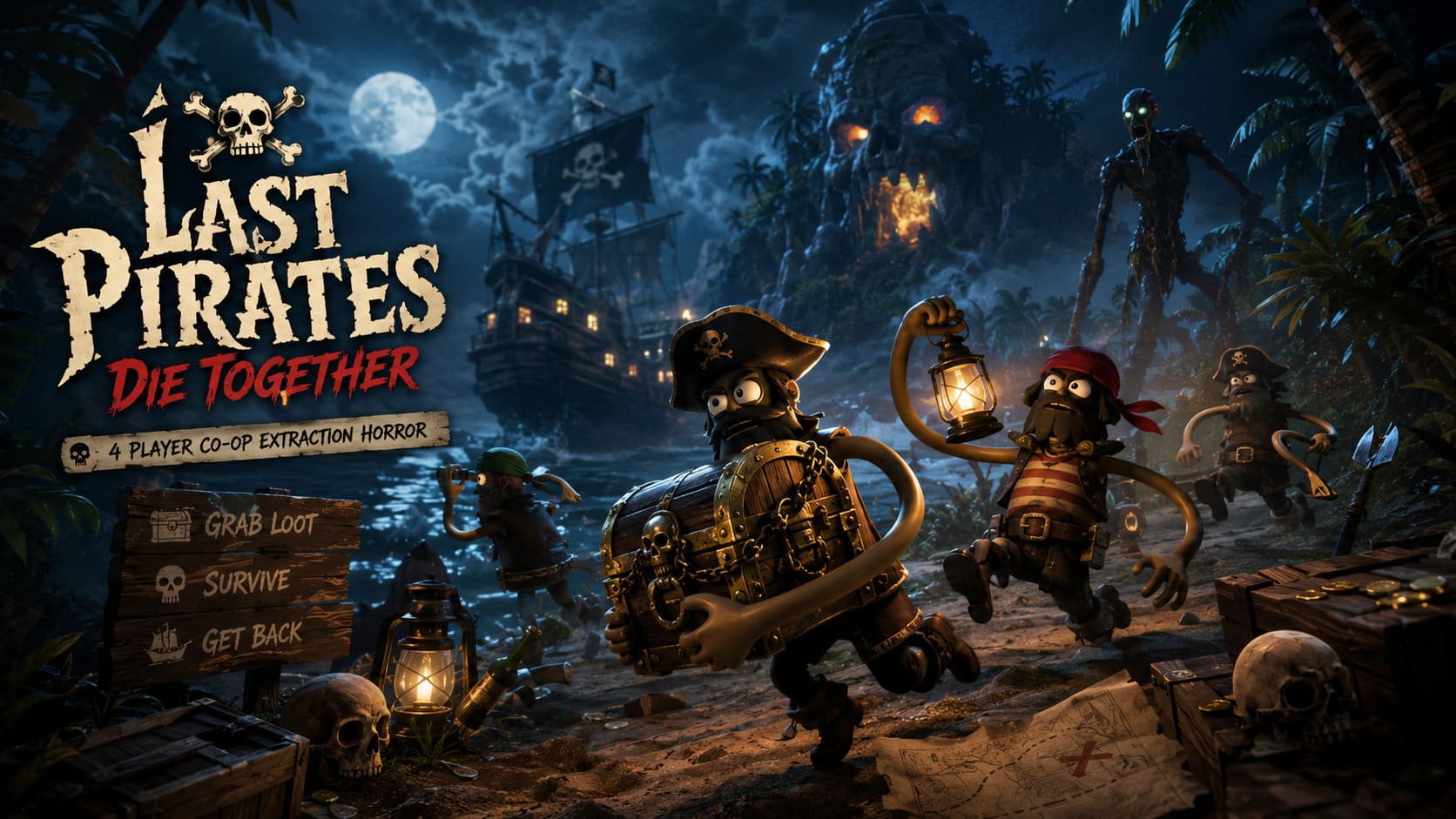
The structure will feel familiar if you’ve spent time with games such as Lethal Company or R.E.P.O.. You enter a dangerous area, search for valuable loot, deal with increasingly nasty threats, and try to return safely before your run falls apart.
The difference is the setting and the physical comedy.
Instead of abandoned industrial facilities or conventional horror environments, you’re dealing with cursed tropical islands populated by supernatural threats and strange creatures. Your crew consists of pirates sent out by a demanding captain who cares considerably more about the treasure quota than your survival prospects.
That immediately creates the right kind of pressure.
You aren’t exploring simply because the map looks cool. You’re exploring because there is something worth bringing home.
And the longer you stay, the greedier you become.
That’s where things usually go wrong.
The Basic Gameplay Loop: Loot Fast, Don’t Get Greedy
The main gameplay loop is deliberately compact.
A typical run is expected to last roughly 10 to 30 minutes, which is a smart choice for this type of co-op game. There’s very little downtime. You don’t need to commit your entire evening to a single expedition, and a disastrous run doesn’t feel like you’ve just wasted an hour of your life.
The objective is straightforward:
- Enter the island with your crew.
- Search for treasure and valuable resources.
- Deal with monsters, traps, and environmental hazards.
- Carry your loot back to the ship.
- Meet the captain’s demands.
- Spend your earnings on future upgrades and equipment.
The interesting part is everything that happens between those bullet points.
One player might find a valuable chest while another spots a monster nearby. Someone else is already overloaded with treasure. Then the fourth teammate falls into a hole.
Suddenly, the carefully planned extraction becomes a rescue mission.
That’s exactly where Last Pirates: Die Together should shine.
The game isn’t trying to reinvent extraction gameplay through complicated inventory spreadsheets or hardcore survival systems. Its appeal comes from making the simple act of collecting treasure unpredictable.
And if you’ve played enough co-op games, you already know that unpredictable physics plus three friends is basically a recipe for disaster.
The Elastic Arms Are the Real Star
The strangest feature in Last Pirates: Die Together is also the one that gives the game its identity.
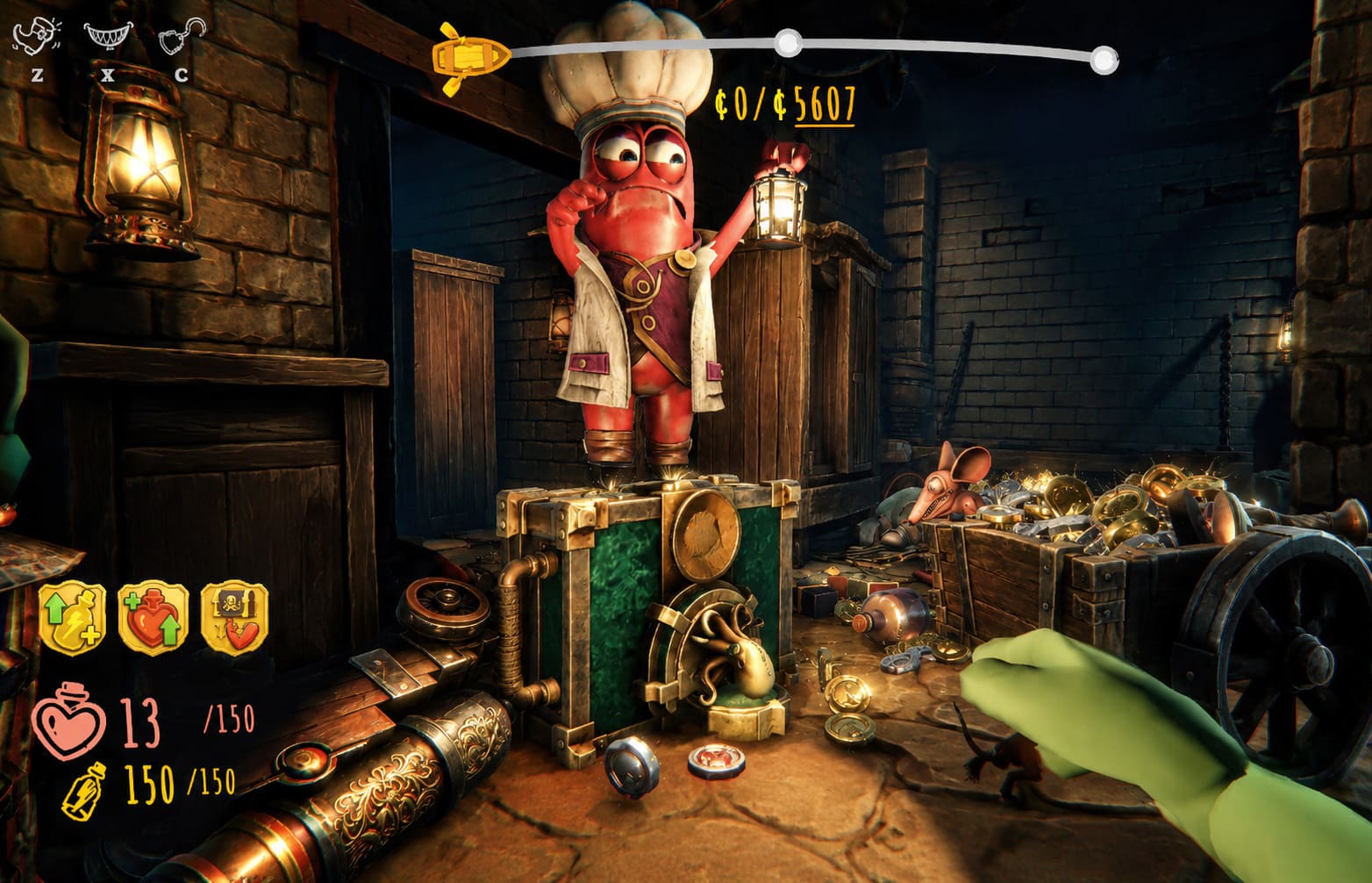
Every pirate has extremely long, elastic arms that behave according to the game’s physics system. They’re not just a visual joke. They are a major part of how you interact with the environment.
You can use those ridiculous limbs to grab objects from a distance, manipulate environmental objects, break things, move furniture, and reach treasure that would otherwise be difficult to access.
This changes the way players approach spaces.
A normal character might need to walk up to a door and interact with it.
Your pirate can potentially reach across the room and start messing with things from a distance.
That sounds useful until you remember that the arms are also affected by physics.
Why the Physics Can Completely Ruin Your Plan
Heavy objects aren’t just convenient loot containers.
They have weight.
The more valuable or cumbersome the treasure you’re carrying becomes, the harder it can be to control your character. Your limbs can swing around, objects can collide with the environment, and teammates can get caught in the chaos.
This is where the game gets its personality.
A carefully organized four-person extraction can turn into:
“DON’T MOVE, I’M HOLDING THE CHEST.”
“I’M NOT MOVING!”
“THEN WHY ARE YOUR ARMS WRAPPED AROUND ME?”
“I DON’T KNOW!”
That’s the kind of multiplayer nonsense this system is built to generate.
The physics aren’t simply there to make movement harder. They create situations that players will remember.
Teamwork Is Necessary. Coordination Is Optional.
Last Pirates: Die Together is designed for groups of up to four players, and having a full crew should make the experience considerably more entertaining.
You can divide responsibilities naturally. One player can focus on finding treasure, another can keep an eye on threats, while others handle carrying loot and clearing a path.
But the game doesn’t exactly guarantee that your friends will cooperate.
And that’s part of the fun.
Your elastic arms can collide with teammates, knock players around, block passages, or cause somebody to drop an important item at exactly the wrong moment.
Stamina and knockdown states add another layer of danger. A player who gets too exhausted can temporarily become helpless, which is particularly bad when a monster is nearby.
The smartest strategy is therefore not simply “grab everything.”
It’s knowing when to stop.
Greed is one of the biggest threats in extraction games, and Last Pirates appears to lean directly into that idea.
If you’ve already collected enough treasure to satisfy the captain, maybe leaving is the correct move.
Of course, nobody ever leaves when they should.
There’s always one more chest.
Death Has a Very Weird Solution
Death is expected to be a regular part of the experience.
But getting killed isn’t the end of the story for your crew.
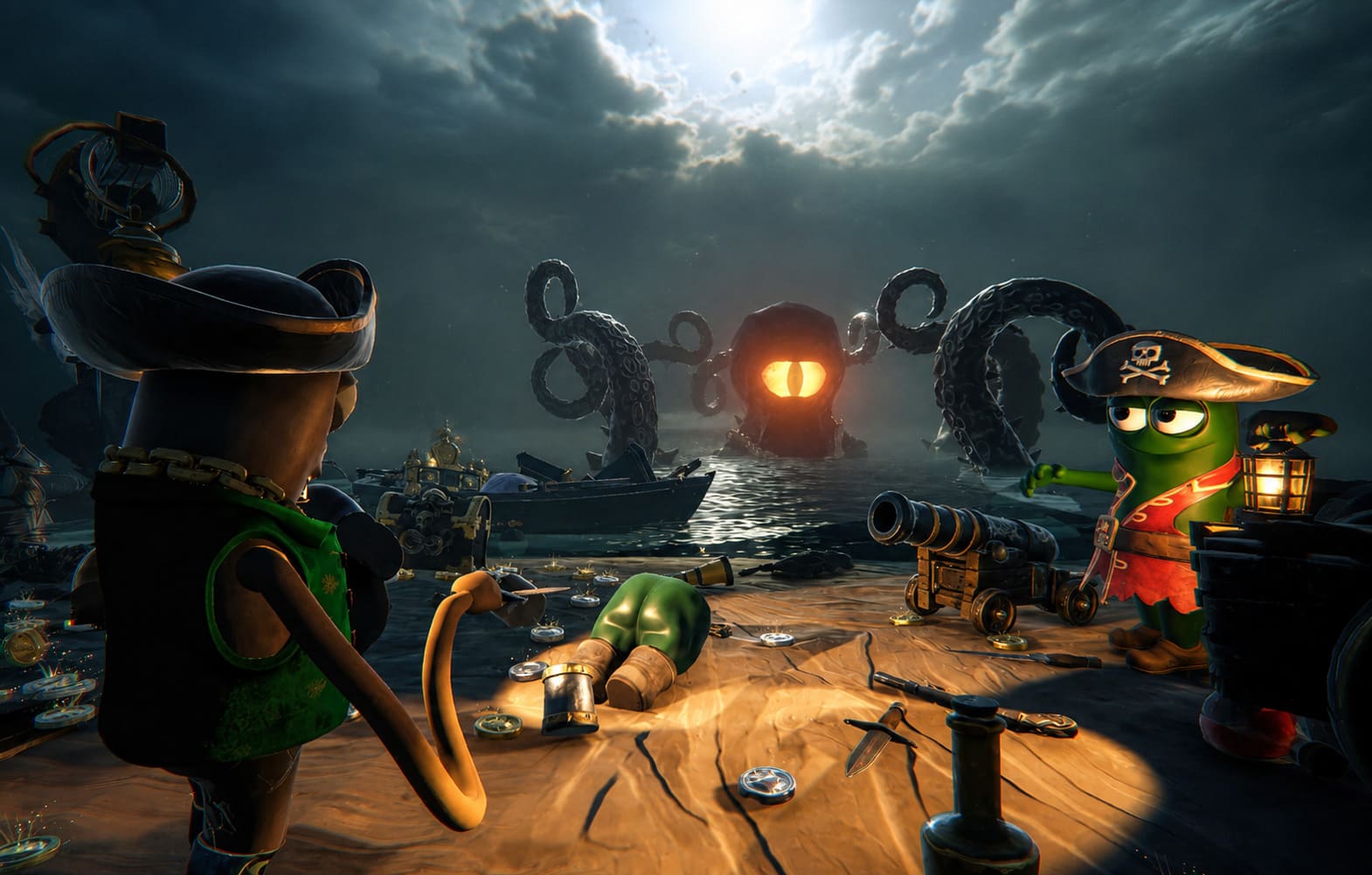
The game’s revival mechanic is one of its most absurd ideas. When a pirate dies, their body is separated, leaving the upper portion behind while the lower part becomes a physical object somewhere in the environment.
To revive the fallen teammate, surviving players need to find the missing lower body, drag it back, and reconnect it to the dead pirate.
It sounds ridiculous because it is.
But mechanically, this is a clever way to turn death into another objective instead of simply forcing a player to sit around and wait for the next round.
Imagine fighting your way through a cursed island while carrying an enormous treasure chest.
Then your friend dies.
Now you’re searching the jungle for his missing body parts while something supernatural is chasing you.
That’s the sort of ridiculous emergency that can make a co-op horror game memorable.
Monsters and Environmental Threats
The islands aren’t dangerous simply because they’re dark and creepy. They are filled with creatures and hazards designed to disrupt your run.
Several threat types have already been associated with the game’s showcased gameplay and testing builds.
Ghost Sharks and Sea Monsters
Some areas are protected by supernatural aquatic predators.
These creatures can force players to think about positioning and movement rather than simply sprinting toward the nearest treasure. In some encounters, distraction or feeding mechanics can provide a safer way through.
That creates a useful change of pace.
Not every monster needs to be killed.
Sometimes the best weapon is knowing when to leave something alone.
Tall Stalking Creatures
There are also humanoid threats with a distinctly unsettling design.
Some of these enemies become particularly dangerous when players look directly at them, encouraging a very different style of movement. Instead of charging toward the enemy with whatever weapon you’ve found, the safer option can be simply avoiding attention.
That’s classic horror design, but the physics system gives it a ridiculous twist.
Players can potentially attempt improvised solutions with environmental objects, because apparently the logical response to a supernatural monster is to throw a cooking pot at it.
I’d absolutely expect players to test that theory anyway.
Mimics and Cursed Treasure
Loot isn’t automatically safe.
Some chests and objects can turn against players, meaning that even finding treasure can become a problem.
This is important for the extraction loop because it prevents loot from being purely positive. Every valuable object creates another decision.
Do you take it?
Can you carry it?
Is it worth the risk?
And most importantly:
Is that chest actually a chest?
Traps and Terrain
The environment itself can also kill you.
Spikes, drops, unstable terrain, and collapsing areas can punish players who sprint through an area without paying attention.
Honestly, this may be the biggest killer in a group of experienced players.
The monster gets blamed.
The trap gets blamed.
But everyone knows the real problem was Dave running ahead without looking.
Progression and What Happens Between Runs
The extraction loop would become repetitive very quickly without progression, so the Early Access version expands the systems between expeditions.
Treasure successfully brought back to the ship can be converted into resources for future purchases.
That means every successful run should make the next one more manageable.
The planned progression includes:
- Shop upgrades and useful equipment
- Additional tools and defensive gear
- Expanded maps and locations
- Updated ship and cannon mechanics
- Additional weapons
- Cosmetic customization
- Proximity voice chat
- Quick emotes
The progression approach is especially important because it gives failed runs some context.
If you lose everything during a disastrous expedition, you’re going to be annoyed.
But if you can immediately start another run and work toward a useful upgrade, the loss becomes part of the loop rather than a reason to quit.
Multiplayer Features Matter More Than They Look
For a game like this, communication is everything.
Proximity voice chat should be one of the most important features in the entire package. Hearing a teammate panic from somewhere behind you is half the entertainment in this genre.
Quick emotes also give players another way to communicate when everything has already gone sideways.
The game reportedly uses Z, X, and C for quick expressive emotes, giving players simple communication options without needing to stop what they’re doing.
It’s a small feature, but games like this live or die on those little interactions.
Early Access Content and Long-Term Potential
Last Pirates: Die Together already has a useful foundation going into Early Access.
An earlier open playtest reportedly attracted more than 16,000 unique players, giving RetroStyle Games a substantial pool of feedback before the full Early Access launch.
The Steam Next Fest demo also helped expand the game’s feature set.
That matters because this genre depends heavily on replayability.
Nobody is going to care about the same island forever. The game needs new locations, new threats, new loot situations, new tools, and enough weird physics interactions to keep four players laughing after dozens of runs.
The good news is that the basic concept gives the developers plenty of room to experiment.
New enemies can change how players approach familiar locations.
New equipment can create different extraction strategies.
New environmental hazards can make old routes dangerous.
And new cosmetics can give players another reason to personalize their ridiculous pirates.
Last Pirates: Die Together PC System Requirements
One of the best things about the game’s presentation is that it doesn’t appear to demand a monster gaming PC.
The stylized 3D visuals are relatively accessible, and the official minimum specifications are quite modest by 2026 standards.
| Requirement | Minimum | Recommended |
|---|---|---|
| OS | Windows 7 64-bit or later | Windows 10/11 64-bit |
| CPU | Intel Core i5 or equivalent | Modern Intel Core i5 / AMD Ryzen 5 |
| RAM | 8 GB | 8 GB, with 16 GB preferable for heavier multiplayer use |
| GPU | NVIDIA GTX 1050 or equivalent | NVIDIA GTX 1060 / GTX 1660 or AMD equivalent |
| Storage | 5 GB | 5 GB, SSD preferred |
| Network | Internet connection | Broadband connection |
The 5 GB storage requirement is particularly friendly. You won’t need to clear half your SSD just to make room for this pirate adventure.
There is one important caveat regarding the operating system.
Although the listed minimum requirement supports Windows 7 64-bit or later, the modern Steam Client itself officially requires Windows 10 or newer for regular operation. So if you’re actually planning to play through Steam in 2026, Windows 10 or Windows 11 is the sensible target.
For multiplayer, I’d also recommend going beyond the bare minimum where possible. 16 GB of RAM and an SSD are much more comfortable choices for modern gaming, especially if you’re running voice chat, Discord, a browser, or recording software at the same time.
How to Fix Twisted Tower Save File Corruption and Steam Cloud Sync Errors (2026 Guide)
My Take: This Could Be a Proper Co-Op Chaos Machine
I’ve played enough co-op horror games to know that mechanics alone don’t make one memorable.
You need situations.
You need stories that start with “we were going to do one quick run” and end with everyone screaming because somebody dropped the treasure into a pit.
That’s where Last Pirates: Die Together has a real advantage.
The elastic-arm physics are stupid in exactly the right way. The extraction structure gives every run a clear purpose. The monsters create pressure, while the physics system ensures that your biggest problem might still be your own teammates.
The biggest question isn’t whether the concept works.
It clearly does.
The question is whether RetroStyle Games can provide enough maps, enemies, progression, loot variety, and unpredictable scenarios to keep the experience fresh beyond the initial novelty.
If the Early Access roadmap delivers on that front, this could become one of those games that permanently occupies a group’s weekend rotation.
Because sometimes you don’t need another massive 100-hour RPG.
Sometimes you need four idiots with elastic arms, a cursed island, a treasure quota, and absolutely no idea what they’re doing.
Last Pirates: Die Together enters Steam Early Access on August 18, 2026. If your PC can handle the surprisingly modest requirements and you’ve got three friends willing to make terrible decisions with you, this is one co-op horror game I’d keep an eye on.