Factory Town 2: Paradise Gameplay Walkthrough and Automation Guide (PC 2026)
I’ve spent years bouncing between factory simulators, city builders, and logistics sandboxes. Hundreds of hours disappeared into conveyor spaghetti in Factorio, carefully balanced production chains in Satisfactory, peaceful planning in Timberborn, and the charming chaos of the original Factory Town. Every one of those games offered something memorable, but they also had limitations that became obvious after enough playtime.
After spending time with Factory Town 2: Paradise, I came away with the feeling that it isn’t trying to copy any of them. Instead, it takes familiar automation mechanics and wraps them in a surprisingly relaxing tropical setting while introducing several systems that genuinely change how you think about expansion.
This isn’t just a prettier sequel. It feels like a complete reimagining of what Factory Town could become.
Why Factory Town 2 Feels Different
The first thing that stood out to me wasn’t the graphics or the new animations. It was the overall philosophy behind the game.
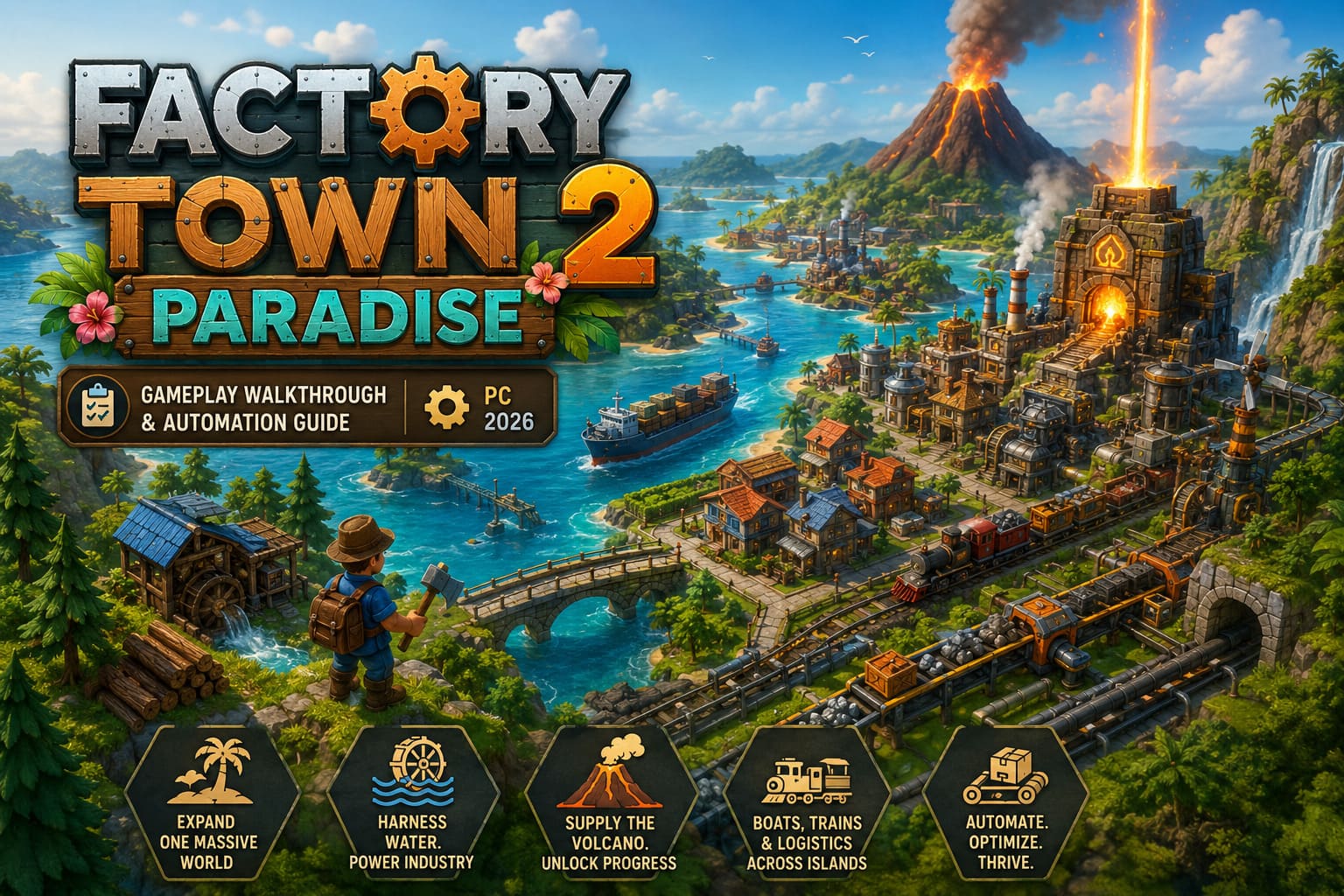
Instead of constantly throwing pressure at the player, Factory Town 2 encourages experimentation. You’re still building efficient production lines, but the atmosphere is much calmer than most factory games. You spend less time worrying about disasters and more time optimizing because you actually want to, not because the game forces you.
That slower pace doesn’t make the gameplay shallow. If anything, it gives you more room to appreciate how all the systems interact.
A World That Actually Keeps Growing
One of my favorite improvements is the world structure.
In the original Factory Town, moving forward often meant leaving everything behind and starting fresh on another map. That wasn’t necessarily bad, but it sometimes felt like abandoning projects you had invested hours into.
Here, your settlement keeps expanding across one massive tropical world.
Instead of replacing your factory, you’re extending it.
Every newly unlocked island feels like another district of your growing industrial empire rather than a completely separate save file.
That small design decision completely changes long-term planning.
| Feature | Original Game | Factory Town 2: Paradise |
|---|---|---|
| World Progression | Separate maps | Continuous expanding world |
| Building Space | Limited per map | Multiple connected islands |
| Expansion Style | Restart frequently | Grow one massive settlement |
| Long-Term Planning | Moderate | Much more rewarding |
The Early Game Feels More Personal
Unlike many automation games where you’re essentially an invisible builder, Factory Town 2 lets you directly control your character.
At first, I wasn’t sure this change would matter.
It actually does.
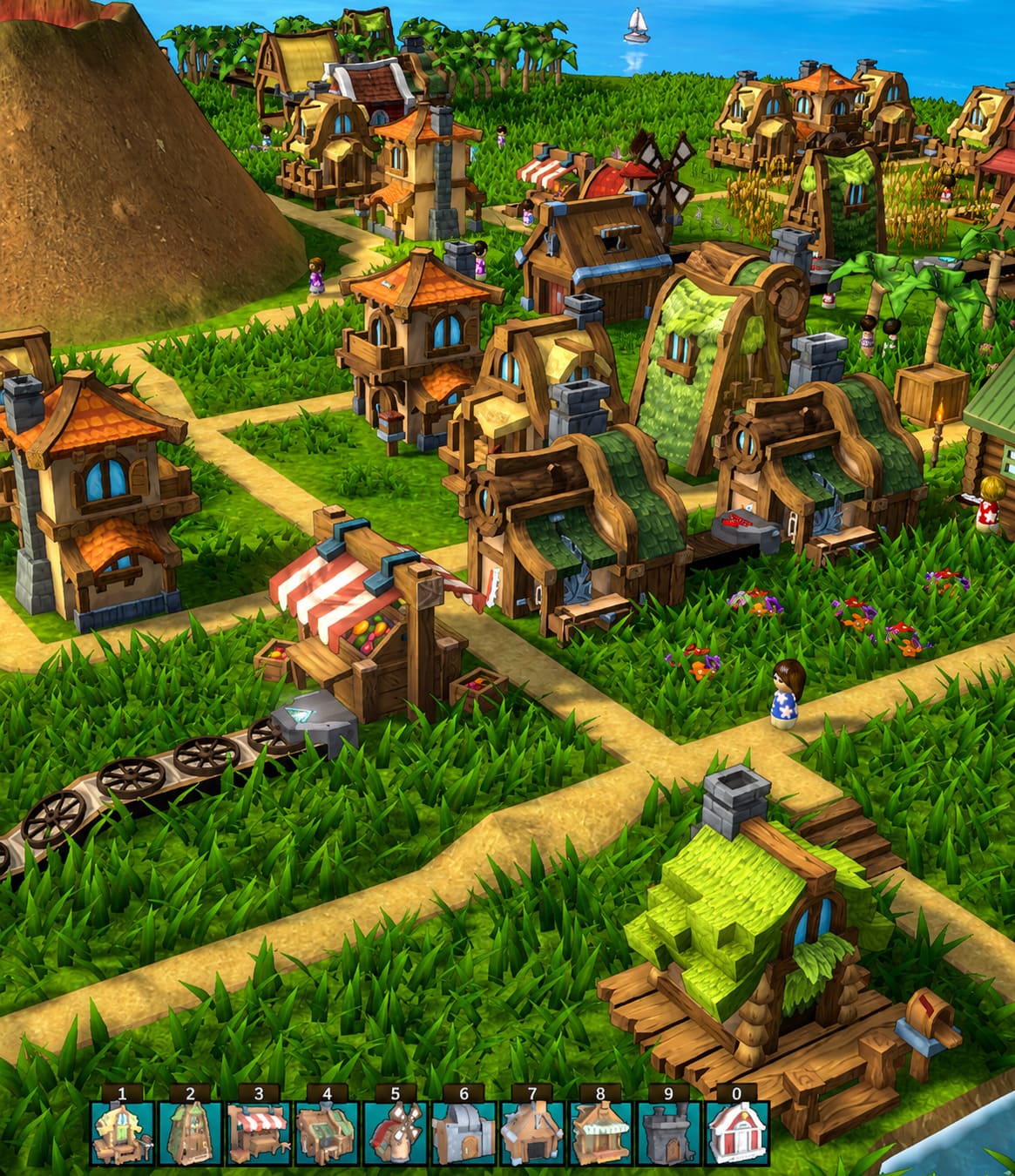
Gathering the first pieces of wood, placing your initial buildings, and watching your tiny village come to life gives the opening hours much more personality than simply clicking menus.
Your first priorities remain familiar:
- Collect wood and stone.
- Build a Town Center.
- Create several worker houses.
- Establish basic storage.
- Connect everything with roads.
Nothing revolutionary here, but the pacing feels much smoother than I expected.
Roads Matter More Than You Think
One lesson I learned surprisingly quickly is that roads are incredibly valuable.
Early workers deliver everything by hand, and even small improvements to walking speed noticeably increase production.
Rather than rushing toward conveyors immediately, I found myself improving road layouts first.
That sounds boring on paper.
In practice, it creates satisfying progression because every efficiency upgrade is immediately visible.
Water Is Finally More Than Decoration
One feature I absolutely loved is the new water simulation.
Most city builders treat rivers as static scenery.
Factory Town 2 turns them into actual gameplay mechanics.
You can reshape terrain, redirect streams, dig canals, and create flowing water that powers your industry.
Watching a carefully dug channel feed multiple water wheels is surprisingly satisfying.
Instead of simply placing a power generator anywhere, you begin looking at the landscape itself as part of your production chain.
That makes every map feel far more dynamic.
The Volcano Is a Surprisingly Clever Progression System
The biggest surprise for me wasn’t automation.
It was the volcano.
Normally, research systems involve collecting points or waiting for timers to finish.
Factory Town 2 does something much more interesting.
The volcano constantly asks for goods.
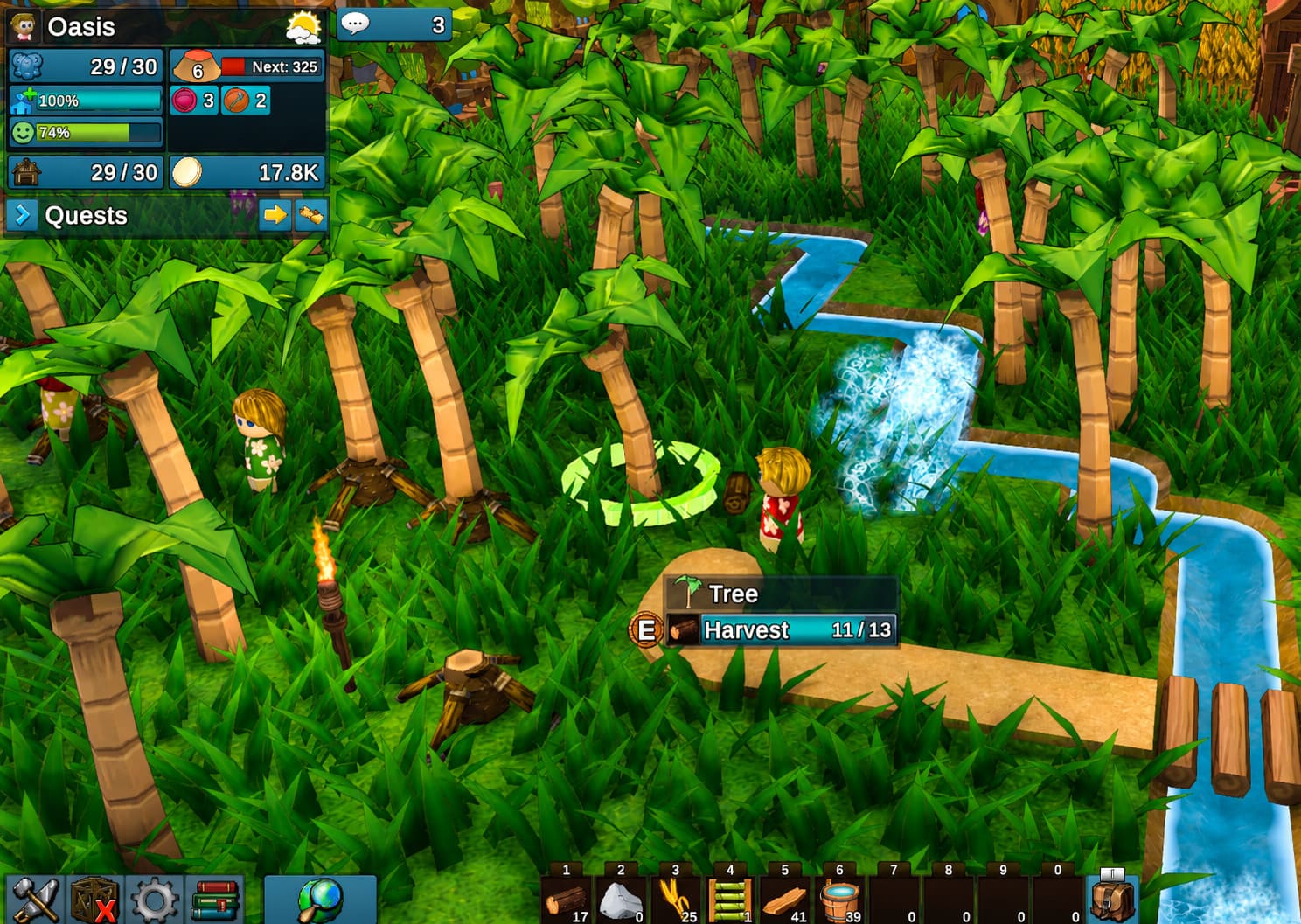
Food.
Tools.
Clothing.
Refined materials.
Instead of storing everything forever, you’re encouraged to automate deliveries into the volcano itself.
That creates a constant demand for expanding production.
The more efficiently your factory operates, the faster you unlock new technologies and entirely new islands.
It’s one of those mechanics that sounds strange until you actually play it.
Then it becomes addictive.
Conveyor Belts Are Still the Stars
Of course, no factory game lives or dies without good logistics.
Thankfully, conveyor systems remain excellent.
One piece of advice I wish I had followed earlier:
Always leave extra room around production buildings.
It is incredibly tempting to place everything tightly together.
Eventually you’ll need:
- Splitters
- Mergers
- Storage buffers
- Extra belts
- Alternate routes
Space becomes more valuable than almost any resource.
Future-you will appreciate every empty tile you leave today.
Underground Logistics Change Everything
Probably my favorite addition is the underground logistics layer.
Instead of covering every square meter with belts and pipes, you can build a proper underground infrastructure.
After several hours I naturally settled into this pattern:
| Surface Level | Underground Level |
|---|---|
| Houses | Main conveyor buses |
| Parks | Water pipelines |
| Markets | Freight rail |
| Decorations | Long-distance logistics |
The result is a town that actually looks like a town instead of an industrial maze.
It’s a small visual improvement that dramatically changes late-game organization.
Boats, Trains, and Multi-Island Planning
Eventually your starting island simply isn’t enough.
Some resources only exist elsewhere, forcing you to think about transportation on a much larger scale.
Boats are perfect for bulk cargo between islands.
Trains handle enormous volumes across larger landmasses.
What I appreciated most is that transportation feels like solving another logistics puzzle rather than just unlocking a faster vehicle.
Choosing whether something belongs on belts, boats, trains, or launch systems becomes part of the optimization process.
Electricity Arrives at the Right Time
Many automation games overwhelm players with complicated power grids almost immediately.
Factory Town 2 waits.
By the time electricity appears, you’ve already mastered the basics.
Steam turbines power generators.
Power lines distribute electricity.
Advanced machinery suddenly becomes available.
It feels like a natural evolution instead of another confusing mechanic thrown into the mix.
I especially liked how electrical shortages have visible consequences.
When production slows, your entire settlement notices.
That creates meaningful reasons to maintain spare generating capacity instead of barely meeting current demand.
My Favorite Building Habits
After experimenting with several layouts, these habits consistently made my factories easier to manage:
- Store products before consumption. Warehouses act as excellent buffers and prevent supply interruptions.
- Separate production districts. Farming, mining, manufacturing, and housing work better when organized into dedicated zones.
- Keep transportation specialized. Avoid mixing unrelated cargo whenever possible.
- Build wider than necessary. Empty space almost always becomes useful later.
These aren’t mandatory rules, but they saved me countless rebuilding sessions.
What I Think Factory Town 2 Does Better Than Other Automation Games
I don’t think Factory Town 2 is trying to replace Factorio or Satisfactory.
Those games focus heavily on scale and optimization.
Factory Town 2 focuses on making optimization enjoyable.
That’s an important distinction.
There’s less stress.
Less punishment.
More creativity.
Even after dozens of hours, I found myself improving layouts simply because I wanted a cleaner-looking settlement—not because an enemy attack forced me to rebuild everything.
That relaxed atmosphere gives the game its own identity.
Things That Could Still Improve
Since the game is in Early Access, there are naturally areas that can grow.
I would personally like to see:
- More advanced late-game production chains.
- Additional transportation options.
- Better production statistics and analytics.
- Expanded decorative building tools.
- More endgame objectives after unlocking every island.
Fortunately, the core gameplay already feels solid enough that these additions would enhance an already strong foundation rather than fix fundamental problems.
Cat Chess Low FPS, Stuttering & Multiplayer Infinite Loading Screen Fixes
Final Thoughts
After playing countless automation and city-building games over the years, it’s rare for a new release to surprise me.
Factory Town 2: Paradise managed exactly that.
It combines satisfying logistics, beautiful environments, meaningful progression, and a relaxed atmosphere into something that feels genuinely refreshing. The continuous world, underground transportation, dynamic water mechanics, and volcano-driven research system all work together to create an experience that encourages experimentation rather than perfection.
If you’re looking for endless optimization challenges, you’ll certainly find them here. But if you also enjoy building attractive towns, watching complex production networks slowly come alive, and expanding across a colorful tropical archipelago at your own pace, this game offers something many factory simulators don’t: balance.
For me, that’s what makes Factory Town 2: Paradise stand out. It respects the depth longtime automation fans expect while remaining welcoming enough that even players new to the genre can enjoy watching their first humble village evolve into a sprawling industrial paradise. It’s still Early Access, so there’s plenty of room to grow, but based on what I’ve played so far, this is easily one of the most promising automation games of 2026.