Crimson Moon Class System Guide: How Builds, Gear, and Weapon Arts Work
If there is one thing that immediately caught my attention about Crimson Moon, it is the decision to throw the traditional RPG class system out of the window. There is no character creation screen where you pick Warrior, Rogue, Mage, or some other archetype and then spend the next 50 hours wondering whether you made the right choice.
Instead, Crimson Moon gives you the tools and basically tells you to figure out your own fighting style.
That sounds simple on paper, but after looking at how the game’s gear, Weapon Arts, Boons, and Angels work together, I think this could end up being one of the most interesting parts of the game. Your Nephilim isn’t really a “class.” Your build is.
And that distinction matters.
With Crimson Moon scheduled to launch on September 1, 2026, players are already trying to work out which combinations will be strongest. Some will probably chase the biggest damage numbers possible. Others will build defensive monsters that refuse to die. Personally, I’m much more interested in the builds that look ridiculous on paper but somehow become completely broken once everything starts working together.
Here is how the Crimson Moon classless build system works and what you should know before heading into Gildenarch.
Crimson Moon Doesn’t Have Traditional Classes
Let’s get the most important thing out of the way first: there are no traditional character classes in Crimson Moon.
Your Nephilim is a half-human, half-angel warrior, but the game doesn’t force you into a predefined role. Instead, your combat identity comes from the equipment, skills, temporary bonuses, and Angel you take into each hunt.
This gives the game a very different progression structure from a conventional action RPG.
Want to play like a tank?
Use heavy armor, defensive equipment, a shield, and Boons that reward blocking and parrying.
Want to turn your character into a glass cannon?
Stack offensive gear, critical-hit bonuses, aggressive Weapon Arts, and anything that helps you kill enemies before they get close.
And if you get bored, change the build.
That’s what I like about this system. You aren’t permanently married to one playstyle just because you picked something at the beginning of the game.
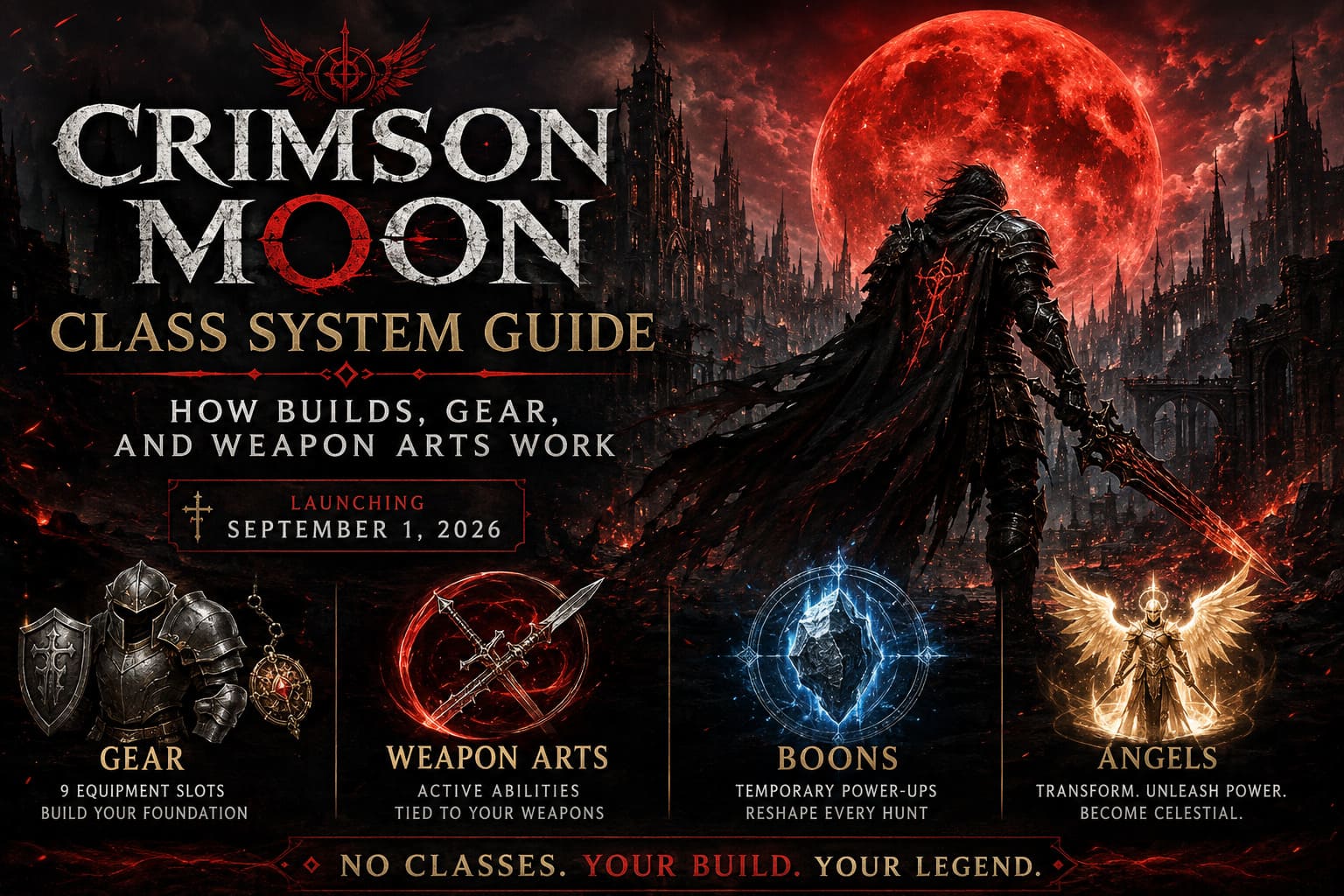
The entire system revolves around four major components:
- Gear – Your core stats and equipment.
- Weapon Arts – Your active combat abilities.
- Boons – Temporary bonuses that shape each hunt.
- Angels – Your ultimate transformation and supernatural specialization.
The fun comes from combining all four instead of treating them as separate systems.
Gear Is the Foundation of Every Build
Your equipment is where your build starts.
Before heading into a hunt, you prepare your Nephilim at the hub and decide what kind of fighter you want to be. The loadout can contain nine pieces of equipment, including armor, trinkets, and weapons.
The armor system covers four slots:
- Head
- Chest
- Hands
- Legs
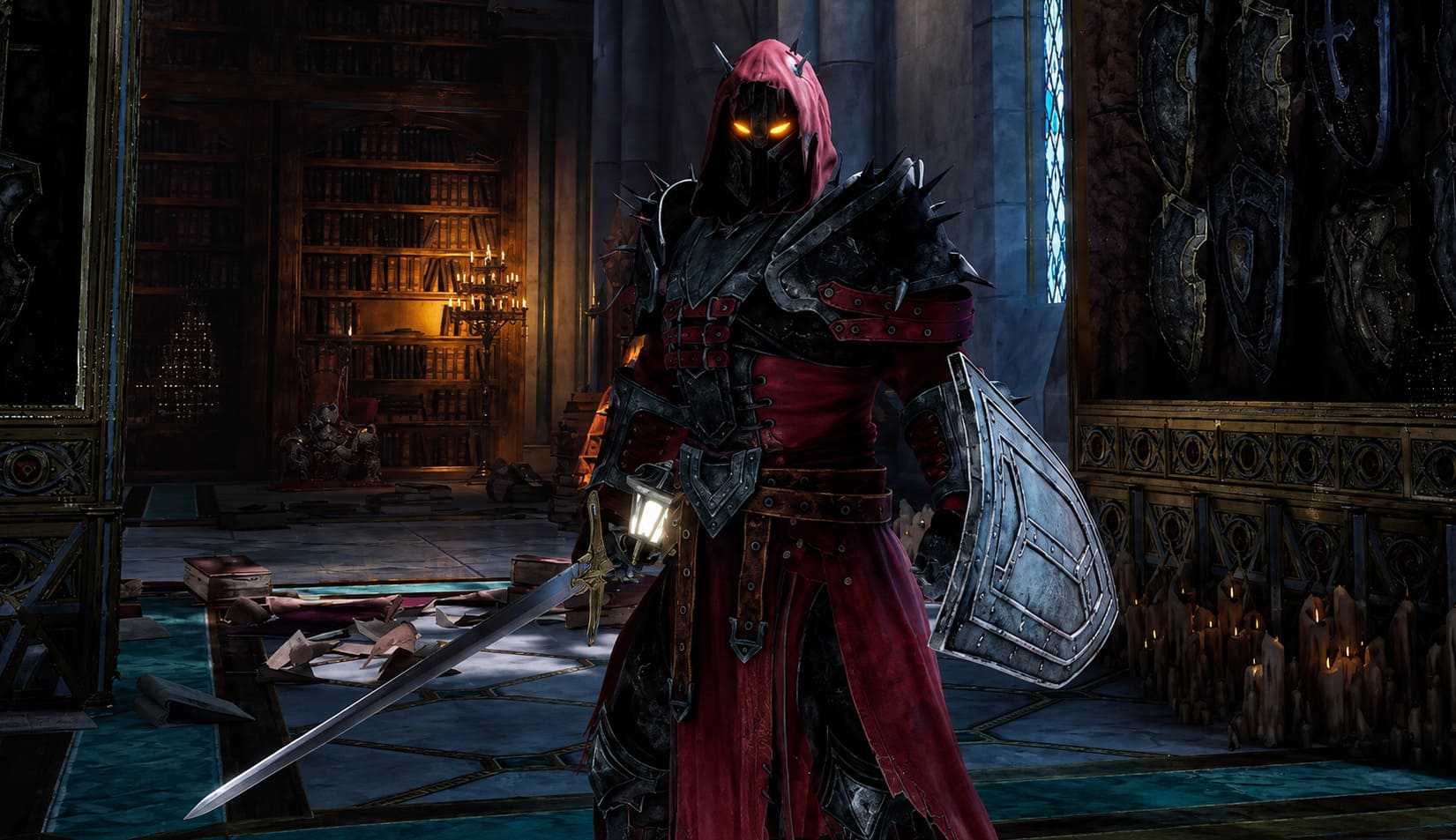
Armor isn’t simply there to make your character look tougher. Different pieces influence defensive statistics, weight, and resistance to dangerous effects such as Hellgrowth corruption.
This creates an obvious choice between protection and mobility.
Heavy armor might allow you to absorb punishment and stand your ground against enormous demons, but a lighter setup could give you the movement needed to dodge attacks and stay behind enemies.
Then there are two Trinket slots.
These are where things can get particularly interesting because Trinkets can provide specialized effects rather than simply increasing your basic defense. A good example would be a bonus that improves critical-hit chance while your health is low.
That’s the kind of effect I personally love in loot-driven games because it changes how you actually play instead of simply giving you another +5 to a statistic.
Weapons Matter Even More
Your weapon choice effectively determines a huge part of your combat identity.
You can build around a one-handed weapon and shield or go all-in with a massive two-handed weapon.
But here’s the important part: don’t judge weapons purely by their damage number.
Two weapons with similar statistics can feel completely different because their Weapon Arts can dramatically alter your combat options.
Weapon Arts Are Your Real Skill Set
This is probably my favorite part of the system.
Instead of giving every class a giant skill tree filled with abilities you’ll eventually memorize, Crimson Moon attaches active abilities directly to weapons.
Every weapon can bring its own Weapon Arts into battle.
A fast sword might have an attack designed to sweep through groups of enemies. A massive mace could have a ground slam that staggers powerful targets. Another weapon might have an ability that is much more useful against a single boss than against a crowd.
That means switching weapons isn’t just a statistical upgrade.
You’re effectively changing your skill set.
This makes weapon experimentation much more important.
If you’re fighting a boss and constantly getting punished while trying to stay close, perhaps your current Weapon Arts aren’t giving you enough control. Switching to something with better stagger potential or a safer attack pattern could completely change the encounter.
I expect this to become one of those systems where experienced players eventually know exactly which Weapon Arts work together.
And that’s when buildcrafting gets really interesting.
Boons Turn Every Hunt Into a New Build
Your starting equipment isn’t the final version of your character.
Once you’re inside Gildenarch, the build begins changing through Boons.
As you explore corrupted districts, you’ll encounter Nexus Gates. These provide opportunities to select temporary bonuses that last for your current run.
This is where Crimson Moon starts leaning heavily into roguelike territory.
You could enter a hunt with a defensive setup and then suddenly receive a Boon that dramatically improves elemental damage. Instead of sticking to your original plan, you might decide to change direction and build around that opportunity.
Some Boons can focus on:
- Offense: Adding elemental effects or increasing melee damage.
- Survival: Rewarding successful parries, dodges, or defensive play.
- Resources: Improving Weapon Art cooldowns or supernatural power generation.
The important thing is that Boons are temporary.
That makes them much more interesting than permanent skill-tree upgrades. You aren’t just building one perfect character over the entire game. You’re making decisions based on what the current hunt gives you.
And yes, that also means some runs will probably go horribly wrong.
That’s part of the fun.
Angels and Angel Mode
If Gear is your foundation and Boons are your temporary modifications, your Angel is the big finishing piece.
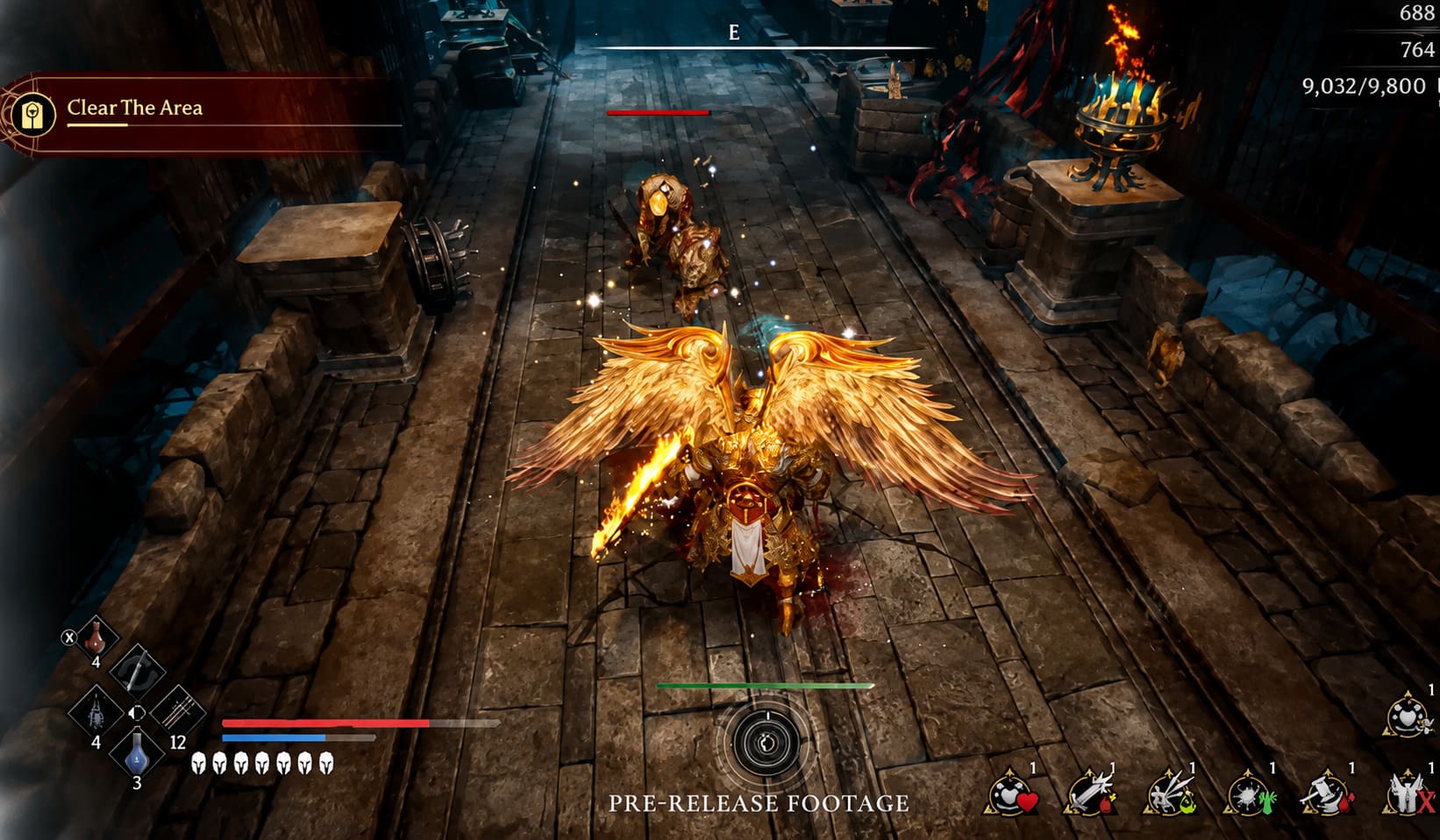
Before starting a hunt, you select an Angel to align with. That choice affects your ultimate supernatural ability and the characteristics of your Angel Mode transformation.
During combat, your actions gradually fill the transformation meter. Once it’s ready, you can activate Angel Mode by pressing L3 + R3.
Your Nephilim transforms, gains powerful celestial abilities, regenerates health rapidly, and becomes dramatically more dangerous.
But Angel Mode isn’t just a panic button.
Your Angel selection can influence what this transformation actually does best.
One option might favor aerial attacks. Another could focus on crowd control. Another might turn the transformation into a pure burst-damage tool.
This creates another layer of build specialization.
Personally, I think the best Angel won’t necessarily be the one with the highest theoretical damage. The strongest choice may depend entirely on your weapon and Boons.
A crowd-control Angel could be incredible with a slow, heavy weapon. A burst-focused Angel might be perfect for an aggressive critical-hit build.
The Risk of Losing Your Build
There is an important catch to all this experimentation.
Crimson Moon’s progression isn’t completely permanent during a hunt.
Each expedition is tied to a Life Pool. If your Nephilim dies, you can consume one of those charges to resurrect and continue.
But once the Life Pool is gone, the run ends.
That’s where the game’s risk-and-reward design starts to matter.
Temporary Boons disappear when the run ends, and equipment that hasn’t been properly secured through purification can also be lost.
That makes successful extraction much more important than simply killing everything in sight.
Purification Is Your Safety Net
The important permanent progression mechanic is Purification.
Successfully completing hunts or reaching certain milestones allows you to secure equipment you’ve discovered. Once purified, an item becomes part of your permanent collection and can be used in future loadouts.
That creates a satisfying loop:
Find → Experiment → Survive → Purify → Upgrade → Go Deeper
Back at the hub, the Blacksmith can upgrade your purified equipment, increasing its basic power and helping you prepare for tougher challenges.
So losing a run isn’t necessarily losing all your progress. The real objective is to make sure the best discoveries eventually become part of your permanent arsenal.
Co-Op Builds Could Get Wild
The classless design becomes even more interesting in two-player online co-op.
Without fixed roles, both players can create complementary builds instead of simply selecting “tank + healer” because the game says that’s how the party should work.
One player could become a heavily armored Vanguard with a shield, defensive Boons, and abilities designed around staggering enemies.
The other could go completely insane with a high-speed critical build.
That combination makes sense because both players are doing something different.
You could also build around elemental interactions, with one player applying a status effect while the other uses a Weapon Art designed to exploit it.
That’s where communication becomes important.
A good co-op team shouldn’t simply bring two individually powerful builds. The best team should make both builds stronger when they’re fighting together.
How to Fix WheelMates Crashing on Startup on PC (Windows 11) – 2026 Guide
Crimson Moon Build System vs Traditional Classes
| Feature | Traditional RPG Classes | Crimson Moon Build System |
|---|---|---|
| Character Role | Chosen early and usually fixed | Created through equipment and choices |
| Skills | Usually tied to class trees | Primarily tied to Weapon Arts |
| Temporary Power | Often limited | Boons reshape each hunt |
| Ultimate Ability | Usually class-based | Determined by your Angel |
| Loot Flexibility | Some items may be class-restricted | Equipment can be swapped during hunts |
| Respecialization | Often requires respec systems | Change your loadout between hunts |
My Take on the Crimson Moon Classless System
For me, the biggest appeal isn’t simply that Crimson Moon has no classes.
Plenty of games have experimented with classless progression before.
What makes this system potentially special is how the different layers appear to interact. Your equipment determines the foundation, Weapon Arts define your moment-to-moment combat options, Boons allow the build to evolve during a hunt, and your Angel provides a powerful identity for the ultimate transformation.
That’s a lot of moving pieces.
It also means there probably won’t be one universally perfect build.
A setup that destroys regular enemies could struggle against a boss. A defensive build might feel slow in solo play but become incredibly useful in co-op. A weapon that looks mediocre on paper could become ridiculous after you find the right Boons and Trinkets.
That’s exactly what I want from a build system.
I don’t want the game to tell me, “You’re a Warrior, so use these six abilities.”
I want to find some completely unexpected combination, realize that everything somehow works together, and then spend the next few hours trying to make it even more ridiculous.
That seems to be the real idea behind Crimson Moon.
You aren’t choosing a class.
You’re building one.
And with the September 1 launch approaching, I’m genuinely curious to see how creative players get once they have the entire system in their hands.