Big Walk Co-Op Guide: Everything We Know About House House’s 12-Player Adventure
There are plenty of multiplayer games that promise unforgettable moments with friends, but very few actually deliver something genuinely different. After spending years jumping between survival sandboxes, extraction shooters, and competitive multiplayer titles, I can honestly say Big Walk instantly grabbed my attention for one simple reason—it isn’t trying to compete with them. Instead, it feels like House House looked at modern co-op gaming, laughed, and decided to build something entirely focused on conversation, exploration, and shared chaos.
That alone makes it one of the most interesting releases on my radar. The same creative team responsible for the hilarious success of Untitled Goose Game has gone in a completely different direction, creating an adventure where communication is the core mechanic instead of combat. After following developer presentations, community discussions, and gameplay showcases, I’m more convinced than ever that Big Walk could become the breakout multiplayer hit of 2026.
How to Fix Beast of Reincarnation Stuck on Loading Screen & Startup Crashes (2026 Guide)
A Co-Op Adventure That Doesn’t Feel Like Everything Else
Most modern multiplayer games rely on familiar formulas. Defeat enemies, collect better loot, level up your character, repeat. Big Walk throws almost all of those expectations away.
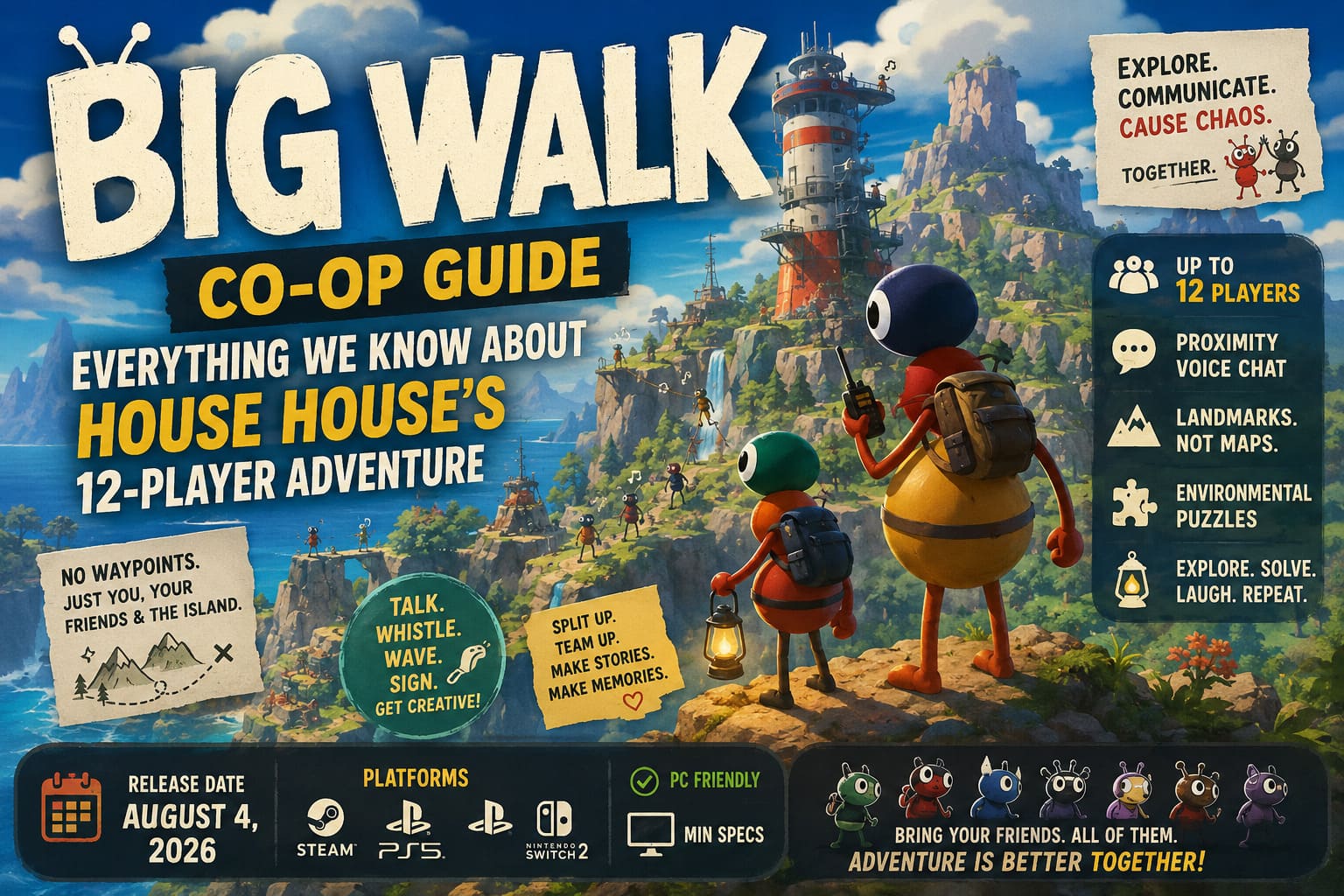
You and up to eleven friends are dropped onto a colorful island packed with mysteries, giant landmarks, environmental puzzles, and hidden locations. There are no endless combat encounters constantly interrupting exploration, and the interface remains intentionally minimal. Instead of chasing objective markers every few minutes, you’re encouraged to actually look at the world around you.
That design philosophy immediately reminds me of older adventure games where getting lost wasn’t considered bad game design—it was part of the experience. Big Walk embraces that feeling instead of trying to eliminate it.
The Island Becomes the Real Puzzle
One detail I absolutely love is how navigation itself becomes gameplay.
Without a permanent minimap holding everyone’s hand, players need to recognize mountains, unusual rock formations, forests, towers, and other landmarks to stay together. If somebody wanders off, finding them becomes an actual challenge instead of simply following an icon across the screen.
This transforms exploration into something much more memorable than simply running from checkpoint to checkpoint.
- Landmarks replace traditional navigation systems.
- Players naturally create scouting teams.
- Communication becomes essential instead of optional.
- Every journey across the island feels unique.
Finally, A Game Designed for Large Friend Groups
Finding a multiplayer game that comfortably supports more than four players has always been surprisingly difficult. Most developers either limit party sizes or expect players to install unofficial mods just to fit everyone into one lobby.
Big Walk solves that problem from the beginning by supporting up to 12 players in a single cooperative adventure.
That number completely changes group dynamics. Rather than everyone staying glued together, smaller teams naturally form. Some players can investigate distant structures, another group can tackle environmental puzzles, while a few people inevitably get distracted doing something completely ridiculous.
Honestly, that’s probably where the funniest stories will come from.
| Feature | Big Walk | Typical Co-Op Game |
|---|---|---|
| Maximum Players | 12 | 4 |
| Main Focus | Exploration & Communication | Combat & Progression |
| Navigation | Environmental Landmarks | Quest Markers |
| Voice System | Proximity Chat | Global Voice Chat |
| Gameplay Style | Relaxed Adventure | Mission-Based |
Proximity Voice Chat Is More Than a Gimmick
I’ve played enough online games to know that twelve people talking at the same time can quickly become unbearable. Endless overlapping conversations usually force everyone into smaller Discord channels, which defeats the purpose of a shared adventure.
Big Walk approaches this problem in a much smarter way.
Its proximity voice chat means you’ll only hear nearby teammates naturally. Walk deeper into a cave or climb a distant cliff, and voices slowly fade until you’re effectively alone.
That tiny design choice completely changes how exploration feels.
Instead of hearing constant chatter from across the map, every expedition carries a little uncertainty. If someone disappears into the wilderness, they actually feel isolated.
Creative Communication Makes Every Situation Funny
When teammates move beyond speaking distance, the game doesn’t simply leave them stranded.
Players receive a collection of playful communication tools that fit perfectly with House House’s style. Walkie-talkies allow distant conversations, whistles help signal directions, while lanterns and visual cues become useful after sunset.
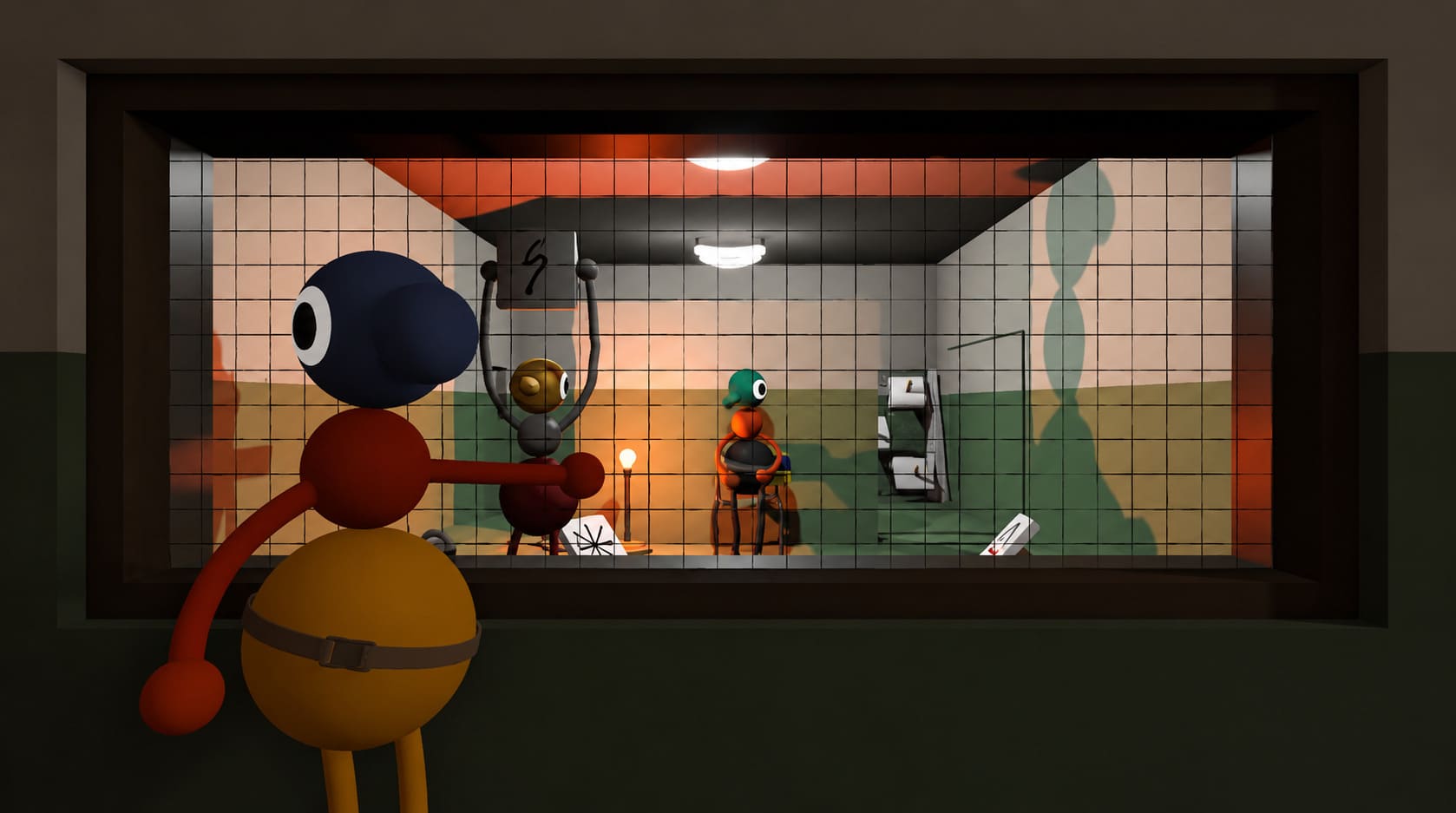
Even more entertaining is the possibility that certain puzzles temporarily prevent your character from speaking at all.
Imagine trying to explain a complicated solution using nothing but frantic gestures while eleven friends confidently misunderstand everything you’re attempting to communicate. That’s exactly the kind of unpredictable comedy I expect from this game.
Puzzles Built Into the Environment
One thing that impressed me during gameplay previews is how naturally the puzzles blend into the world.
Instead of opening separate puzzle rooms, challenges exist directly inside the environment.
You may find yourself activating switches on opposite cliffs, redirecting sunlight through mirrors, guiding teammates through dense forests, or coordinating multiple groups spread across enormous distances.
Because players constantly split up, everyone stays busy rather than standing around watching one person solve everything.
House House Still Loves Controlled Chaos
If you enjoyed the playful energy of Untitled Goose Game, don’t worry—it hasn’t disappeared.
Despite emphasizing teamwork, Big Walk encourages harmless mischief just as much as cooperation.
Some of my favorite mechanics shown so far include:
- Borrowing your friend’s equipment… and conveniently forgetting to return it.
- Piggyback rides across difficult terrain.
- Holding hands while navigating dangerous areas.
- Turning simple travel into complete comedy through accidental mistakes.
That balance between helping friends and lightly trolling them feels incredibly authentic. Every gaming group has at least one player who can’t resist causing harmless trouble, and Big Walk seems designed around that reality instead of fighting against it.
Visual Style That Stands Out
Photorealistic graphics aren’t everything, and Big Walk proves exactly why.
The world bursts with vibrant colors, exaggerated character designs, soft lighting, and landscapes that almost resemble animated storybooks. Everything looks inviting rather than dangerous.
The strange insect-inspired explorers are especially memorable. They’re awkward, expressive, and instantly recognizable without relying on complicated character customization systems.
Sometimes personality matters more than technical realism, and this game appears to understand that perfectly.
PC Requirements Look Surprisingly Friendly
One pleasant surprise is that PC players won’t necessarily need cutting-edge hardware.
| Component | Minimum Requirement |
|---|---|
| Operating System | Windows 10 64-bit |
| Processor | Intel Core i7-7700K / AMD Ryzen 5 1600X |
| Memory | 12 GB RAM |
| Graphics | GTX 750 Ti 2GB / Radeon R7 370 2GB / Intel Arc A380 |
Considering the scale of the multiplayer sessions, these requirements remain refreshingly accessible for a modern release.
Release Date and Platforms
Players won’t have to wait much longer.
Big Walk is currently scheduled to launch on August 4, 2026. The adventure will be available on PC through Steam alongside PlayStation 5 and Nintendo Switch 2.
I also appreciate the unusual marketing approach. Instead of relying exclusively on digital demos, the developers organized small in-person preview events, letting players experience the game together. That perfectly matches the entire philosophy behind Big Walk—it’s a game about bringing people together.
Why I’m Genuinely Excited
After years of battle passes, seasonal grinds, daily objectives, and increasingly exhausting multiplayer ecosystems, Big Walk feels like someone finally remembered why playing with friends became popular in the first place.
Not every online game needs ranked ladders or competitive pressure. Sometimes the best gaming memories come from getting hopelessly lost, laughing at communication failures, and somehow solving impossible puzzles together despite complete confusion.
That’s exactly the impression Big Walk gives me.
Will every experiment work perfectly? Probably not. Managing twelve players will inevitably create unpredictable situations, but that’s precisely why I’m interested. The funniest moments won’t be scripted by developers—they’ll be created by the people playing.
If House House successfully captures that spontaneous energy while delivering satisfying exploration and clever environmental puzzles, Big Walk could easily become one of the defining cooperative games of 2026. My Steam wishlist already has it bookmarked, and I’m already trying to convince enough friends to assemble a full twelve-player expedition on launch week.