Slay the Spire 2 Enchantments Guide: Best Builds & Synergies
I’ve been streaming roguelikes for years, and every so often a mechanic shows up that completely rewrites how you approach deckbuilding.
In Slay the Spire 2, that mechanic is Card Enchantments, and it genuinely feels like one of those systems that punishes “solved game” thinking.
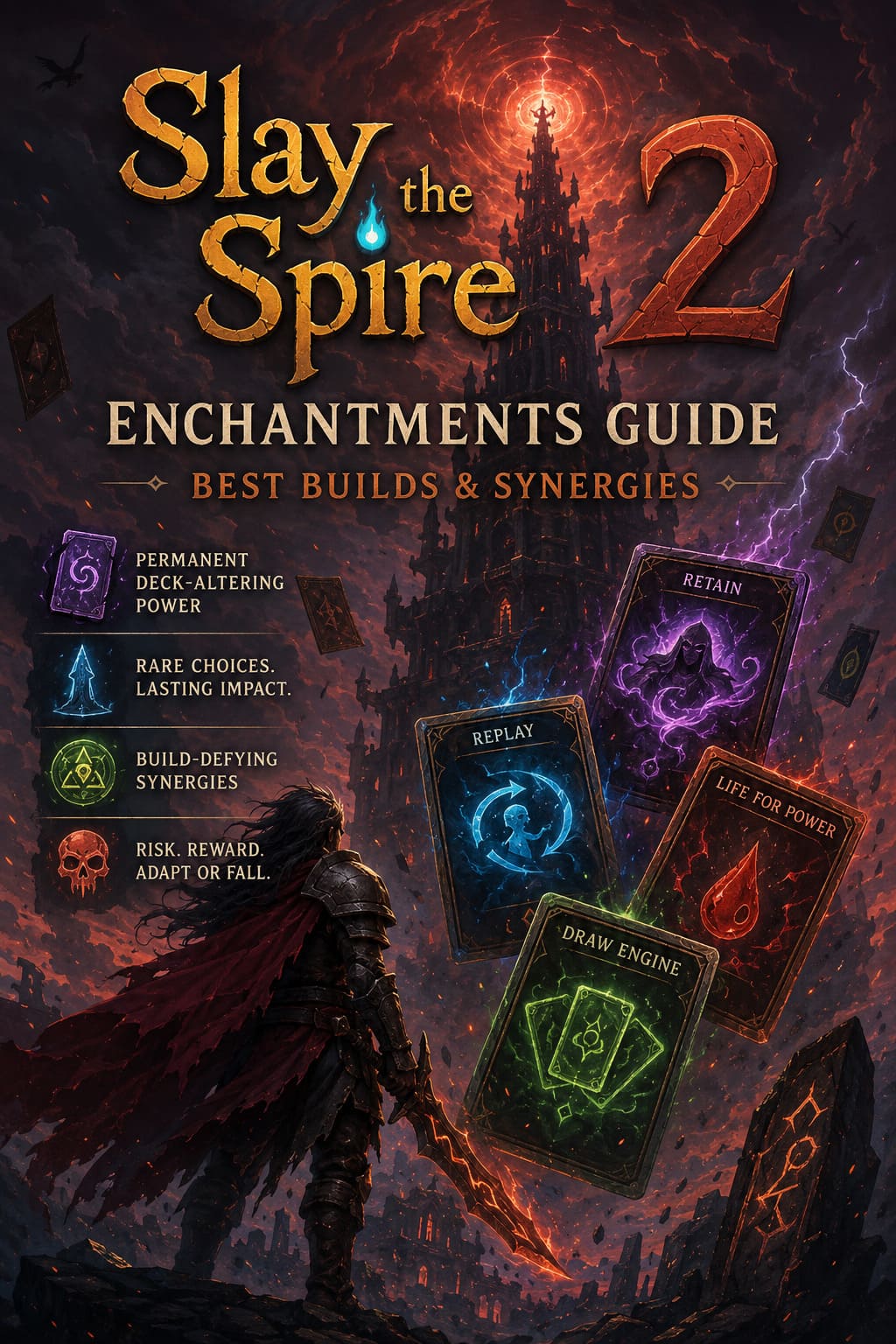
On stream, I’ve seen players overvalue them, undervalue them, and straight-up lose runs because they treated them like simple upgrades. They are not upgrades—they are build-defining mutations.
Slay the Spire 2 Infinite Combos: Broken Deck Loops & Fast Wins
What Card Enchantments Actually Do
Forget the formal definitions. From a player’s perspective, Enchantments are permanent modifications that change how a card behaves for the entire run. Not temporarily, not situationally—permanently.
The key thing most players miss is that Enchantments don’t just improve cards, they reshape the identity of your deck. A single Enchanted card can force your entire strategy to pivot, whether you want it to or not.
Core behavioral rules
In practice, Enchantments follow a few consistent rules that matter during real runs:
- – One Enchantment per card at a time, with overrides replacing older effects
- – Permanent persistence across all acts and combats
- – Visually distinct card changes that make them easy to track in deckbuilding decisions
This matters because it removes flexibility. Once you commit, you are locked into that version of the card for the rest of the run.
Slay the Spire 2 Character Unlock Guide: Fast Progression Tips
How You Actually Obtain Enchantments
One of the biggest misconceptions I see is that Enchantments are common. They are not. You don’t casually pick them up like normal card rewards.
Instead, they appear through structured, high-impact decisions:
- – Post-boss progression rewards that open transformation opportunities
- – Rare event chains that require sacrificing resources like HP or gold
- – Shop-based special interactions with limited availability
- – Relic-driven mechanics that modify specific cards on acquisition
On stream, I’ve started calling these “commitment checkpoints” because every time you engage with one, you’re essentially deciding how your entire run will behave from that point forward.
Types of Enchantments (From Real Gameplay Experience)
After testing multiple runs and watching community builds evolve, I mentally categorize Enchantments into three practical groups. This helps avoid overthinking during runs.
1. Stable Utility Enchantments
These are the safest options, though “safe” is relative in this game. They usually provide incremental advantages like damage boosts, block increases, or consistency improvements such as Retain or card draw effects.
They don’t create flashy moments, but they stabilize runs. If your deck is inconsistent, these are often the correct choice.
2. High-Risk Scaling Enchantments
This is where things get chaotic. These Enchantments introduce trade-offs that scale both power and danger.
Typical effects include damage multipliers with HP costs, randomized energy behavior, or reward systems tied to exhausting cards.
On stream, these are the “chat screams YES while I hesitate” choices. Sometimes they instantly turn a mediocre deck into a boss-melting machine. Other times they quietly kill your run over five fights because the downside scales faster than your ability to recover.
3. Structural Manipulation Enchantments
These are the most underrated category and arguably the most powerful when used correctly. Instead of changing numbers, they change how your deck behaves structurally.
This includes effects like modifying draw order, enabling replay mechanics, or forcing specific setup consistency at the start of combat.
These are the Enchantments that create those “how did you do that on turn one?” moments during streams.
Why Enchantments Matter More Than Relics in Some Runs
Relics are passive. Enchantments are active identity changes. That distinction is important.
Relics support your deck. Enchantments redefine it.
If you take the wrong relic, your run might slow down. If you take the wrong Enchantment, your entire win condition can collapse or shift into something you didn’t plan for.
Class Synergy Breakdown (Streamer Perspective)
Different characters interact with Enchantments in very different ways, and understanding this is key to avoiding forced losses.
Ironclad: Controlled Chaos
Ironclad is the class most capable of abusing risky Enchantments because of his natural sustain and high HP pool. Self-damage mechanics or aggressive scaling effects are far less punishing here than elsewhere.
In practice, Ironclad turns “dangerous” Enchantments into tempo tools, often shortening fights dramatically.
Silent: Precision Engine
Silent benefits most from consistency and sequencing improvements. Enchantments that improve draw reliability, cost efficiency, or setup timing are significantly stronger than raw damage boosts.
She doesn’t want chaos—she wants controlled execution.
Defect: System Manipulator
Defect thrives on Enchantments that accelerate setup or modify multi-hit or orb-related mechanics. When optimized correctly, these can lead to extremely deterministic combat patterns.
It often feels less like playing a deck and more like executing a script.
Regent and Necrobinder: Emerging Complexity
These newer classes feel explicitly designed with Enchantments in mind. Regent benefits from optimization chains that stack value over time, while Necrobinder gains defensive stability from preserving key summon interactions.
These are the classes where experimentation matters most right now.
Most Powerful Enchantment Combinations Observed
Across multiple runs and community testing, certain combinations consistently stand out as game-breaking when assembled correctly.
Replay Effects + High-Damage Skills
This turns single-card plays into multi-hit burst turns. The value scales dramatically with card quality, often producing instant fight-ending sequences.
Retain + Setup Cards
This combination eliminates timing issues entirely. You gain full control over when your key cards are deployed, smoothing out variance across fights.
Cost Reduction + Draw Engines
This is where infinite-style loops begin to emerge. Once efficiency surpasses energy constraints, the deck starts self-sustaining.
Exhaust Removal on High-Impact Effects
This turns limited-use cards into repeatable engines, dramatically increasing long-term scaling potential in drawn-out fights.
Strategic Rules I Follow on Stream
After enough failed runs, I’ve developed a simple decision framework for Enchantments that consistently improves win rate.
- – Never pick Enchantments without identifying your win condition first
- – Avoid randomness unless your deck can stabilize variance
- – Treat HP costs as long-term debt, not immediate value
- – Prioritize structural effects over raw stat increases in most cases
- – If it looks overpowered immediately, assume there is hidden scaling risk
Final Thoughts
What makes Enchantments interesting isn’t just their power—it’s the way they force adaptation. Every run becomes less about following a fixed strategy and more about reacting to forced identity shifts.
I’ve had runs where a single Enchantment turned a struggling deck into a dominant win condition, and others where it quietly dismantled consistency over time without obvious warning signs.
The real skill in Slay the Spire 2 isn’t picking the strongest effect. It’s understanding what kind of deck you are becoming after you pick it.
Once that clicks, the game stops being predictable optimization and becomes controlled chaos that you are constantly trying to steer in the right direction.