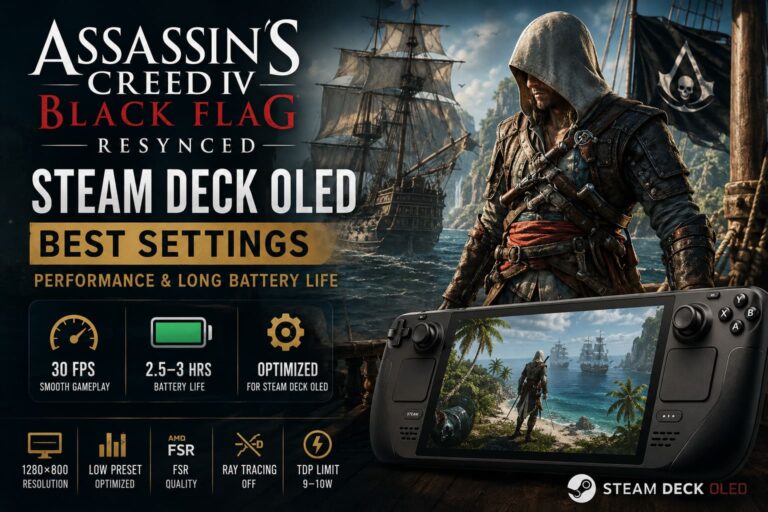
Assassin’s Creed Black Flag Resynced PS5 Pro Optimization Explained: 60 FPS Ray Tracing, PSSR 2.0, and Performance Modes
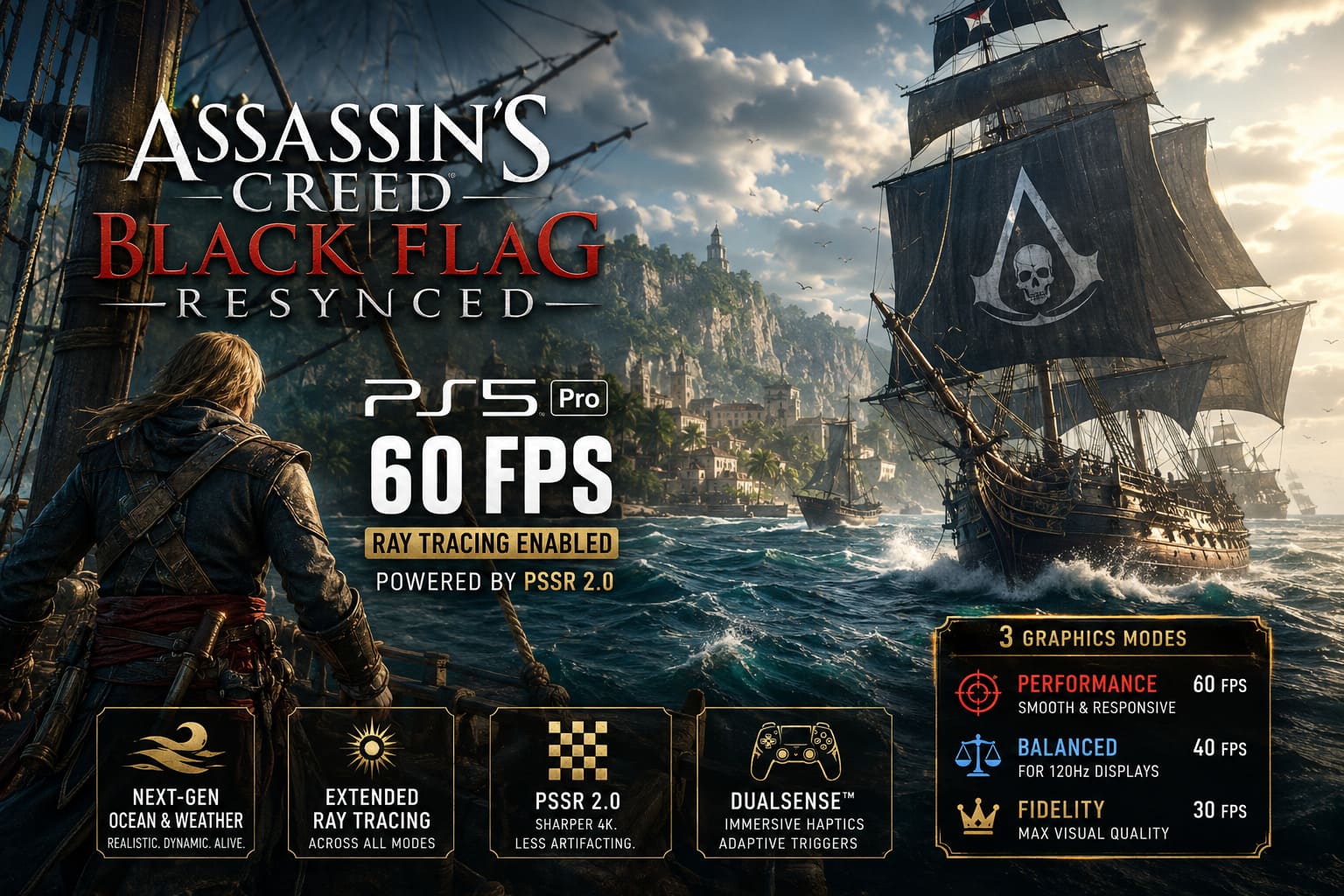
The return of Assassin’s Creed Black Flag has been one of the biggest gaming stories of the year, but after digging through Ubisoft’s technical presentations, community discussions, and every trailer frame available, one thing becomes obvious: this isn’t another lazy remaster wearing a fresh coat of paint.
Assassin’s Creed Black Flag Resynced feels like Ubisoft went back to the drawing board and rebuilt one of the greatest pirate adventures ever made with modern hardware in mind. The original game was already special thanks to Edward Kenway, unforgettable naval battles, and an open Caribbean that encouraged exploration instead of checklist gaming. The remake doesn’t abandon that formula—it supercharges it.
What surprised me most isn’t just the visual leap. It’s how aggressively Ubisoft is using the PlayStation 5 Pro hardware to erase compromises that console players have accepted for years.
Black Flag Was Already Great—Now the Technology Finally Matches the Vision
Back in 2013, Black Flag looked incredible for its generation. The ocean simulation, weather effects, and ship combat were miles ahead of many competitors.
But hardware limitations were everywhere.
- Cities required loading tricks.
- Vegetation had noticeable pop-in.
- Water physics looked impressive until you compared them with modern rendering techniques.
- Lighting relied on baked solutions.
- Character models showed their age during close-up cinematics.
The new version changes almost every technical layer without losing the identity that made Black Flag legendary.
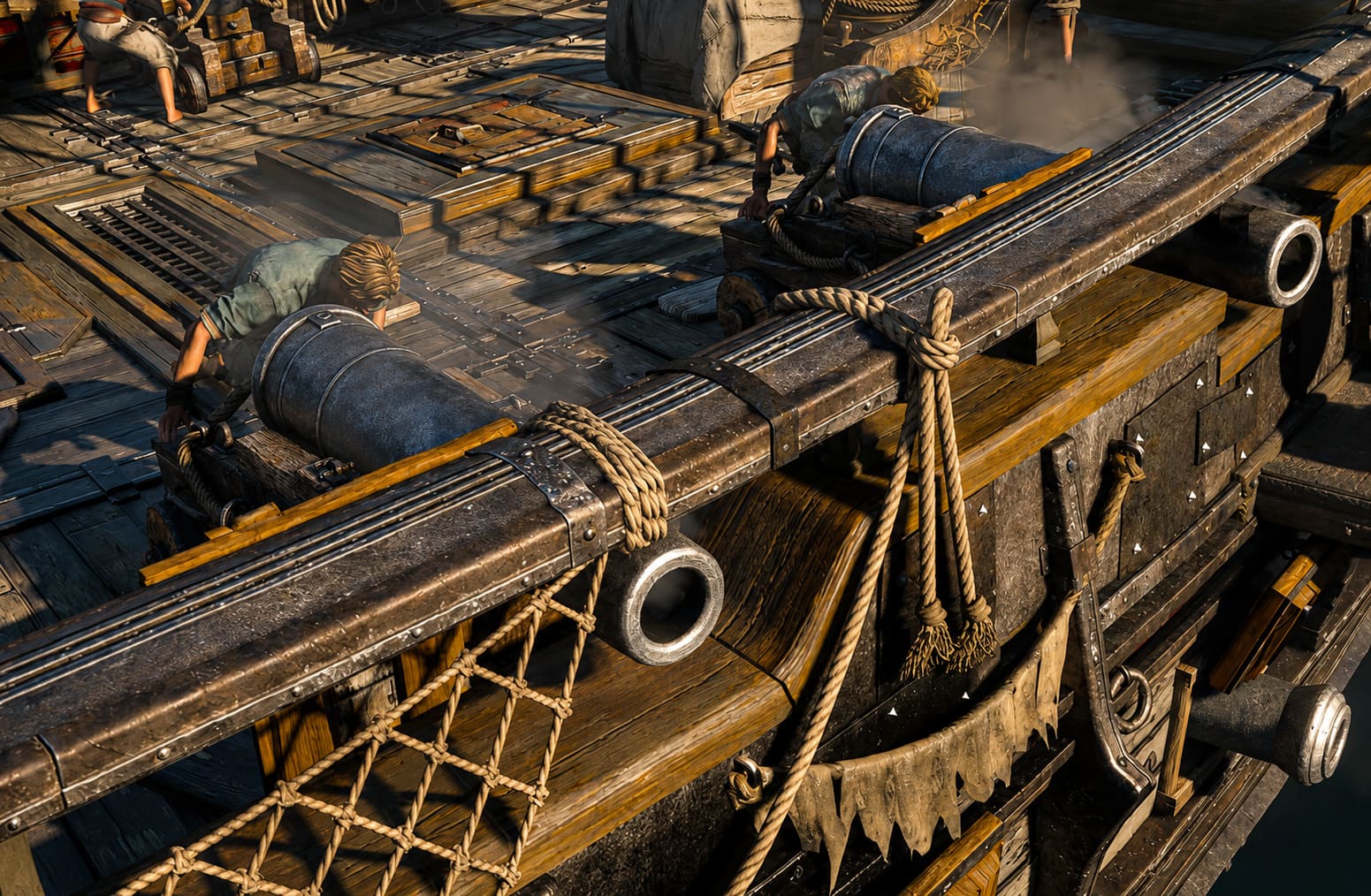
Powered by Ubisoft’s latest Anvil Engine, the Caribbean has been reconstructed using modern rendering technology rather than simply increasing texture resolution.
Some of the biggest improvements include:
- Physically based rendering (PBR) across every environment.
- Completely redesigned ocean simulation with volumetric foam.
- Dynamic weather systems affecting water behavior.
- Higher-density vegetation and environmental geometry.
- Virtually seamless travel between cities and open seas.
- Massive improvements to environmental lighting.
Instead of feeling like an old game wearing HD textures, Resynced genuinely looks like a title designed for current-generation hardware.
The Caribbean Finally Feels Alive
The ocean has always been the real star of Black Flag.
After watching gameplay demonstrations, it’s easy to see why Ubisoft spent so much development time rebuilding the water technology from scratch.
Every wave interacts naturally with the Jackdaw.
Storms create believable turbulence instead of scripted animations.
Wind influences sea movement with much greater realism.
Foam builds around rocks and ships dynamically.
Even underwater effects have received significant upgrades through improved lighting and particle systems.

Small details matter here.
- Sunlight bouncing across moving waves.
- Rain creating temporary surface disturbances.
- Ships cutting through rough seas with realistic displacement.
These aren’t flashy marketing buzzwords—they noticeably improve immersion during long sailing sessions.
PS5 Pro Removes the Biggest Compromise Console Players Always Faced
One thing console gamers know all too well is choosing between graphics and performance.
Want smooth gameplay? Lose visual effects.
Want better visuals? Accept 30 FPS.
That trade-off has existed for years.
The PS5 Pro version of Black Flag Resynced is one of the first Ubisoft games where that compromise becomes dramatically smaller.
Thanks to additional GPU power and PSSR 2.0 (PlayStation Spectral Super Resolution), Ubisoft can preserve premium visual features while maintaining much higher frame rates.
Instead of forcing players to sacrifice ray tracing for performance, the Pro hardware keeps advanced lighting enabled across every graphics preset.
That’s a huge win.
PSSR 2.0 Makes a Bigger Difference Than Resolution Numbers
People often obsess over native resolution.
Personally, I care far more about image quality than raw pixel counts.
PSSR 2.0 intelligently reconstructs lower internal resolutions into a remarkably clean 4K presentation while reducing shimmering and temporal artifacts that can ruin foliage-heavy environments.
The Caribbean is filled with exactly those kinds of scenes:
- Palm trees
- Rope rigging
- Dense jungle
- Ship sails
- Complex architecture
Those elements traditionally expose weaknesses in upscaling techniques.
PSSR 2.0 appears to handle them impressively well while freeing valuable GPU resources for more demanding rendering features.
Extended Ray Tracing Is Active Across Every PS5 Pro Mode
Ray tracing isn’t just about shiny puddles.
In Black Flag Resynced it changes nearly every part of environmental presentation.
- Lighting behaves naturally inside taverns.
- Ocean reflections accurately mirror nearby ships.
- Sunlight reacts realistically during storms.
- Metal weapons reflect surrounding environments.
- Interior lighting transitions smoothly into outdoor scenes.
Unlike the standard PlayStation 5, the Pro version maintains Extended Ray Tracing regardless of which graphics preset players choose.
That means smoother gameplay no longer comes at the cost of dramatically simplified lighting.
Every Graphics Mode Explained
| Mode | Frame Rate | Best For | Major Features |
|---|---|---|---|
| Performance | 60 FPS | Combat, exploration, naval battles | PSSR 2.0, Extended Ray Tracing, stable gameplay |
| Balanced | 40 FPS | 120Hz displays with VRR | Higher internal resolution, sharper visuals, smoother motion than 30 FPS |
| Fidelity | 30 FPS | Screenshots and cinematic presentation | Maximum draw distance, highest shadow quality, enhanced ray tracing |
Performance Mode
This will probably become the community favorite.
A stable 60 FPS completely changes sword fights, climbing, naval combat, and parkour responsiveness.
The impressive part is that Ubisoft isn’t stripping away visual effects to reach that target.
Ocean reflections, global illumination, and lighting remain intact.
That wasn’t possible on older console hardware.
Balanced Mode
If you own a 120Hz television, Balanced Mode deserves serious attention.
Forty frames per second doesn’t sound exciting on paper, but anyone who has played modern PlayStation exclusives knows how surprisingly smooth it feels on compatible displays.
It’s an excellent compromise between visual fidelity and responsiveness.
Fidelity Mode
This mode pushes visual quality as far as possible.
- Higher-quality shadows.
- Longer ray tracing distances.
- Maximum environmental density.
- Expanded crowd populations.
- Better HDR presentation.
It’s clearly designed for players who enjoy taking screenshots or experiencing the game with every graphical setting pushed to its limit.
Hair Physics Are Surprisingly Impressive
One unexpected technical upgrade comes from the new strand-based hair simulation.
Instead of using traditional flat texture cards, important characters now feature individual hair strand rendering.
Edward’s hair reacts naturally while climbing.
Blackbeard’s beard shifts during storms.
Wind continuously affects long hairstyles during sailing.
It’s a subtle improvement that becomes surprisingly noticeable during cinematic conversations.
DualSense Features Go Beyond Basic Controller Vibration
Ubisoft is also making excellent use of the PlayStation ecosystem.
- Adaptive triggers simulate firearm resistance.
- Different sword impacts produce distinct haptic feedback.
- Heavy waves create physical resistance while steering the Jackdaw.
- Environmental vibrations help indicate nearby explosions or enemy attacks.
Combined with Dolby Atmos and 3D Audio, the result feels considerably more immersive than simply increasing graphical settings.
Sea shanties echo across the deck.
Cannons thunder from believable directions.
Storms surround the player instead of sounding like generic background noise.
Gameplay Improvements Matter Just as Much as Graphics
Visual upgrades alone wouldn’t justify a remake.
Thankfully, Ubisoft also revisited many gameplay systems that frustrated players over the years.
- Redesigned tailing missions with alternative failure states instead of immediate mission restarts.
- Modern stealth mechanics, including smoother crouching and improved environmental cover.
- Refined parkour, featuring better momentum, cleaner traversal, and more responsive controls.
- Updated combat, replacing repetitive counter-kill chains with timing-based parries, dodges, and tactical weapon usage.
- Expanded naval progression, including recruitable officers that unlock passive bonuses and unique side missions.
- Additional narrative content for iconic historical pirates, complete with newly recorded dialogue.
These changes don’t replace the soul of Black Flag—they remove many of the frustrations that players have complained about for more than a decade.
Should You Upgrade to PS5 Pro for Black Flag Resynced?
If Black Flag Resynced ends up performing as well as Ubisoft has demonstrated, it may become one of the strongest showcases for the PlayStation 5 Pro.
For years, players dreamed about experiencing Black Flag with modern lighting, high frame rates, seamless exploration, and realistic ocean technology.
That dream is finally becoming reality.
The biggest achievement isn’t any individual feature.
It isn’t PSSR 2.0.
It isn’t ray tracing.
It isn’t even 60 FPS.
It’s how all of those technologies work together without forcing players into painful compromises. Sailing across the Caribbean while maintaining fluid gameplay, realistic lighting, detailed reflections, and dramatically improved environmental density creates an experience that feels genuinely next generation rather than simply higher resolution.
For longtime fans, this remake looks like the version Black Flag always deserved. And for newcomers, there may never have been a better opportunity to discover why Edward Kenway’s adventure remains one of Ubisoft’s greatest achievements. If the final release delivers on everything shown so far, Assassin’s Creed Black Flag Resynced won’t just revisit gaming history—it will redefine one of the finest pirate games ever created for an entirely new generation.