Gothic 1 Remake: When to Drink Permanent Stat Potions (Min-Max Guide)
After spending dozens of hours streaming Gothic 1 Remake and experimenting with different character builds, I’ve noticed one mistake that keeps appearing in chat, Steam discussions, and community forums.
Players find a permanent Strength, Dexterity, or Mana potion and immediately drink it.
It feels like the smart thing to do.
You become stronger right away, enemies die faster, and new weapons suddenly become available.
Unfortunately, if you’re aiming for an optimized character, that’s often the worst decision you can make.
Today I want to share what I’ve learned during my playthroughs and testing sessions. If you’re planning to push your character to the limit, understanding when to use permanent stat potions is one of the most important things you can learn in Gothic 1 Remake.
Why Permanent Potions Are More Valuable Than They Look
One thing I absolutely love about Gothic 1 Remake is that it respects the old-school RPG philosophy.
The game doesn’t simply hand out power.
Every point of Strength, Dexterity, and Mana feels earned.
You level up, gain Learning Points, find trainers, and carefully decide how your character develops. Every investment matters, which is exactly why permanent stat potions become such a big deal.
Unlike temporary buffs, these elixirs increase your attributes forever.
That sounds amazing on paper.
The problem is that many players use them too early without realizing how the game’s progression systems interact with attribute training.
Understanding the 100-Point Training Barrier
During my first serious build test, I noticed something interesting.
Most trainers are willing to teach your character until you reach a specific threshold. Once your displayed attribute reaches that limit, their training options disappear.
For practical purposes, that magic number is usually 100 points.
Whether you’re focusing on:
- Strength
- Dexterity
- Mana
your trainers eventually stop offering additional lessons.
This creates a very important question:
Would you rather spend Learning Points to reach 100 and then gain bonus stats from potions, or reach 100 through potions first and lose access to some training opportunities?
The answer is obvious once you see the numbers.
The Early Potion Trap
Let’s imagine a typical melee character.
You invest points into Strength and eventually reach 75.
Along the way, you discover several permanent Strength potions and decide to drink them immediately.
Now your displayed Strength jumps significantly.
Sounds great, right?
Not necessarily.
If your displayed value reaches the trainer’s limit too early, you may stop being able to purchase additional Strength training despite still having Learning Points available.
That means you’re effectively replacing trainable points with rare consumables.
As someone who enjoys squeezing every bit of potential from RPG systems, I consider this one of the biggest efficiency losses in the entire game.
My Recommended Min-Max Strategy
After testing multiple builds, this is the method I personally follow.
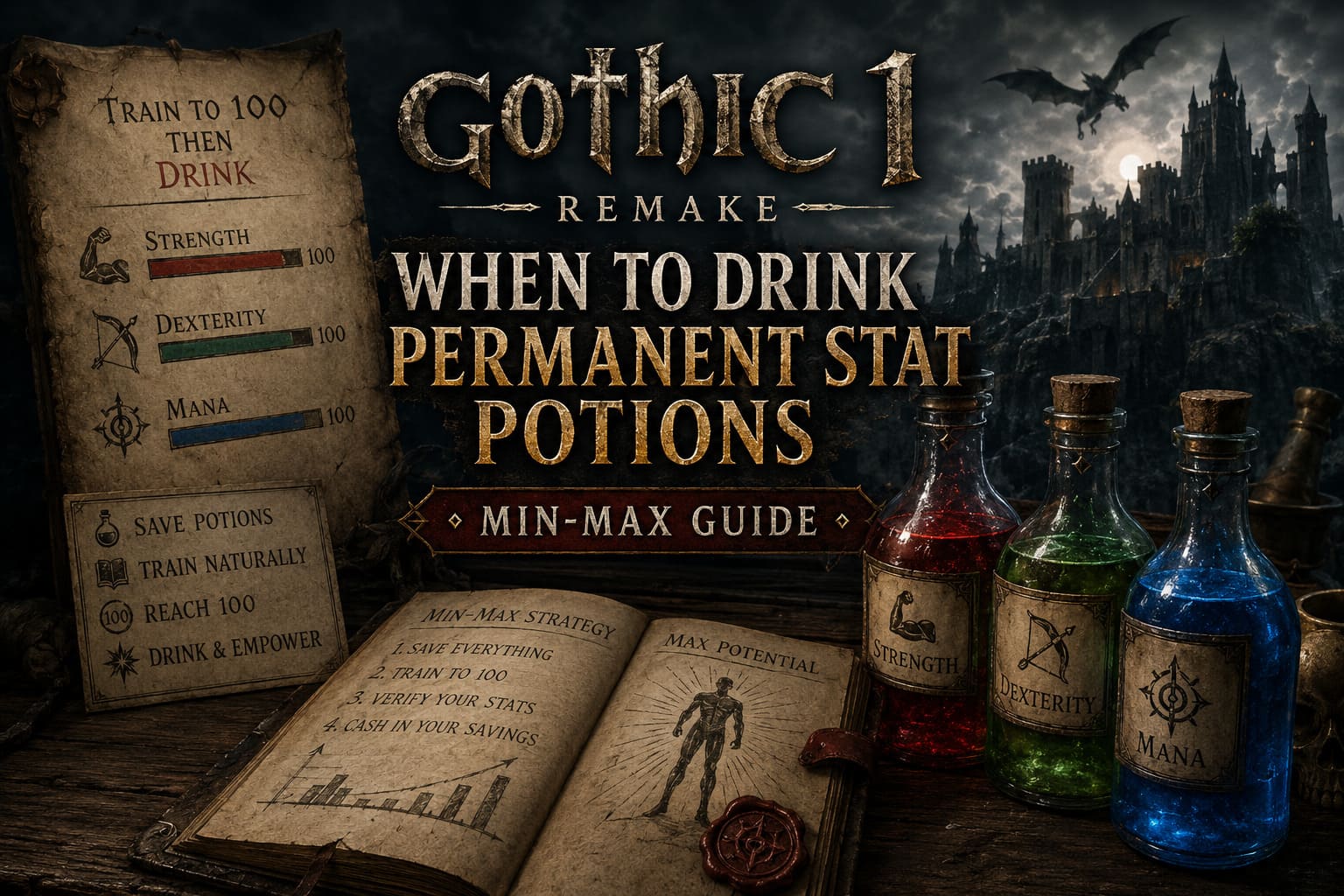
Step 1: Save Everything
Do not drink:
- Permanent Strength potions
- Permanent Dexterity potions
- Permanent Mana potions
- Rare attribute-boosting herbs
Store them and forget they exist.
Seriously.
Pretend they aren’t even in your inventory.
Step 2: Focus on Natural Growth
Use your Learning Points normally.
Visit trainers.
Raise your chosen primary attribute until you reach the natural training limit.
For most characters, that means pushing Strength, Dexterity, or Mana all the way to 100.
Step 3: Verify Your Real Stats
Before talking to trainers, remove any equipment that grants bonuses.
This includes:
- Rings
- Amulets
- Belts
- Special accessories
Many players overlook this detail.
A piece of jewelry granting +5 Strength might be enough to trigger the trainer cap earlier than expected.
Step 4: Cash In Your Savings
Once you’ve exhausted available training and reached the natural limit, it’s finally time.
Open your inventory.
Drink every permanent potion you’ve been collecting.
Use every stored herb.
Watch your stats skyrocket.
This is where your character transforms from strong to absurdly powerful.
Attribute Priorities by Build
Different playstyles benefit from this strategy in slightly different ways.
| Build Type | Primary Stat | Potion Timing |
|---|---|---|
| One-Handed Warrior | Strength | After 100 Training |
| Two-Handed Warrior | Strength | After 100 Training |
| Archer | Dexterity | After 100 Training |
| Crossbow Build | Dexterity | After 100 Training |
| Fire Mage | Mana | After 100 Training |
| Hybrid Build | Main Attribute | After 100 Training |
The rule remains consistent regardless of specialization.
Natural progression first.
Permanent bonuses second.
What About Mage Characters?
Mage progression deserves special attention.
Many RPGs allow spellcasters to scale differently from physical fighters, but Gothic 1 Remake remains surprisingly strict.
Mana is incredibly important throughout the game.
Higher Mana pools mean:
- More spell casts
- Better combat endurance
- Less dependence on restoration items
- Greater effectiveness during extended fights
Because of this, many new players are tempted to consume Mana potions immediately.
I understand the temptation.
Casting stronger spells earlier feels fantastic.
However, from a long-term perspective, I still recommend waiting until you’ve maximized your trainable Mana.
The payoff later in the game is enormous.
The One Exception I Can Understand
Normally, I advocate saving every permanent stat potion.
There is, however, one situation where I think using a potion early can be justified.
If you’re completely stuck.
Maybe a stronger weapon requires just a few more Strength points.
Maybe a difficult quest is blocking progression.
Maybe a boss encounter feels impossible.
In those situations, drinking a potion for immediate power isn’t a disaster.
Games are supposed to be fun.
If a small boost helps you continue enjoying your adventure, go for it.
Just understand that you’re trading some long-term optimization for short-term convenience.
For most players, that’s perfectly acceptable.
For dedicated min-maxers, patience remains the better option.
Permanent Health Potions Are Different
Here’s the good news.
Not every potion requires careful planning.
Permanent Health potions are much more straightforward.
Whenever I find one during a stream, I usually drink it immediately.
Extra health improves survivability right away and doesn’t interfere with attribute training in the same way Strength, Dexterity, and Mana can.
As a result, HP-boosting consumables are generally safe to use the moment you obtain them.
That’s free value.
Take it.
My Final Verdict
After spending countless hours exploring the Colony, testing character progression, and experimenting with various builds, I’ve reached one clear conclusion:
The strongest Gothic 1 Remake characters are built through patience.
The temptation to drink every permanent potion immediately is understandable.
I’ve done it myself.
But once you understand how attribute training works, hoarding those valuable consumables becomes one of the smartest decisions you can make.
My personal rule is simple:
Train first. Drink later.
Reach the natural limit through trainers, remove all bonus equipment before training sessions, and save every permanent attribute booster until you’ve exhausted your normal progression.
When you finally unleash that stockpile of potions, the power spike is incredibly satisfying.
And trust me—as someone who genuinely loves deep RPG progression systems—few moments in Gothic 1 Remake feel better than watching your carefully planned character evolve into an absolute monster during the final chapters of the game.
If your goal is creating the strongest possible hero, this strategy remains the gold standard.