Wanderburg Early Access Review 2026: Is This Rolling Castle Roguelike Worth Your Money?
There are moments when a game comes along and immediately makes me think, “Okay, this is actually something I haven’t played before.” After spending time with Wanderburg, that was pretty much my reaction.
The roguelike and bullet heaven market is absolutely packed right now. Since Vampire Survivors turned the survivors-like formula into one of gaming’s biggest trends, we’ve seen countless games built around auto-attacks, hordes of enemies, XP gems, upgrades, and increasingly ridiculous screen-filling combinations. Some are great. Others feel like the same game wearing a different costume.
Wanderburg takes that familiar formula and throws it onto a giant medieval fortress with wheels.
And yes, you literally drive a castle around the map.
Developed by Randwerk and published by Sidekick Publishing, Wanderburg enters Steam Early Access on September 8, 2026. The concept is ridiculous in exactly the right way: instead of controlling a lone warrior, you’re piloting a growing mobile fortress that consumes villages, enemies, animals, structures, and rival strongholds while expanding into an increasingly absurd war machine.
I’ve played plenty of roguelikes that promised something different before, but Wanderburg actually delivers on that promise. At the same time, this is very clearly an Early Access game, and some of its rough edges are impossible to ignore.
So, is Wanderburg worth buying right now? My answer is complicated — but mostly positive.
A Roguelike Where Your Character Is an Entire Castle
The first thing that hooked me was the central idea.
You don’t start as some legendary knight with a sword and ten abilities. You begin with a relatively humble moving fortress and a lot of empty space waiting to be filled.
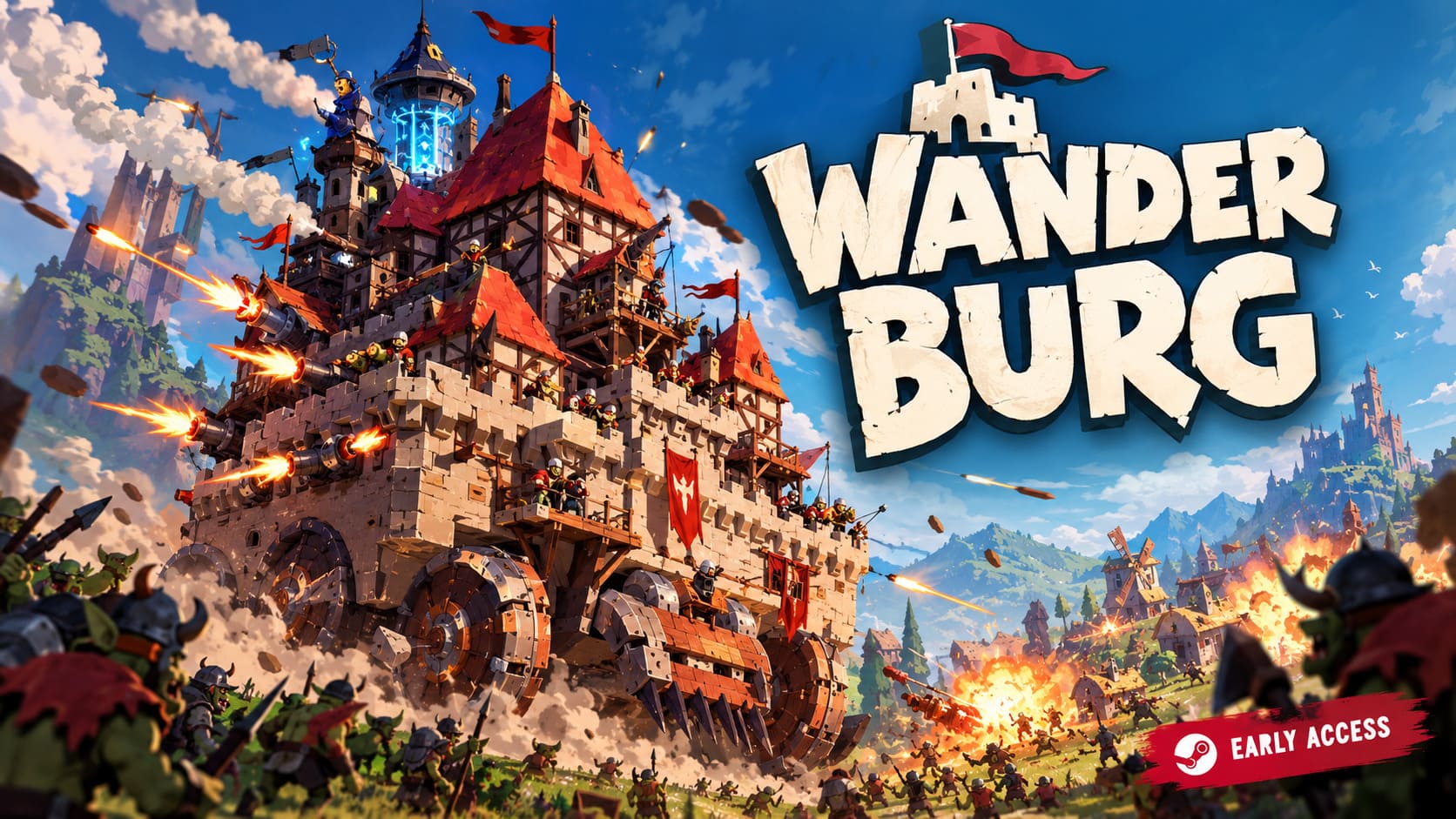
Your castle travels through a procedurally generated world, and almost everything around you can become part of your progression. Villages run away from you, enemies attack from every direction, and wandering groups become targets for your enormous rolling stronghold.
The more you consume, the larger your fortress becomes.
This is where Wanderburg immediately separates itself from most bullet heaven games.
In a traditional survivors-like, gaining a level might give you +10% damage or another projectile. In Wanderburg, progression is physical. Your fortress actually grows on screen. New structures appear on your vehicle, additional weapons occupy space, and your once-small castle gradually becomes a ridiculous medieval battleship.
Watching that transformation happen during a run is incredibly satisfying.
And the game isn’t afraid to get silly with its arsenal.
You can combine traditional medieval defenses with magical and industrial technology, creating combinations that look like somebody threw a fantasy castle, a steam engine, and an arcade shooter into the same blender.
- Wizard towers and magical attacks
- Steam-powered siege equipment
- Rapid-fire cannons
- Heavy defensive structures
- Specialized barracks and combat units
- Ridiculously armored knights riding bicycles
That last one pretty much summarizes Wanderburg for me. The game understands that being serious isn’t always necessary. It wants you to build the most ridiculous fortress possible and then drive it directly through a battlefield.
The Modular Building System Is the Real Star
The modular construction system is probably my favorite part of the game.
Instead of simply selecting upgrades from a menu and watching numbers increase, you’re building your fortress piece by piece. The structure of your castle becomes part of your strategy.
That creates some genuinely interesting decisions.
Do you concentrate on offensive weapons and try to destroy everything before it gets close? Do you create a heavily defended fortress that can survive being surrounded? Or do you build around particular synergies and deliberately chase combinations that become completely broken later in the run?
Breaking the game is practically part of the fun.
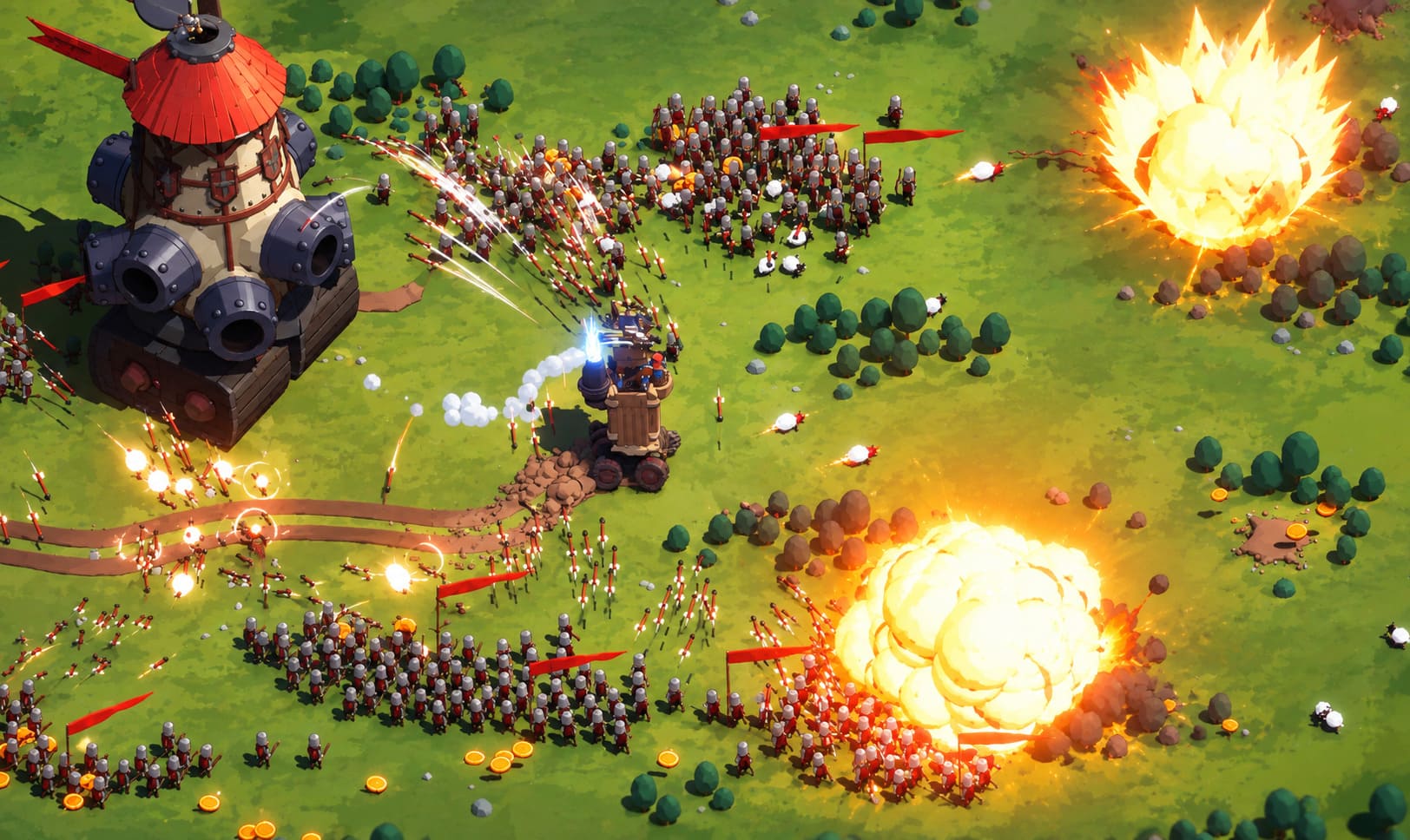
That’s something I always look for in a roguelike. I want that moment where a build suddenly clicks and I go from barely surviving to wondering whether the developers actually intended my ridiculous combination to work.
Wanderburg has plenty of those moments.
The meta-progression system also gives you reasons to return after a failed run. Resources can be used to unlock additional vehicle frames, engine modules, weapons, and other options that gradually expand your build possibilities.
So even when a run goes horribly wrong, it rarely feels completely wasted.
It Looks Like Mortal Engines Met a Whimsical Fantasy World
Visually, Wanderburg has a personality that I really appreciate.
The aesthetic feels like a strange collision between medieval fantasy, giant mechanical vehicles, and whimsical animated fantasy design. There are obvious echoes of the kind of world you might expect from Mortal Engines, but the presentation isn’t trying to be relentlessly grim.
That contrast works surprisingly well.
You’ve got enormous structures rolling across the landscape while magical effects, mechanical weapons, knights, and various enemies turn the battlefield into complete chaos.
The visual growth of the castle is especially important. Because your fortress physically changes throughout a run, progression feels much more meaningful than a spreadsheet full of stat increases.
For me, that’s a huge win.
Where Early Access Starts Showing Its Cracks
Now we get to the part where I have to pump the brakes a little.
Wanderburg has a fantastic idea, but the current Early Access build isn’t polished enough for everyone.
The biggest issue I’ve seen discussed by players is performance.
Under normal conditions, the game can run very well. But once your fortress becomes enormous and the screen fills with enemies, projectiles, elemental effects, and units, things can get ugly.
Some players have reported enormous frame-rate drops during especially chaotic encounters. The problem appears particularly noticeable when multiple effects and high-density structures interact simultaneously.
And this is exactly the kind of problem that hurts a bullet heaven.
The entire appeal of the genre is watching the game descend into beautiful, ridiculous chaos. If that chaos turns into stuttering and single-digit frame rates, the spectacle becomes frustrating very quickly.
The Tutorial Problem Is Even More Noticeable
Performance isn’t my only concern.
The onboarding needs work.
If you’re coming into Wanderburg without knowing anything about its systems, the game doesn’t always do a great job of explaining what you’re supposed to prioritize.
There are moments where I wanted the game to simply stop and tell me:
“Here is how this system works. Here is why this structure matters. Here is how these two upgrades interact.”
Instead, you’re often expected to experiment.
Experimentation can be fun, but there is a difference between discovering a clever strategy and trying to understand an unexplained mechanic.
The early interface also feels unfinished in places, reinforcing the impression that this is a game still being actively assembled.
Some early builds reportedly even lacked a conventional in-game quit option, which is exactly the kind of small detail that screams Early Access.
Wanderburg on Steam Deck
This is where things get interesting.
Despite the desktop performance complaints, Wanderburg has developed a surprisingly enthusiastic following among handheld players, particularly Steam Deck users.
During normal gameplay, reports from players suggest that the game can maintain around 50–60 FPS on both LCD and OLED Steam Deck models. Naturally, the heaviest battles can still cause drops, but the short-run structure makes the game a particularly good fit for portable gaming.
Personally, I think this genre is almost perfect for Steam Deck anyway.
You can pick it up, play a run, experiment with a build, fail spectacularly, unlock something new, and put the device down.
A 50Hz lock has become one of the commonly suggested approaches for achieving a smoother experience when the action gets particularly hectic.
I’d still like to see stronger graphics options and proper FSR support in future updates. Those additions could make the handheld experience considerably more consistent once late-game chaos starts getting ridiculous.
My Pros and Cons
| Category | My Take |
|---|---|
| Core Gameplay | ⭐⭐⭐⭐⭐ |
| Build Variety | ⭐⭐⭐⭐⭐ |
| Visual Identity | ⭐⭐⭐⭐½ |
| Meta Progression | ⭐⭐⭐⭐ |
| PC Optimization | ⭐⭐½ |
| Steam Deck Experience | ⭐⭐⭐⭐ |
| Tutorials / UX | ⭐⭐ |
| Early Access Potential | ⭐⭐⭐⭐⭐ |
What I Like
- A genuinely original premise in an overcrowded roguelike market.
- Physical castle expansion makes progression incredibly satisfying.
- Modular construction creates lots of room for experimentation.
- The ridiculous weapon combinations are exactly the kind of chaos I want from this genre.
- Strong potential for future updates and additional content.
- Steam Deck is already a surprisingly good place to play it.
What Needs Work
- PC performance can collapse during extremely busy encounters.
- The onboarding experience needs much more explanation.
- UI elements still feel unfinished in places.
- Early difficulty can be rough for players without permanent upgrades.
- Current content can start feeling repetitive after extended sessions.
Wanderburg PC System Requirements: Storage Size and Spec Analysis for 2026’s Best Indie Roguelike
Is Wanderburg Worth Buying in Early Access?
This is one of those games where I completely understand both sides of the argument.
If you expect a polished, finished product with perfect optimization, detailed tutorials, perfectly balanced progression, and a huge amount of content, I wouldn’t rush to buy Wanderburg on day one.
I’d put it on your Steam Wishlist and watch the updates.
But if you’re the kind of player who enjoys finding weird builds, experimenting with systems, and watching a game gradually turn into complete nonsense, then Wanderburg is much easier to recommend.
The biggest compliment I can give it is simple:
I wanted to keep playing.
That’s more important to me than whether every menu is perfect.
The concept has genuine personality. The castle actually feels like a character because it grows throughout the run. There’s something deeply satisfying about starting with a relatively pathetic moving fortress and eventually becoming a gigantic mechanical nightmare capable of rolling through entire formations.
And that’s something the genre desperately needs right now.
There are too many survivors-like games that feel interchangeable. Wanderburg doesn’t have that problem.
It might be rough around the edges, but the idea underneath is fantastic.
For me, this is a “buy if you love experimentation, wishlist if you demand polish” situation. I wouldn’t recommend it blindly to everyone, but I absolutely want to see where Randwerk takes it over the next several months.
If the developers improve performance, rebuild the onboarding experience, expand the biomes, and keep adding interesting modules and interactions, Wanderburg could become one of those Early Access games that people look back on and say, “I was there before it got huge.”
For a game about driving an absurd castle around and eating villages, that’s a pretty good place to start.
Verdict: 8/10 — Wildly creative, addictive, and full of potential, but still waiting for the polish to catch up with the idea.