The Blood of Dawnwalker: Best Beginner Starter Build Guide (2026)
If there is one thing I learned quickly while playing The Blood of Dawnwalker, it is that this is not the kind of RPG where you can casually throw skill points around and expect everything to work out later.
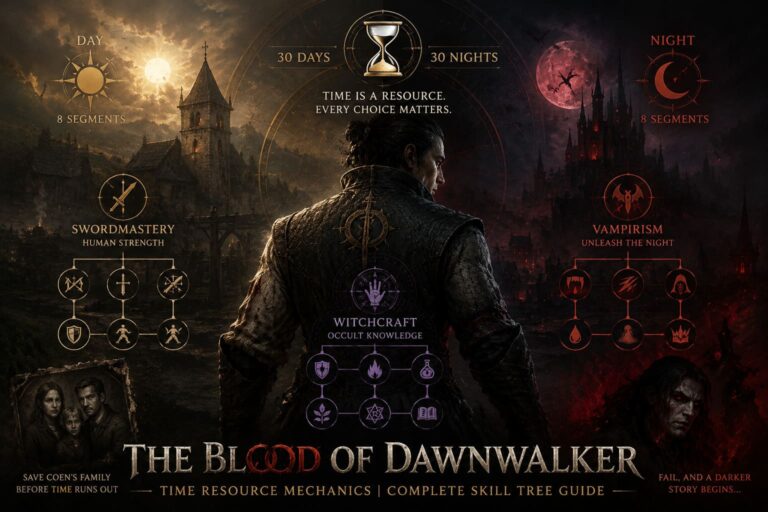
Coen is dealing with two completely different identities. During the day, he is still close enough to humanity to use Witchcraft and conventional survival tools. At night, the vampire side takes over, opening up a completely different set of movement and combat options. Add the game’s 30-day time limit, the cost of using travel shrines, and the lack of a traditional respec system, and suddenly every upgrade feels like it matters.
That is why I prefer what I call the Balanced Vanguard build.
It is not designed to produce the biggest possible damage number or turn Coen into a glass-cannon vampire. Instead, it gives you something much more valuable during a first playthrough: consistency. You have reliable stamina, forgiving defense, strong melee damage, useful daytime magic, and enough Vampirism to make nighttime exploration dramatically faster.
If you’re starting The Blood of Dawnwalker in 2026 and don’t want to spend half your playthrough wondering whether you ruined Coen’s build, this is where I’d start.
Why the Balanced Vanguard Build Works
The biggest mistake a new player can make is treating the three skill trees as separate builds.
They aren’t.

The real strength of Coen comes from making his different abilities cover each other’s weaknesses. Swordmastery gives you the dependable combat foundation, Witchcraft handles daytime utility, and Vampirism turns nighttime into an opportunity rather than something you simply survive.
Here’s how I think about the three trees:
| Skill Tree | When It Matters | Main Purpose |
|---|---|---|
| Swordmastery | Day & Night | Melee, defense, stamina |
| Witchcraft | Daytime | Utility, buffs, healing support |
| Vampirism | Nighttime | Mobility, ambushes, burst damage |
The important part is that you don’t need to max everything.
In fact, I’d strongly recommend against trying to unlock every interesting ability you see. The world clock makes experimentation expensive, and every visit to a shrine can consume a time segment when you’re unlocking or upgrading skills.
Your build should support your actual playstyle, not your completionist instincts.
First Priority: Fix Coen’s Mobility
Before worrying about damage, I would get movement sorted out.
Veil Sangora is large, and the amount of time you can waste simply traveling between objectives is surprisingly important. With only 30 days available for the larger story, being able to move efficiently isn’t just convenient — it can directly affect how much content you have time to complete.
Fortunately, two early abilities are particularly useful.
Mercurial Fervour
This Witchcraft ability improves Coen’s daytime sprint and is one of those upgrades that doesn’t look spectacular on paper until you’ve played without it.
Once you start crossing larger stretches of the map, you’ll appreciate it constantly.
Shapeshift
At night, Shapeshift gives Coen access to his wolf form.
You need to start building Corruption before you can access the Vampirism progression, so spend some time using Voracious Bite on suitable animals around the southern bogs near Leslie Glenn Village.
Personally, I’d grab this extremely early. Fast travel is nice, but having a strong movement option available while you’re actually exploring makes the entire game feel better.
My advice: don’t treat mobility as a luxury upgrade. Get it early.
Swordmastery Should Be Your Main Investment
If you only remember one thing from this guide, make it this: Swordmastery is the backbone of the beginner build.
The directional combat system can be intimidating at first. You’re watching attack angles, managing stamina, blocking, dodging, and trying to recognize enemy patterns instead of simply holding a block button and waiting.
That means stamina and defensive consistency are incredibly valuable while you’re still learning.
And believe me, you’ll make mistakes.
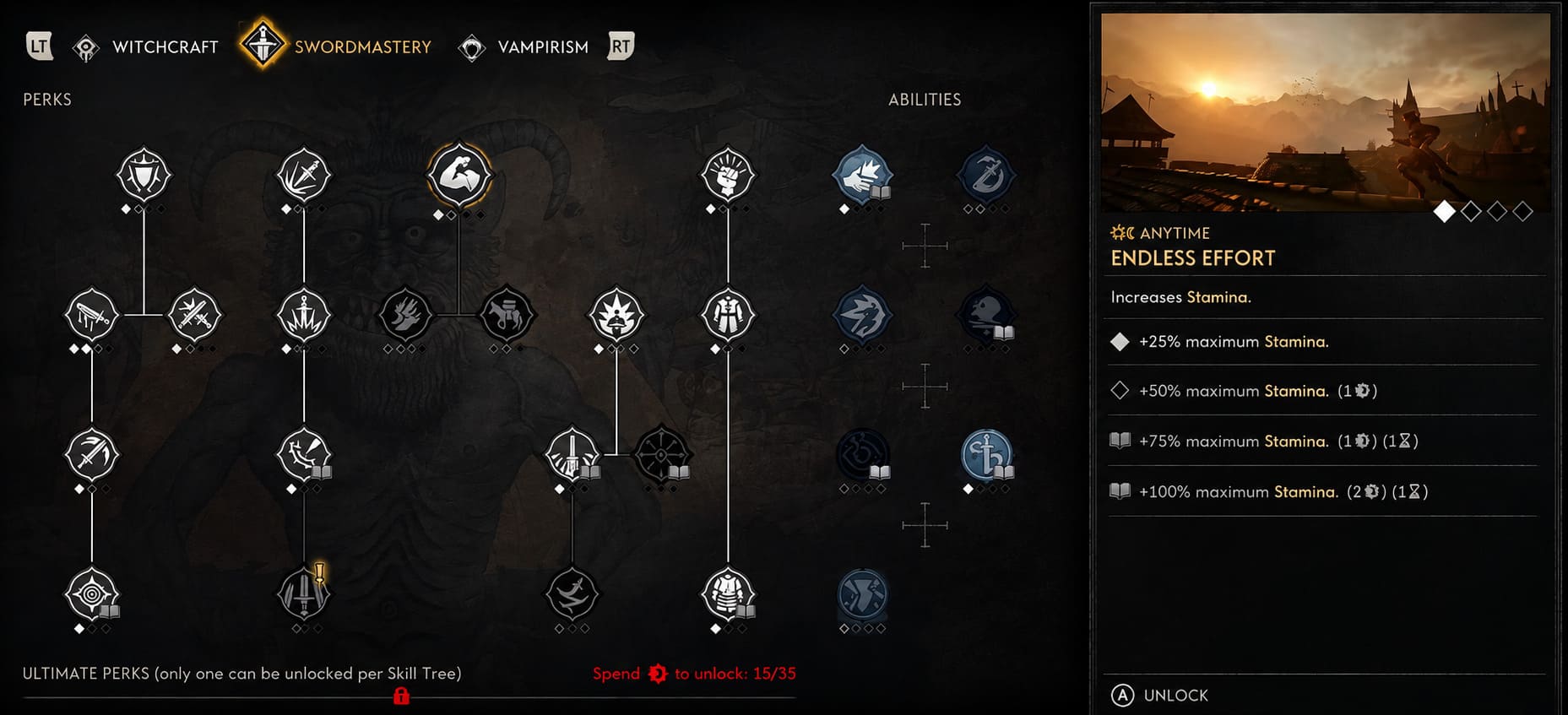
Endless Effort
I’d put Endless Effort near the top of your shopping list.
More stamina and better stamina recovery improve practically every part of melee combat. Attacking consumes it. Defending consumes it. Dodging consumes it.
A larger stamina cushion gives you room to make mistakes.
And believe me, you’ll make mistakes.
Omniblock
The directional blocking system is one of the more interesting parts of The Blood of Dawnwalker, but early on it can also make basic encounters unnecessarily stressful.
Omniblock gives you a much more forgiving defensive option against standard attacks from different directions, although you’ll pay for that convenience with additional stamina consumption.
For a beginner, I think that’s a fair trade.
Once you become comfortable reading attacks, you can rely more heavily on directional defense and perfect timing. Until then, Omniblock is your safety net.
Perfect Riposte and Counterattack
This is where the build starts becoming genuinely fun.
Once you’ve learned enemy attack patterns, successful defensive timing can turn directly into offensive pressure.
Perfect Riposte rewards you for reading attacks correctly, while Counterattack improves what happens after you’ve successfully defended.
This combination fits the Balanced Vanguard perfectly because you’re not choosing between defense and damage. You’re using defense to create damage opportunities.
Artery Strike
I’d also pick up Artery Strike early.
The chance to instantly eliminate weaker enemies through a decapitating strike can save a surprising amount of time during routine encounters. It isn’t necessarily the most exciting ability in the tree, but anything that speeds up low-level fights has value when you’re operating under a strict world-clock system.
Later, Stinging Blade and Growing Momentum become attractive follow-up choices as you lean further into sustained melee combat and critical-hit potential.
Witchcraft: Take Utility, Not Everything
Witchcraft is where I see new players potentially getting carried away.
The tree looks tempting because it gives Coen magical tools that can completely change how daytime encounters work. The catch is simple: Witchcraft abilities consume Coen’s health rather than a traditional mana pool.
That means spamming spells without thinking can turn a manageable encounter into a healing problem.
For this build, I’m much more interested in sustainability.
Font of Life
Font of Life is one of my favorite early utility picks because passive daytime regeneration makes the whole system less punishing.
You’re essentially getting value without constantly spending resources.
Potent Blood
This is another strong supporting perk.
Because Witchcraft consumes HP, having a chance for spells to cost nothing gives you more freedom to use your magical toolkit without constantly worrying about whether you’re sacrificing too much health.
Aether Flow
Cooldown reduction is rarely flashy, but it becomes increasingly useful as you start depending on utility spells more frequently.
Aether Flow lets you cycle those tools faster, which makes the Witchcraft side of the build feel much more practical rather than something you only activate in emergencies.
Turn Into a Monster at Night
Once darkness arrives, Coen’s combat philosophy changes.
This is where I would stop trying to play like a normal swordsman and start taking advantage of the abilities that make him a Dawnwalker in the first place.
Ravenous Flock
Ravenous Flock is fantastic when several enemies are giving you trouble.
The bat swarm can blind and disrupt groups, creating the breathing room you need to reposition or isolate targets. It’s especially useful when a clean one-on-one fight turns into something much messier.
Its progression can also be improved through windchime-related world activities, so keep an eye out for those while exploring.
Death From Above
This is one of those abilities that makes you feel clever.
Instead of walking through the front door of an enemy position, Death From Above lets you use elevation to your advantage.
Against weaker enemies, it can remove a target immediately. Against stronger opponents, it can soften them before the real fight starts.
Whenever the environment gives you rooftops, cliffs, or elevated positions, look for opportunities to exploit them.
Shadow Step
For aggressive nighttime combat, Shadow Step is another excellent choice.
Being able to rapidly reposition behind an enemy can completely change an encounter, especially when you’re already combining directional sword combat with vampire abilities.
I wouldn’t use it simply because it’s available. Save it for moments where repositioning creates a genuine advantage.
Weapons: Why I Recommend Longswords First
You can build around different weapon types, but for a first playthrough I strongly prefer longswords.
They offer a comfortable middle ground between reach, attack speed, stamina consumption, and damage. More importantly, they complement the defensive playstyle of Perfect Riposte and Counterattack.
Greatswords are tempting because they hit extremely hard and their sweeping attacks can be excellent against groups. However, their stamina demands are much less forgiving.
Short swords are faster and can work well for aggressive players, but their shorter reach puts you closer to danger.
| Weapon | My Verdict | Best For |
|---|---|---|
| Longsword | Best Beginner Choice | Balanced combat |
| Greatsword | High Risk / High Reward | Experienced players |
| Short Sword | Aggressive Option | Fast attacks |
If you’re learning the combat system, take the longsword and spend your time learning enemy animations instead of fighting the weapon’s limitations.
Don’t Ignore Early Armor
Armor is easy to overlook when you’re excited about skill trees, but early defensive gear can make the first stages of the game considerably smoother.
Keep an eye out for Artisan Armor and useful bandit equipment around the Outlaw’s Gorge area.
I’d prioritize gear that improves your sustainability, particularly pieces with the Mending Augment and useful stamina-related bonuses.
I wouldn’t obsess over finding a perfect armor set immediately. Your early-game priority should be getting functional gear and moving forward rather than burning valuable time searching every corner for a marginal upgrade.
Healing Works Differently Depending on the Time of Day
One of the easiest systems to misunderstand is Coen’s healing.
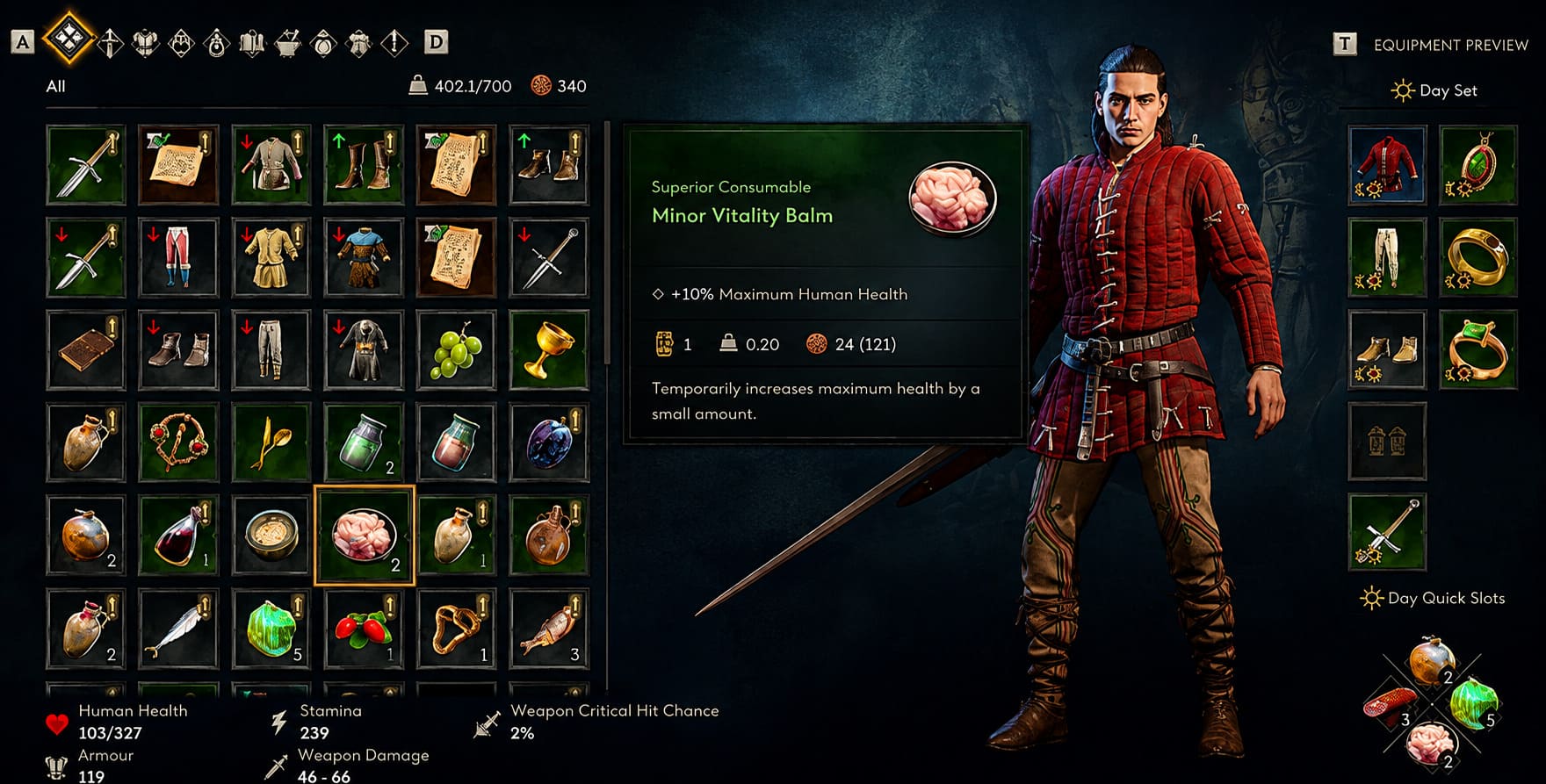
During the day, your survival routine is much closer to traditional RPG crafting. Gather materials such as Ribwart Plantains and Canteens of Water and use them to create Minor Healing Ointments.
At night, however, the situation changes.
Food and water aren’t your primary source of health recovery. Instead, you’re relying much more heavily on Voracious Bite and stored blood vials.
That means you should think ahead.
If you’re heading into a dangerous nighttime section, don’t arrive with an empty supply of blood and assume you’ll magically find enough enemies to recover from every mistake.
Be Careful Who You Feed On
This is probably my biggest non-combat warning for new players.
The easiest solution to hunger isn’t necessarily the smartest one.
You can build Corruption by feeding, but killing important NPCs can have consequences beyond the immediate encounter. Named characters may be connected to quests, merchants, information, or other parts of the world.
So before biting someone just because they’re standing nearby, ask yourself whether you’ve actually checked who they are.
I’d much rather spend a little extra time finding a safer source of blood than accidentally destroying a quest opportunity because I was hungry.
The 30-Day Clock Is Your Real Enemy
The most important resource in The Blood of Dawnwalker isn’t gold.
It isn’t XP.
It isn’t even health.
It’s time.
Every shrine visit used for skill progression can consume a time segment, and travel, side activities, and unnecessary detours can add up quickly.
This completely changes how I approach exploration.
Before traveling toward a random marker, look at what you’re actually getting from it. If an activity could reward you with a useful Skill Manual, unique equipment, or meaningful progression, it may be worth the time.
If you’re spending a huge chunk of your schedule for a handful of minor resources, I’d keep moving.
The game practically encourages you to think like this:
What am I gaining, and what am I sacrificing to get it?
That’s why the Balanced Vanguard works so well. You’re investing into abilities that remain useful across a large portion of the game instead of constantly chasing niche upgrades.
Blood of Dawnwalker Armourer Locations: Complete Armor Upgrade & Skill Manual Guide
My Recommended Early Progression
If I were starting a fresh playthrough today, my priorities would look roughly like this:
- Mercurial Fervour for daytime mobility.
- Shapeshift after reaching the required Corruption level.
- Endless Effort to stabilize stamina.
- Omniblock for safer early combat.
- Perfect Riposte + Counterattack as your main defensive damage engine.
- Artery Strike for faster routine encounters.
- Font of Life for daytime sustain.
- Potent Blood to reduce Witchcraft’s health burden.
- Aether Flow for better utility uptime.
- Expand into Ravenous Flock, Death From Above, and Shadow Step as your nighttime toolkit develops.
This isn’t the only viable way to play Coen, and that’s important. If you’re already comfortable with directional combat, you can push deeper into offensive Swordmastery earlier. If you love supernatural abilities, you can lean harder into Vampirism.
But for a first run?
I’d rather have a build that almost never feels bad than one that looks incredible on paper and collapses whenever the situation changes.
The Blood of Dawnwalker Blacksmith Locations & Gear Upgrade Guide
Final Thoughts
The Blood of Dawnwalker is at its best when you stop thinking about Coen as a conventional RPG protagonist and start treating him as two overlapping characters sharing the same body.
During the day, you’re managing health, Witchcraft and human-style combat. At night, you’re hunting, moving faster and exploiting supernatural abilities.
The Balanced Vanguard connects those two playstyles without forcing you into an overly specialized build.
Build your stamina first, learn the directional combat system, grab your mobility tools early, and don’t waste time at shrines simply because you have a spare skill point. Use Witchcraft as a support system rather than a spell-spamming replacement for melee, then let Vampirism take over when darkness gives you the advantage.
Most importantly, respect the clock.
The 30-day limit isn’t just a story gimmick. It changes how you should explore, upgrade, travel and even decide which fights are worth taking.
And honestly, that’s one of the things I’m most excited about with The Blood of Dawnwalker. Your build isn’t just about numbers — it’s about how you spend your limited time. Once you understand that, Coen becomes much easier to build and a lot more fun to play.