Vacation Cafe Simulator Ultimate Beginner’s Guide: Tips, Tricks, and Strategies to Build the Perfect Italian Seaside Cafe
Vacation Cafe Simulator is the kind of management game that immediately made me suspicious.
I have played plenty of restaurant simulators where the word “relaxing” is used in the store description, only for the actual gameplay to become a frantic battle against timers, angry customers, broken equipment, and a kitchen that somehow catches fire every three minutes. So when Alice Games released Vacation Cafe Simulator on August 20, 2026, promising a cozy Italian seaside business experience, I expected the usual routine with prettier scenery.
Thankfully, the game takes a different approach.
Set in a colorful Italian coastal village, Vacation Cafe Simulator gives you a small café and a simple objective: turn it into a place worth visiting. There is cooking, management, decorating, exploration, shopping, and expansion, but the game does not constantly punish you for taking a moment to think. That slower pace is probably its biggest strength.
But don’t confuse “cozy” with “mindless.” The manual cooking system, ingredient management, customer flow, and expansion costs can absolutely slow down beginners who spend their early money in the wrong places. After working through the opening stages, I found that the best strategy is not to rush toward the biggest menu or the prettiest café. It is to build a clean gameplay loop first.
This guide covers the best beginner tips, early-game priorities, money-making strategies, kitchen management tricks, and expansion advice for Vacation Cafe Simulator.
Start by Understanding the Actual Gameplay Loop
The basic loop is easy to understand:
Prepare food → serve customers → earn money → upgrade the café → unlock more opportunities.
The important part is that each stage feeds into the next one.
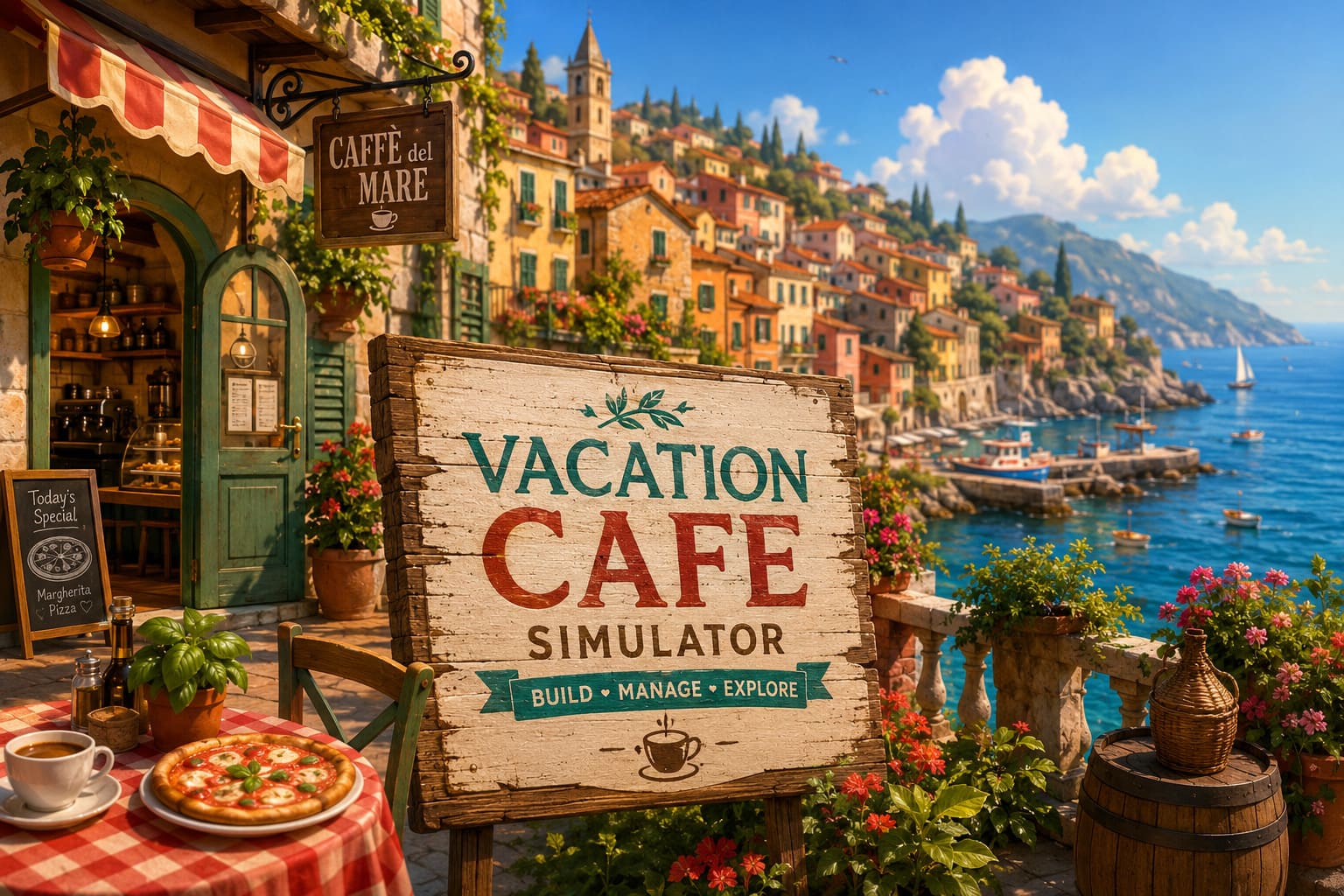
You cannot simply click “cook” and wait for a progress bar. Vacation Cafe Simulator wants you to interact with the kitchen. Ingredients need to be taken from storage, moved onto preparation surfaces, chopped, cooked, assembled, and served manually.
That sounds like a gimmick at first. And honestly, after playing many simulation games with overly complicated interaction systems, I expected the novelty to wear off quickly. Instead, the tactile mechanics become much smoother once you organize your kitchen properly.
The game is at its best when you stop treating every order as a separate emergency and start thinking like someone running an actual small restaurant.
Your goal should be to create a repeatable routine.
A Good Daily Routine Looks Like This
- Check the Dish of the Day
- Buy or prepare the required ingredients
- Pre-chop common food components
- Open the café
- Serve customers efficiently
- Clean tables and maintain your workspace
- Spend profits on upgrades that improve capacity or workflow
- Explore the village when business is slow
Because there are no brutal countdown timers forcing you into panic mode, you have room to experiment. Use that freedom. The game rewards organization more than frantic clicking.
The Best Early-Game Trick: Prepare Before Opening
If there is one habit I would recommend to every new player, it is this:
Do your prep work before opening the café.
This sounds obvious, but many players jump straight into service because they want to start making money immediately. That usually creates more work later.
Take a few minutes to prepare common ingredients such as tomatoes, onions, garlic, cheese, and anything else your active recipes frequently use. Keep those prepared components on clean counters or in prep areas where they are easy to reach.
The difference becomes obvious as soon as several customers arrive.
Instead of repeatedly opening storage, grabbing ingredients, chopping everything from scratch, and assembling a dish under pressure, you can immediately move into the cooking and plating stages.
That improves your overall rhythm considerably.
I would especially recommend creating a basic prep station near the center of your kitchen. Try to keep:
Storage close to preparation → preparation close to cooking → cooking close to plating.
It sounds like standard restaurant-game advice, because it is. But Vacation Cafe Simulator’s manual interactions make physical movement more important than in games where workers automatically handle everything.
A badly designed kitchen becomes annoying very quickly.
Keep Your Starting Menu Small
This is where many management-game players sabotage themselves.
You unlock recipes and suddenly feel the urge to offer everything.
Don’t.
A huge menu might look impressive, but during the early game it creates unnecessary inventory problems. More recipes mean more ingredients, more storage management, and more unfamiliar preparation sequences.
My recommendation is to focus on a few dependable items that share ingredients.
A small early menu built around dishes like Bruschetta, Margherita Pizza, simple pasta dishes, and Espresso is much easier to manage than a restaurant offering ten completely unrelated recipes.
| Priority | What to Do | Why It Matters |
|---|---|---|
| Early Game | Keep a small menu | Reduces inventory clutter |
| Early Game | Reuse common ingredients | Lowers preparation complexity |
| Mid Game | Add profitable recipes | Improves earnings per customer |
| Late Game | Expand variety gradually | Supports larger customer demand |
The best menu is not necessarily the largest one.
A restaurant with five dishes you can prepare quickly will usually feel more efficient than one with fifteen recipes that constantly force you to search through storage.
Always Pay Attention to the Dish of the Day
The Dish of the Day is one of the easiest systems to underestimate.
Each day, check what the featured recipe is before you begin service. Customers are more likely to order it, and successfully serving it can provide better rewards through increased earnings and reputation.
So don’t just notice the daily special and forget about it.
Build your preparation around it.
If Margherita Pizza is featured, make sure your kitchen has enough dough, tomatoes, cheese, and any other required ingredients ready before opening. If a pasta dish is highlighted, prepare the components in advance.
This is one of those small optimization habits that does not feel important during the first hour but becomes increasingly useful as your café grows.
The daily special should influence your shopping list.
That is a simple rule, but it prevents a lot of unnecessary trips and wasted preparation time.
Make Delivery Work Part of Your Early Economy
Restaurant income is not the only way to make money.
During the early stages, part-time delivery jobs are worth considering when your café alone is not generating enough cash for important upgrades.
These jobs are useful because they give you another source of income without requiring a major investment. You can step away from the café, complete deliveries around the village, and earn additional money and tips.
I like this system because it prevents the early game from feeling too dependent on waiting for customer traffic.
If business is slow, you still have something productive to do.
That said, I would not recommend turning delivery work into your permanent main activity. The café is still the core progression system. Use deliveries as a financial boost when you need money for equipment, furniture, or expansion.
Think of them as side quests for your restaurant budget.
Save for Expansion Before Buying Too Many Decorations
Vacation Cafe Simulator gives you plenty of attractive furniture and decorations. That is dangerous.
I have played enough cozy simulation games to know exactly what happens next: you convince yourself that another plant, wine rack, lamp, or decorative barrel is a “necessary investment,” and suddenly your upgrade budget has disappeared.
Early on, function should come before decoration.
Your most important long-term investments are the ones that increase what your café can actually do.
The second-floor expansion is especially valuable because additional space allows you to increase seating capacity and handle more visitors. Once your reputation grows, limited seating can become a bottleneck.
The red stairs and upper-floor layout also create more flexibility when designing your building.
My advice is simple:
Buy enough furniture to make the café functional and comfortable, but save your serious money for structural upgrades.
Decorate heavily after your business can support it.
Don’t Destroy Your Own Pathfinding
Speaking of decorations, placement matters.
The game gives you a lot of freedom, but freedom can produce terrible layouts.
Avoid filling every available space with furniture. Keep clear routes between:
- The entrance
- Customer tables
- The kitchen
- Storage areas
- Stairs
- Service zones
If your character has to squeeze between chairs, plants, barrels, and decorative objects every time you carry food, your café will become inefficient.
I strongly prefer wide pathways over a visually crowded layout.
A cozy restaurant should feel full, not impossible to navigate.
Put large decorative items against walls and use corners for objects that do not need constant interaction. Keep the middle of your main service area relatively open.
Better Furniture Is More Than Just Cosmetic
Once you are ready to invest in the interior, pay attention to comfort-oriented furniture.
Higher-quality chairs and tables can improve the customer experience, encouraging visitors to stay longer, order additional drinks, and potentially leave better tips.
That makes furniture one of the few decorative categories that can eventually support your business performance.
I would prioritize upgrades in this order:
- Kitchen efficiency
- Customer capacity
- Comfortable seating
- Decorative atmosphere
This order worked better for me than trying to build the perfect-looking café immediately.
A beautiful restaurant that cannot serve customers efficiently is still a bad business.
Explore Beyond the Town Square
One of Vacation Cafe Simulator’s better ideas is that your world does not end at the café door.
The surrounding region contains farms, specialty producers, wineries, village streets, and other locations worth visiting.
Do not rely entirely on generic grocery shopping.
Local farms can provide higher-quality ingredients, while regional wineries help expand your beverage options. Premium ingredients can improve the value of your finished dishes and give your menu more high-end options.
This becomes particularly useful once you are financially stable.
Early on, cheap and reliable ingredients are fine. Later, better sourcing becomes a way to improve your profit potential.
And while exploring, look for hidden coins.
Check corners, alleys, harbor areas, spaces behind buildings, and other places that are easy to ignore when you are focused on your next objective. Small coin pickups may not transform your economy instantly, but free currency is still free currency.
Over time, those small gains add up.
My Recommended Beginner Progression
If you want the smoothest possible start, this is the approach I would follow:
Days 1–3: Learn the cooking controls and keep the menu small. Focus on mastering a few dishes.
Early upgrades: Improve your workspace and buy equipment that reduces unnecessary movement.
First major savings goal: Prioritize structural expansion over expensive decorations.
During slow periods: Complete delivery work and explore the village.
After your workflow improves: Upgrade seating and comfort to increase customer value.
Mid game: Begin sourcing premium ingredients from farms and wineries.
Later progression: Expand the menu gradually and invest more heavily in visual design.
The biggest mistake is trying to progress through every system at once.
Vacation Cafe Simulator is better when you build your business in layers.
Final Thoughts
Vacation Cafe Simulator works because it understands something many cooking management games forget: not every player wants every order to feel like an emergency.
The slower pace does not remove the management challenge. It simply changes where the challenge comes from.
Instead of racing against a countdown, you are optimizing your kitchen. Instead of surviving impossible customer waves, you are deciding how to spend your money. Instead of blindly unlocking every recipe, you are building a menu that actually makes sense for your current operation.
And honestly, I think that makes the game more satisfying.
The best beginner strategy is to stay disciplined. Prepare ingredients before opening, focus on the daily special, avoid an oversized menu, use delivery jobs for extra early income, and save your major funds for meaningful expansion.
Once your workflow feels natural and your café has enough space to grow, then you can start worrying about turning the place into your dream Italian seaside restaurant.
That is when the creative side of Vacation Cafe Simulator really starts to shine.