Survival Log Strategy: Surviving the Outbreak and Optimizing Base Defenses
I’ve played my fair share of survival games, and I’ll admit that I’m usually the guy who spends the first hour picking up everything that isn’t nailed down. Give me a ruined city, an abandoned warehouse, and a backpack with questionable storage capacity, and I’m probably going to loot the entire neighborhood.
Survival Log, however, quickly taught me that this is exactly how you lose.
Developed by Midnight Workshop and published by Lilith Games, Survival Log launched on Steam on August 12, 2026, and it immediately caught my attention because it approaches the zombie apocalypse from a different angle. This isn’t simply another game where you grab a rifle, build a wooden wall, and start mowing down zombies. The real enemy here is time.
You know the outbreak is coming. You know your home needs to become a fortress. You know there are useful supplies scattered around the city. The problem is that you simply don’t have enough hours to get everything.
That creates a surprisingly addictive gameplay loop. Every failed attempt becomes another lesson, every wasted minute becomes something you remember, and every new run gives you a chance to improve your route.
After spending time experimenting with the early game, I’ve put together the strategy I wish I had followed from the beginning.
Survival Log Is Really a Game About Time Management
The first thing I noticed about Survival Log is that it doesn’t play like a conventional open-world zombie game.
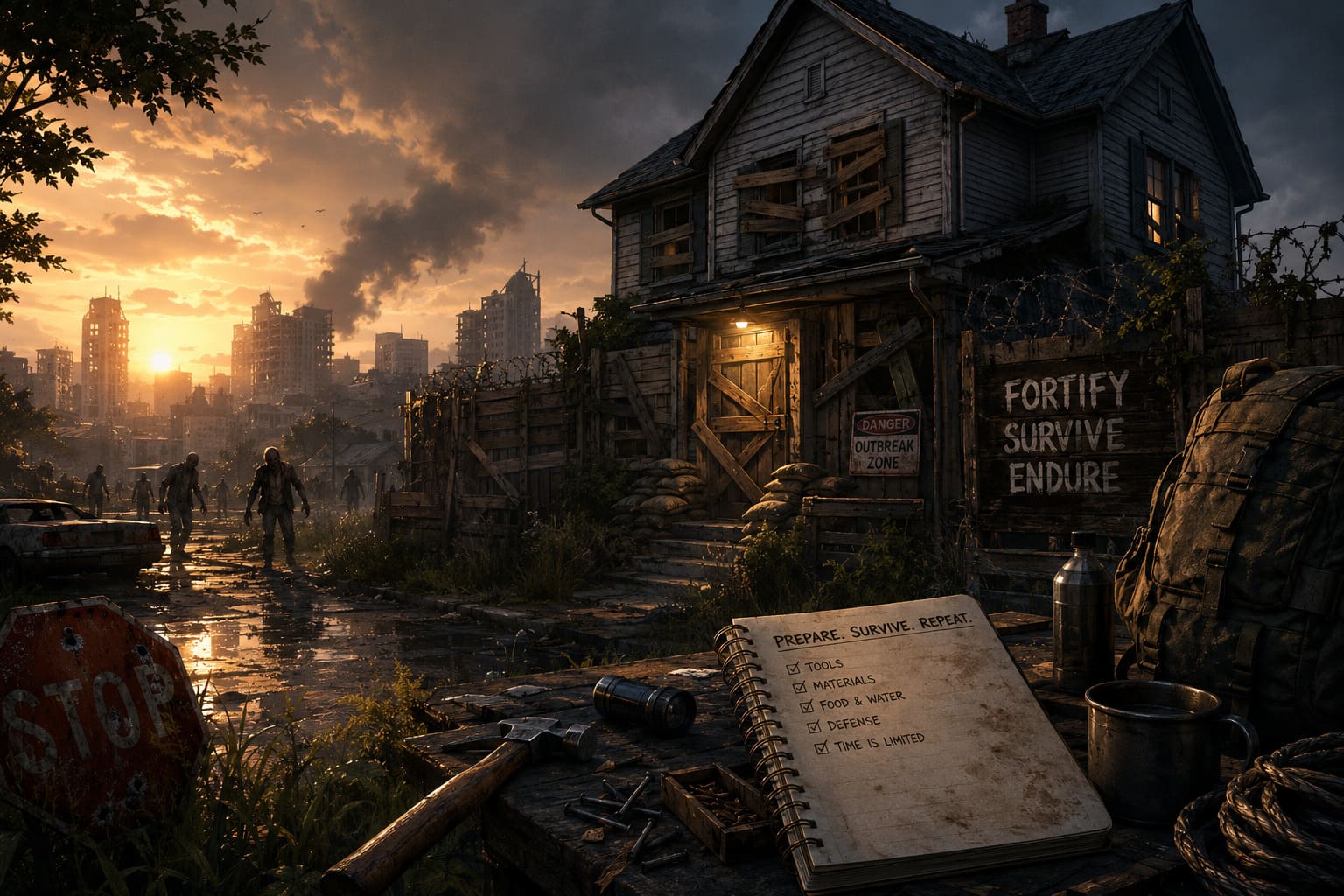
There isn’t an endless amount of time to explore. Instead, practically every action has a cost. Searching an area, traveling somewhere, moving supplies, organizing your belongings, resting and performing other activities all consume valuable time.
That means a run can go wrong without a single zombie touching you.
You can simply spend too long rummaging through a mediocre location, return home with a backpack full of junk, realize you forgot something important, and suddenly a huge chunk of your preparation window has disappeared.
For me, that is one of the best things about Survival Log.
The game makes boring survival-game activities feel meaningful because you constantly have to ask yourself whether something is actually worth your time.
| Early-Game Priority | Why It Matters |
|---|---|
| Tools | Improve your ability to gather and prepare resources |
| Construction Materials | Essential for securing your home |
| Containers | Increase the usefulness of your limited storage |
| Food & Water | Keep your character functional during longer runs |
| Useful Utility Items | Can save time and resources later |
The important lesson is simple: don’t confuse quantity with value.
Ten useless objects aren’t necessarily better than two tools that will save you hours later.
Stop Looting Everything
This is probably my biggest tip for new players.
Do not become a digital hoarder just because the game is called Survival Log.
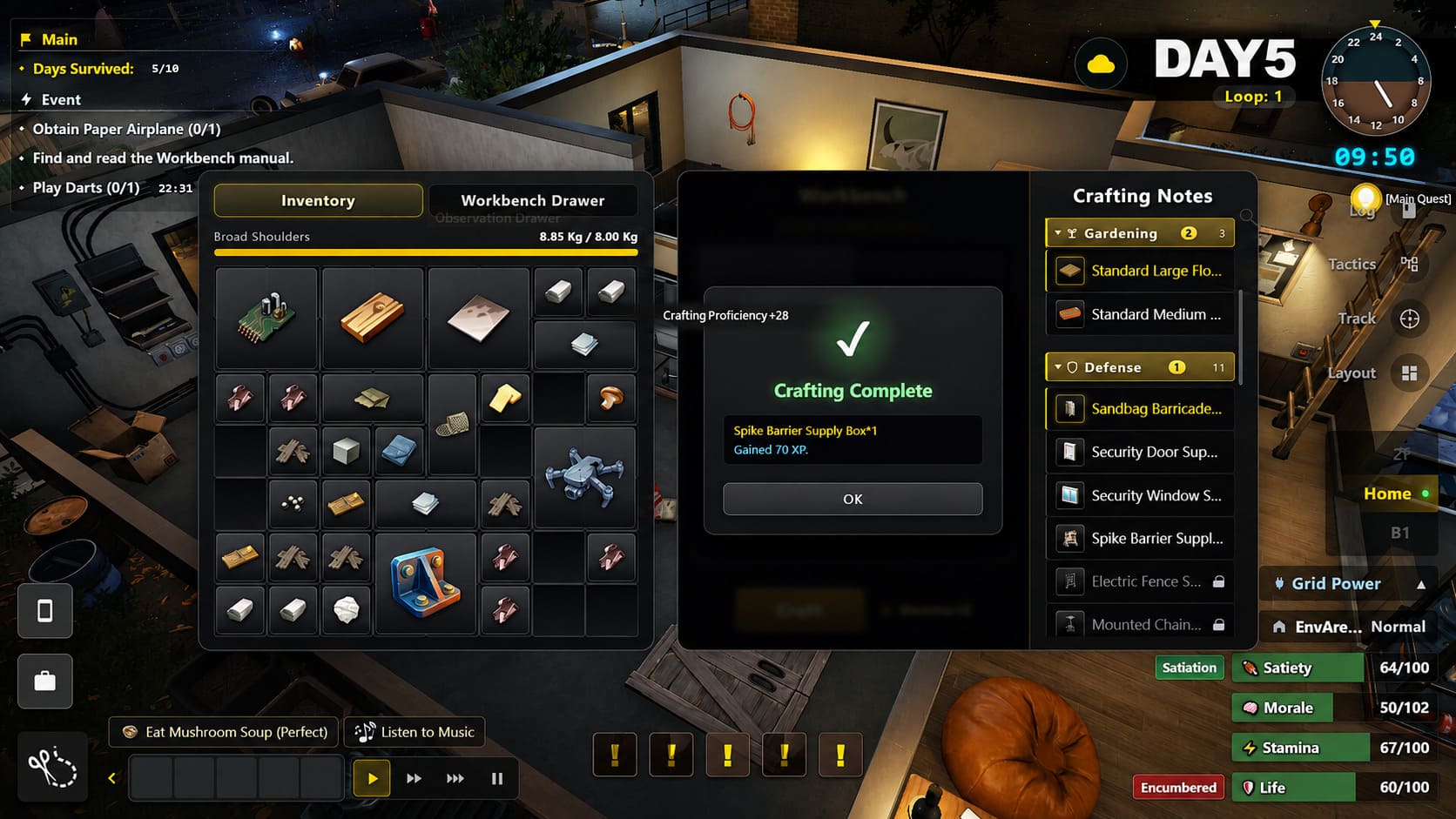
Early in my runs, I made the classic survival-game mistake. I walked into a location, opened every container, picked up anything that looked remotely useful and then discovered that my inventory was full.
So I walked home.
Then I went back.
Then I realized I had forgotten something.
Then I walked home again.
That sounds funny when written down, but when the game is measuring your preparation time, those unnecessary trips can completely destroy a run.
Instead, I recommend creating a mental hierarchy for your loot.
What I Grab First
My priority is usually tools, construction materials, useful containers, defensive components and essential survival supplies.
If something is heavy and has a questionable purpose, I’m leaving it.
Food is obviously important, but you don’t need to turn every kitchen into your personal supermarket. The same applies to random household objects. If an item doesn’t contribute to your survival plan, ask yourself whether carrying it across the map is really worth the time.
Most of the time, the answer is no.
Industrial Locations Are Your Best Friends
One of the biggest discoveries during my early runs was how much more valuable certain locations can be compared with random residential areas.
Hardware stores, renovation-related locations and industrial supply points are particularly attractive because they can provide the kinds of materials that directly support your long-term survival strategy.
A random bathroom might give you something useful occasionally, but spending half your preparation window searching every apartment isn’t a strategy.
I prefer to think about the map in terms of resource efficiency.
If a location has a strong chance of giving me tools, materials or useful storage equipment, it deserves a place on my route. If I’m visiting somewhere purely because I haven’t searched it yet, that’s usually a bad reason.
This also creates one of Survival Log’s most satisfying progression systems: knowledge itself becomes a resource.
Once you discover where valuable items tend to appear, you don’t have to blindly explore those areas in future attempts.
You already know.
And that makes your second, third and fourth runs dramatically more efficient.
Your First Runs Are Supposed to Fail
This is something I think players should understand before starting Survival Log.
Failure isn’t necessarily failure.
The game is built around learning from your previous attempts and converting that knowledge into stronger future runs.
Maybe you discovered that you don’t have enough building materials by the time the outbreak becomes dangerous.
Maybe you spent too much time traveling.
Maybe you ignored your hunger and fatigue until they started ruining your efficiency.
Or maybe you simply fortified the wrong part of your house.
Good.
Now you know.
The next run should be different.
That is where the game’s meta-progression becomes particularly interesting. Survival points can be used to unlock permanent improvements that make subsequent attempts more forgiving.
Some upgrades can improve things such as hunger depletion while sleeping or recovery efficiency, which might sound minor initially. In a game where every resource matters, however, small permanent advantages can become extremely valuable over several runs.
Don’t Ignore Hunger, Thirst and Fatigue
It’s easy to get tunnel vision when you’re trying to collect materials.
You see an interesting location and think, “I’ll just search one more building.”
Then another.
Then another.
Suddenly your character is exhausted, hungry and thirsty, and your carefully planned route has fallen apart.
I learned pretty quickly that physiological meters aren’t background decorations. They are part of your time-management puzzle.
Sleep can restore your character, but sleeping also consumes time. Food and water take up inventory space, but ignoring them can make your character less effective.
That means you need to think ahead.
Don’t wait until your character is nearly exhausted before deciding when to rest.
If you’ve unlocked upgrades that make sleeping more efficient, take advantage of them. These passive bonuses can make future runs noticeably smoother.
Building a Safehouse: What I Would Fortify First
Once the outbreak starts becoming a serious threat, your house stops being just a home.
It becomes your entire world.
This is where I think Survival Log gets particularly tense. You can spend a huge amount of time gathering supplies, but if your base has an obvious weakness, all that preparation can disappear incredibly quickly.
My first rule is straightforward:
Secure the entrances before worrying about fancy defensive projects.
Start with the most obvious ways enemies can enter your property.
1. Protect Ground-Floor Windows
Windows are easy to overlook because they don’t feel as important as doors.
They are.
If you have limited construction materials, concentrate on securing vulnerable ground-floor openings before investing heavily in complicated external defenses.
I’d rather have a boring but secure house than an impressive fortress with one completely exposed entrance.
2. Reinforce Your Main Door
Your primary entrance should receive immediate attention.
Use the materials you’ve collected during your scavenging runs to strengthen it as early as possible. Don’t wait until the zombies are already at your doorstep to start thinking about defense.
That is generally a bad time to discover that you don’t have enough supplies.
3. Keep Your Interior Practical
Another mistake I made was treating the interior of the house like a storage warehouse.
Don’t.
Your important supplies, resting area and frequently used resources should be organized so that you aren’t constantly running around your own home.
During a crisis, every unnecessary movement is wasted time.
A good safehouse isn’t necessarily the biggest one. It’s the one where you can perform important actions quickly.
Sound and Risk Management Matter Too
One detail that I really like about Survival Log is the idea that your safehouse isn’t automatically safe just because you’ve reinforced it.
Noise and activity can influence the danger around your location, meaning you need to think about what you’re doing during high-risk periods.
This creates a nice tension between “I need to get something done” and “maybe I shouldn’t attract attention right now.”
That makes the house feel less like a menu screen and more like an actual survival environment.
When things get dangerous, I prefer to keep my activity focused and avoid unnecessary actions that could make an already bad situation worse.
My Recommended Early-Run Strategy
If I were starting a completely fresh Survival Log save today, this is the general approach I’d use:
- Plan the first route before leaving home.
- Prioritize industrial, hardware and renovation-related locations.
- Grab tools and construction materials before low-value loot.
- Avoid filling your inventory with heavy junk.
- Monitor hunger, thirst and fatigue instead of ignoring them.
- Return home before your route becomes inefficient.
- Use what you learned from each failed run to improve the next one.
- Fortify doors and vulnerable ground-floor windows first.
I wouldn’t try to make the perfect run immediately.
I’d try to make each run better than the previous one.
That mindset works incredibly well with the game’s loop.
Is Survival Log Worth It? Full 2026 Review, Gameplay Analysis, and Player Impressions
The Biggest Mistake: Trying to Do Everything
If there’s one thing I’d tell someone before they launch Survival Log for the first time, it’s this:
You are not supposed to save everything.
You cannot collect every item.
You cannot search every building.
You cannot prepare for every possible scenario.
And that’s the point.
Survival Log constantly forces you to make decisions about what matters more. Do you spend another hour searching for supplies, or do you return home and reinforce the front door? Do you carry additional food, or do you use that inventory space for construction materials? Do you sleep now, or can you safely push your character a little longer?
Those decisions are what make the game interesting.
Final Thoughts
After playing through the early survival loop, I think Survival Log has a genuinely clever foundation. It takes familiar zombie-survival mechanics—scavenging, resource management, base defense and progression—and places them inside a much tighter time-management framework.
The result is a game where information becomes just as valuable as physical resources.
Your first run might be messy. Your second run should be smarter. By the third or fourth attempt, you start moving through familiar areas with an actual plan, knowing what you’re looking for and what you’re willing to ignore.
That’s when Survival Log really starts clicking.
For me, the most enjoyable part isn’t watching the base become stronger. It’s realizing that I’m becoming better at the game.
The city hasn’t changed.
The apocalypse hasn’t changed.
But I know where to go now.
I know what to take.
I know what to leave behind.
And, most importantly, I know that spending ten minutes searching a useless location isn’t worth it when I could already be reinforcing my front door.
If you’re jumping into Survival Log after its August 2026 Steam launch, my advice is to embrace the failures, learn the map, prioritize useful resources and build your safehouse around efficiency rather than appearance.
The apocalypse doesn’t reward the player who collects the most. It rewards the player who wastes the least.