
Supermarket Chaos Move Speed Upgrade Guide: How to Move Faster and Maximize Efficiency
If you’ve spent more than a couple of hours inside Supermarket Chaos, you already know the truth the game doesn’t tell you upfront: movement speed is basically everything. Not shelf design, not inventory strategy, not even cash flow in the early game. If your character moves like they’re wading through wet cement, your entire store turns into a chaotic mess faster than you can blink.
I’ve sunk enough time into this kind of management-sim rabbit hole to recognize the pattern instantly. You start out thinking, “Yeah, I’ll just organize a few shelves,” and twenty minutes later you’re sprinting between aisles, throwing apples like you’re in some weird grocery-themed dodgeball match. The difference between a smooth-running store and a collapsing disaster zone often comes down to how fast you physically move.
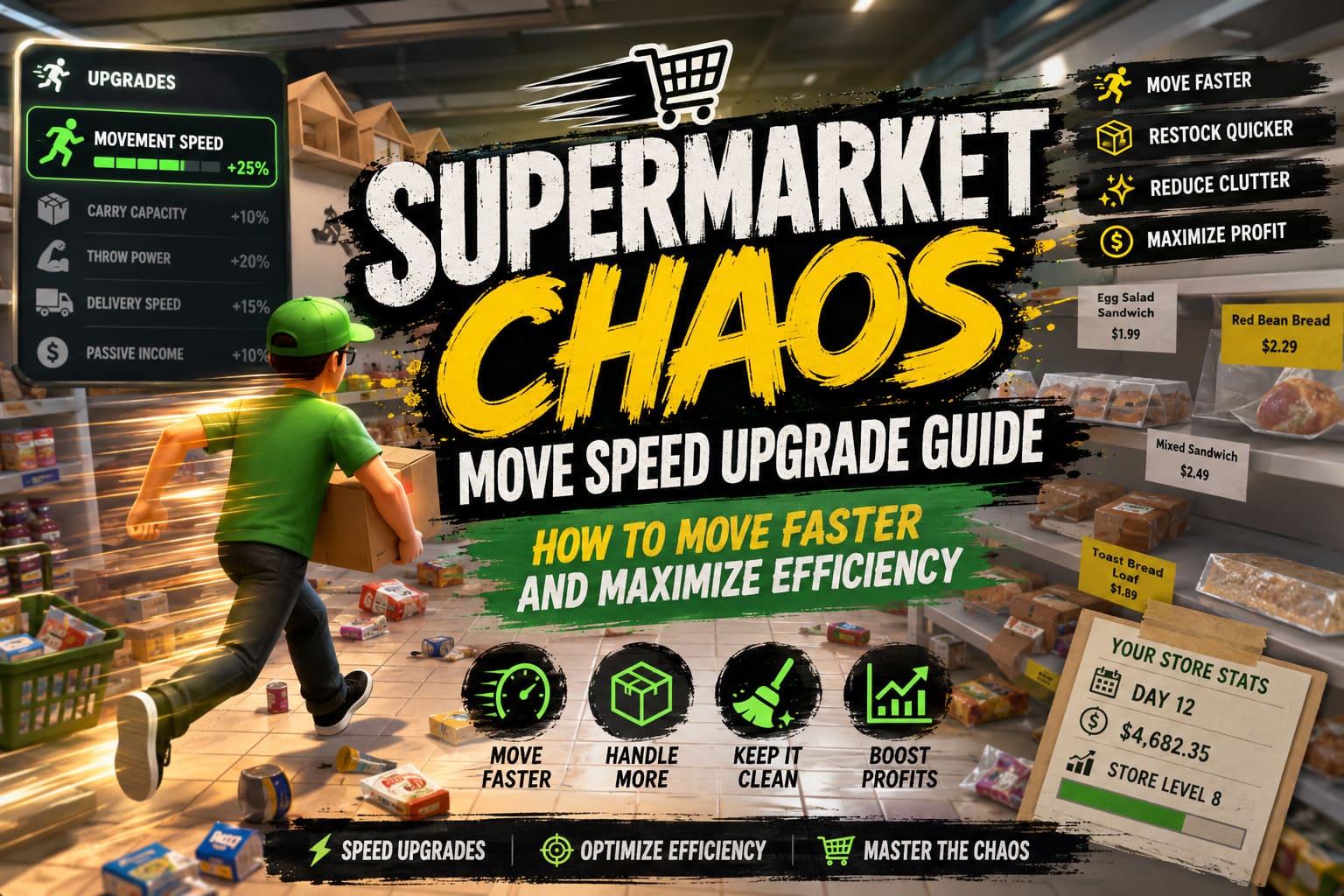
And yeah, the game doesn’t exactly hold your hand here. If anything, it tosses you into the deep end and expects you to figure out the upgrade systems like a puzzle left behind by a slightly chaotic dev team.
Supermarket Chaos Save File Deleted Fix: How to Recover Lost Progress
Why Movement Speed Defines Your Entire Playthrough
Supermarket Chaos sits in that oddly satisfying niche of cozy-but-stressful simulation games. It borrows that “organize everything manually” loop from Supermarket Simulator but cranks up the pressure by putting almost everything on the player’s shoulders instead of delegating to NPC workers.
Here’s the reality once your store starts scaling: deliveries stack up faster than you can process them, shelves get messy within seconds, customers start wandering into cluttered aisles, and you’re stuck walking like you’re carrying emotional baggage and a fridge at the same time.
At default speed, every task feels longer than it should. You stop thinking strategically and start reacting. That’s the breaking point most players hit without realizing why everything suddenly feels off.
Movement speed fixes that entire chain reaction. It’s not just convenience—it’s control. Faster movement means fewer bottlenecks, cleaner store layout management, and way more breathing room during peak chaos moments.
The Game Doesn’t Explain Anything (And That’s Half the Problem)
One of the biggest community complaints is the lack of onboarding clarity. There’s no proper breakdown of progression systems, no clear explanation of skill scaling, and definitely no real tutorial structure to guide new players.
Players end up discovering upgrades like it’s archaeology. You eventually stumble into the upgrade system tucked inside the progression menu, and suddenly everything opens up: movement speed, carrying capacity, throwing power, delivery efficiency, and passive boosts that define your entire playstyle.
The issue is simple—nothing tells you what actually matters early on. And movement speed absolutely matters early on.
Unlocking Movement Speed – The Real Progression Loop
Once you start completing stocking cycles and cleaning up your store, you earn currency and progression points. These feed into a dense upgrade tree that hides more impact than it first appears to.
The movement upgrade path is usually buried alongside other passive stats, which is why so many players miss it entirely or treat it like a later-game luxury.
Core Upgrade Strategy
Open the progression menu as soon as it becomes available. Identify the movement or agility node and prioritize it over convenience upgrades like delivery timing or minor economic boosts. Stack early upgrades before expanding your store too aggressively.
The logic is straightforward: speed multiplies efficiency, and efficiency multiplies profit. Everything else comes after.

Advanced Movement Techniques (Where the Game Gets Fun)
Once you’ve got even a couple of speed upgrades, the game starts to shift tone completely. You stop walking through tasks and start optimizing movement like you’re running a controlled chaos experiment.
One of the most effective tricks is the throw-and-place method. Instead of walking every item to its shelf, you throw products directly into their zones. With upgrades, items essentially snap into place, which feels slightly broken in the best possible way.
This reduces unnecessary walking loops, keeps your central area clean, prevents aisle congestion, and lets you multitask delivery sorting with shelf management.
Another underrated tactic is early clutter control. Clearing small messes immediately prevents them from spreading into full-blown operational bottlenecks later.
Store Flow vs Movement Speed – A Hidden System Most Players Miss
Many players think efficiency is about layout or stock levels, but movement speed quietly defines everything underneath that system.
Here’s a breakdown of how it changes gameplay outcomes:
| Situation | Low Movement Speed | Upgraded Movement Speed |
|---|---|---|
| Restocking shelves | Constant back-and-forth delays | Smooth batch delivery cycles |
| Handling deliveries | Overwhelming pile buildup | Controlled distribution flow |
| Cleaning clutter | Reactive panic cleaning | Preventive maintenance loop |
| Peak hours | Bottleneck chaos | Stable operational rhythm |
The takeaway is simple: movement speed turns the game from reactive to proactive. Without it, you’re always catching up. With it, you stay ahead of the chaos.

Compared to Other Grocery Sims
If you’ve played Supermarket Together or similar co-op grocery sims, you might be used to external tools or mods adjusting pacing. Some players rely on mod ecosystems like Nexus Mods for speed tweaks or automation enhancements.
Supermarket Chaos removes that entire layer. There are no shortcuts, no speed sliders, no automation mods. Everything depends on internal progression and player execution.
That design choice can feel harsh at first, but it makes mastery far more satisfying. When your movement finally becomes fluid, it feels earned instead of patched in.
Final Thoughts
Supermarket Chaos doesn’t reward hesitation. It punishes slow movement more than bad strategy. Once you understand that, the entire game shifts in your favor.
Movement speed isn’t just a stat—it’s the difference between drowning in groceries and running a tightly controlled retail machine.
And honestly, that’s where the game shines. Not in the chaos itself, but in the moment you finally outrun it.


