SAND: Raiders of Sophie – Mastering Trampler Repairs and Survival Inside Your Walking Fortress
The desert world of Sophie in SAND: Raiders of Sophie does not care how prepared you think you are. One moment you are rolling across dunes in your towering Trampler, turning rusted ruins into salvageable loot routes, and the next you are watching your entire mobile fortress get chewed apart by explosive rounds. The game does not treat your mech as a simple vehicle. It is your base, your shield, and your last argument against being turned into scrap in PvPvE chaos.
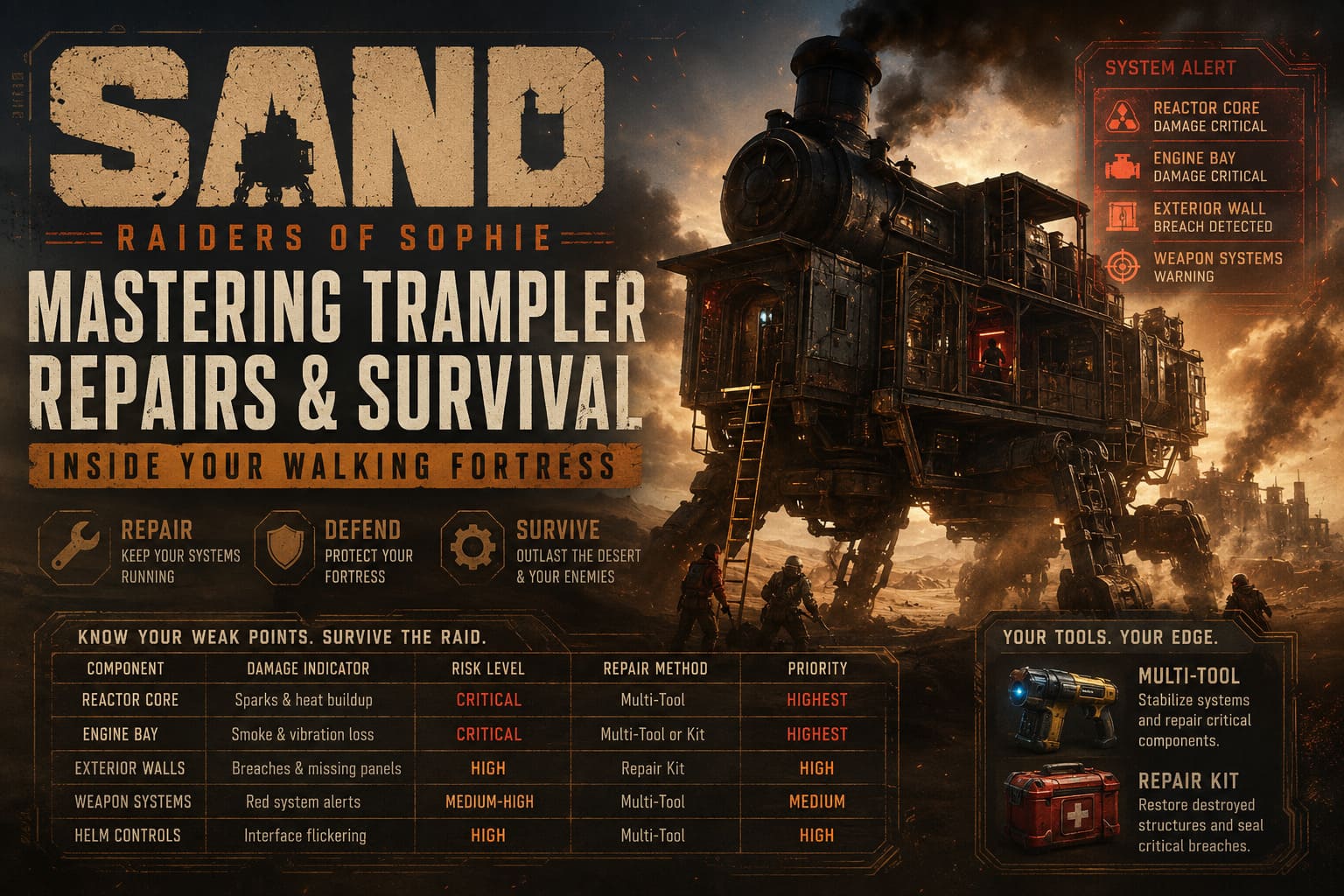
After enough hours inside this shifting battlefield, one thing becomes obvious: knowing how to repair your Trampler is not optional. It is the difference between extracting with a full cargo hold and respawning with nothing but regret. This guide breaks down repairs in a way that matches how real squads survive under pressure, mixing practical mechanics with instincts veteran players develop after dozens of close calls.
The Trampler as a Living Battlefield Structure
The Trampler is not a static machine; it behaves more like a layered ecosystem of systems that can collapse independently. Instead of a single health bar deciding your fate, you are managing multiple weak points that can spiral out of control if ignored. That is where most new raiders make mistakes, assuming they can fix things later while focusing on combat.
Every compartment matters. A damaged engine bay does not just reduce mobility—it invites catastrophic chain reactions. A breached wall is not cosmetic damage—it is a boarding invitation for enemy crews who will not hesitate to push inside and take control of your vessel.
Understanding Structural Vulnerability
Once you start treating the Trampler like a moving fortress with vulnerable internal systems rather than a tank, repair decisions become far more instinctive. Survival is less about reacting to destruction and more about preventing escalation of damage across connected modules.
Reading the Warning Signs Before Everything Goes Wrong
The game provides constant feedback, but survival depends on recognizing it during chaos. Visual damage cues are your earliest warning layer, and they escalate quickly if ignored under fire.
Sparks indicate early-stage system damage. Fires mean critical failure is already developing. System alerts in red UI text point to functional breakdowns in key systems such as reactors, helm controls, or weapon systems.
Damage Escalation Stages
Players who survive long-term raids do not wait for explosions. They respond at the first sign of instability. Ignoring early signals almost always leads to cascading failures across multiple compartments.
Core Repair Method: The Multi-Tool Workflow
The Multi-Tool is your primary internal repair system. It is simple in design but becomes one of the most important survival tools when combat pressure intensifies. Most internal failures can be stabilized without leaving operational flow, but timing is everything.
You equip the tool, move into the damaged compartment, and manually stabilize systems by interacting with broken modules. The challenge is doing this while the Trampler is under attack and not losing awareness of external threats.
Why Multi-Tasking Matters
The biggest mistake players make is tunnel vision. Repairing a reactor while ignoring boarding attempts often leads to total squad wipes. Awareness must remain split between internal repair work and external combat conditions.
Structural Damage and Repair Kits
Once external walls or structural segments are destroyed, the Multi-Tool is no longer sufficient. At that point, you are dealing with full reconstruction rather than maintenance, and Repair Kits become essential.
Repair Kits instantly restore destroyed walls, doors, and structural barriers. They function as limited-use tactical resources rather than casual repair tools, and their timing often determines whether a breach becomes contained or turns into a full internal invasion.
Strategic Use of Repair Kits
Experienced crews treat Repair Kits as combat assets. Using them too early leaves critical vulnerabilities later in the raid, especially during extraction phases where pressure intensifies dramatically.
Component Repair Overview
| Component Area | Damage Indicator | Risk Level | Repair Method | Priority |
|---|---|---|---|---|
| Reactor Core | Sparks and heat buildup | Critical | Multi-Tool | Highest |
| Engine Bay | Smoke and vibration loss | Critical | Multi-Tool or Kit | Highest |
| Exterior Walls | Breaches and missing panels | High | Repair Kit | High |
| Weapon Systems | Red system alerts | Medium-High | Multi-Tool | Medium |
| Helm Controls | Interface flickering | High | Multi-Tool | High |
Mid-Combat Engineering and Squad Strategy
High-level play in SAND: Raiders of Sophie is defined by multitasking under pressure. The best crews never fully disengage from combat to repair systems. Instead, they rotate responsibilities dynamically depending on threats and system stability.
Compact ship design plays a major role in survival. Critical systems placed close together allow rapid repairs and reduce downtime between combat actions and engineering tasks. Poor layouts often cost more lives than enemy fire.
Team Coordination and Roles
In multiplayer squads, role separation is essential. One player should always remain flexible between combat support and emergency repairs while others maintain offensive pressure or navigation control. Coordination is what keeps the Trampler functional under sustained attack.
When the Trampler is Destroyed
If the engine core collapses, the Trampler is permanently lost for that raid. Everything stored inside is destroyed, regardless of its value. However, the player is not immediately eliminated from the session.
Survival continues on foot, shifting gameplay toward extraction-based decision making. Players must navigate hostile terrain, locate evacuation points, and attempt to escape with whatever remains in their personal inventory.
Some players even attempt high-risk extraction strategies such as hijacking abandoned walkers or boarding enemy extraction points. These situations are chaotic, unpredictable, and often define the most memorable moments of a raid.
Final Thoughts: Repairs Are Survival, Not Maintenance
In SAND: Raiders of Sophie, repairs are not a side mechanic. They are part of core survival gameplay. Every spark ignored becomes a breach. Every breach becomes a boarding opportunity. Every missed repair becomes a collapse of the entire system.
Once players begin thinking like engineers inside a living war machine rather than drivers of a vehicle, survival rates increase dramatically. The desert is unforgiving, and the Trampler is only as strong as the crew maintaining it under pressure.