Games Workshop DMCA Strikes Tabletop Simulator Warhammer 40k 11th Edition Mods
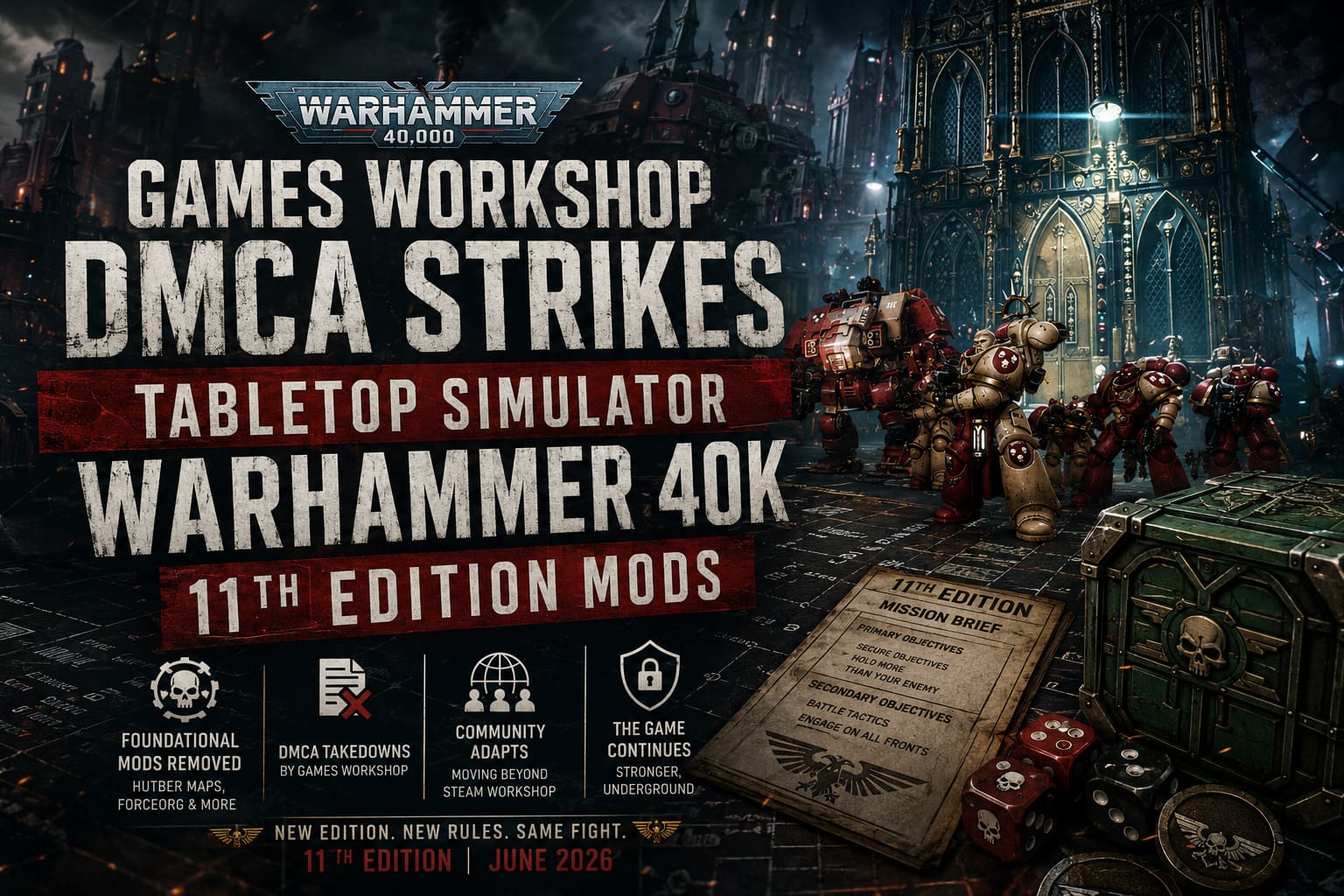
The launch of a new Warhammer 40,000 edition is usually the kind of moment the tabletop community treats like a festival. New rules, new balance shifts, new army possibilities — it’s the sort of reset that gets both veterans and newcomers excited to repaint lists and rethink strategies. But the rollout of Warhammer 40k 11th Edition in June 2026 didn’t just bring hype. It also brought a wave of DMCA takedowns from Games Workshop that effectively wiped out some of the most important community-made mods for Tabletop Simulator on Steam.
As someone who has spent years bouncing between digital wargaming platforms and physical tabletop systems, this situation feels less like a surprise and more like a repeating pattern that never quite gets resolved. The excitement of a new edition is now inevitably followed by legal pressure, community fragmentation, and a quiet migration underground where the actual gameplay continues, just not in public view.
Will GTA 6 Push Video Game Prices to $80? Why Analysts Expect Premium Pricing Trends to Rise
The Mods That Disappeared Overnight
The DMCA wave mainly targeted foundational community tools rather than small cosmetic additions. These weren’t random fan creations — they were structured systems that effectively turned Tabletop Simulator into a functional competitive Warhammer environment.
Two of the most important casualties were widely recognized across the competitive scene: Hutber’s 11th Edition Tournament Map Framework and the ForceOrg Asset and Army Import System. These weren’t just maps or model packs. They were infrastructure-level tools that supported how people actually played Warhammer 40k digitally.
Impact Breakdown of Removed Mods
| Mod Name | Function | Importance | Impact |
|---|---|---|---|
| Hutber Tournament Maps | Competitive board standardization | Essential for tournaments | Disrupted competitive play |
| ForceOrg System | Army building and model integration | Core gameplay utility | Broken workflow for players |
| Community Model Packs | Faction visual assets | High immersion | Reduced accessibility |
| Automation Tools | Rules assistance and scoring | Time-saving utilities | Slower match setup |
When these vanished from Steam Workshop, it wasn’t just inconvenience. For many players, especially those without regular local groups, it meant their primary way of playing Warhammer 40k digitally was suddenly gone.
Why Games Workshop Keeps Doing This
From a corporate standpoint, Games Workshop’s approach is consistent with how it has operated for years. The company has always been highly protective of its intellectual property, and new edition launches often trigger enforcement waves aimed at controlling how its universe is represented online.
The logic is simple. If a fully functional digital version of the game exists for free, it can potentially reduce demand for official miniatures, codexes, and licensed products. With major releases like the Armageddon box set and upcoming titles such as Dawn of War IV, maintaining control over the ecosystem becomes a priority.
This is not new behavior. Similar takedown cycles happened during the 9th and 10th Edition transitions, and even outside Warhammer 40k, the company has pursued projects that resemble its IP too closely.
Community Reaction: Frustration and Adaptation
The reaction across the community has been intense but predictable. Competitive players, hobbyists, and content creators have all expressed frustration, especially on platforms like Reddit and Discord where Warhammer discussion is constant and highly detailed.
Many argue that Tabletop Simulator mods are not replacements for the hobby but extensions of it. They allow players to test lists, practice strategies, and stay connected globally when physical play is not possible.
Others point out that digital play often increases real-world spending, since players use simulations to decide which armies they want to invest in physically. The debate remains unresolved, but the frustration is consistent across most communities.
Common Community Arguments
- Digital mods help new players learn the game faster
- Testing armies reduces expensive purchase mistakes
- Global play keeps competitive scenes alive
- Local store access is not always available
The Underground Shift of the Modding Scene
Despite the takedowns, the community did not slow down. Instead, it adapted quickly. Experienced modders immediately began advising users to back up files locally and move distribution away from public platforms.
Steam Workshop has become less central, while private Discord servers, GitHub repositories, and encrypted file-sharing systems now handle most of the distribution. This creates a split ecosystem where public visibility decreases, but actual activity continues.
New players may struggle to find entry points, but established communities remain active. In practice, the game continues — just in less visible spaces.
Why This Cycle Never Really Ends
The situation reflects a long-standing conflict between traditional copyright enforcement and modern digital fandom. Games Workshop has every legal right to protect its intellectual property, but the community has built systems that function as essential infrastructure for global play.
The key issue is perception. The company sees substitution of sales. The community sees accessibility, education, and connectivity. These two perspectives rarely align, which is why the cycle repeats every new edition.
Even after repeated enforcement waves, the outcome remains the same: temporary removal followed by rapid decentralization and rebuilding elsewhere.
Final Thoughts
The DMCA wave around Warhammer 40k 11th Edition did not end the digital tabletop scene. It simply pushed it out of public visibility once again. Steam Workshop may appear quieter, but the actual community activity continues in parallel spaces that are harder to monitor and control.
As someone who has observed both physical and digital tabletop ecosystems, the most consistent pattern is resilience. Communities built around strong systems do not disappear easily. They adapt, reorganize, and continue playing regardless of platform restrictions.
In the end, this is less about disappearance and more about evolution — a familiar cycle in modern gaming culture where access and control are constantly renegotiated.