Destiny 2 Player Count Hits 2-Year High After Final Update Drops Crushing Marathon Peak
I’ve watched live-service games die slow, awkward deaths more times than I care to admit, but what happened with Destiny 2 after its final major update is something else entirely. Not a sunset. Not a fade-out. More like a full-volume return scream from a game that everyone assumed was already halfway into retirement.
Within days of the update dropping, servers lit up again. Friends lists flooded. Raid teams reassembled like nothing had ever changed.
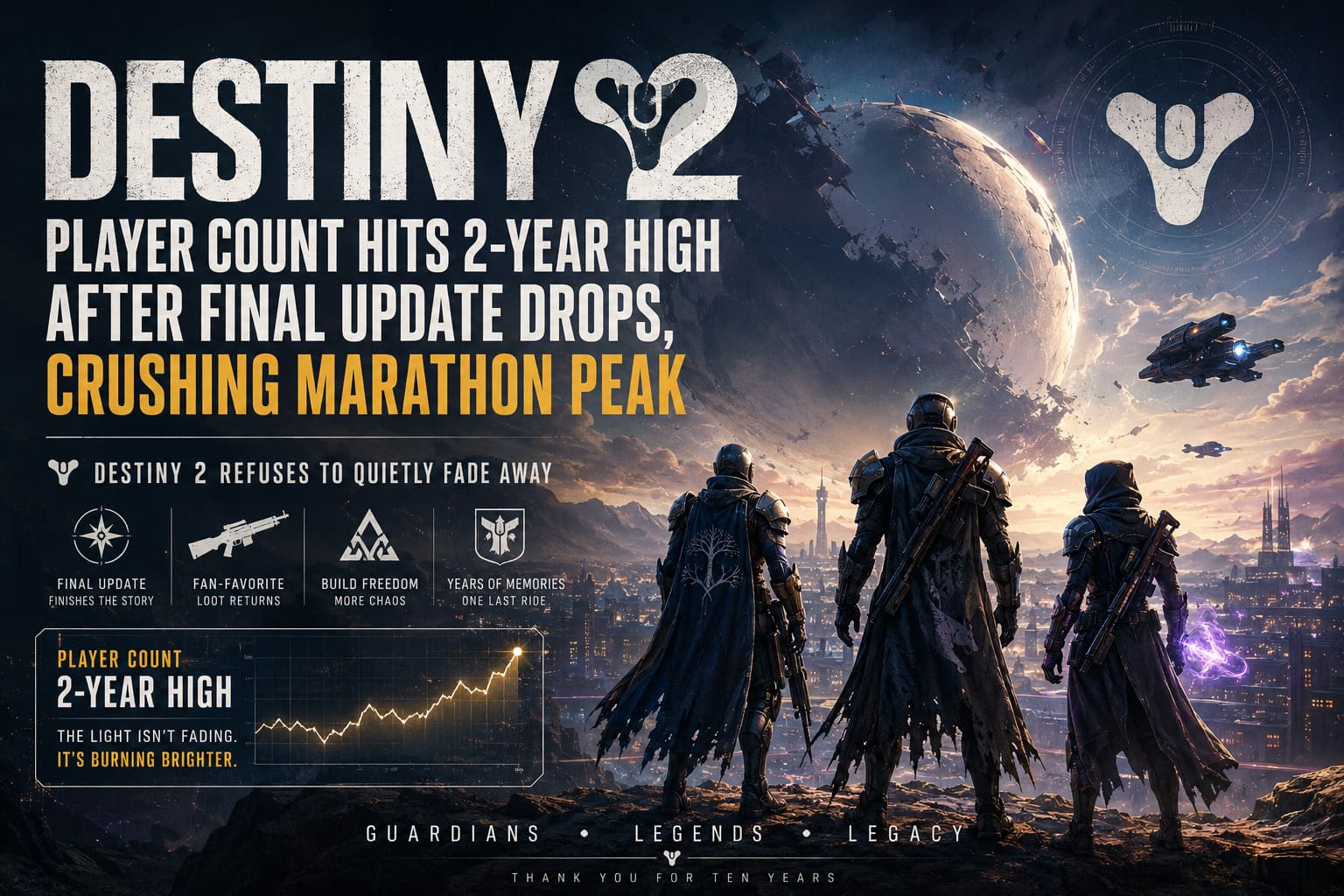
Queue times returned — and weirdly, people were happy about that. It felt like 2019-era Destiny had been temporarily reactivated.
And the biggest shock? The game didn’t come back with a new expansion box or flashy relaunch campaign. It came back on the strength of closure.
The Final Update That Actually Mattered
The update didn’t try to reinvent Destiny 2 — it tried to finish it properly. That alone already sets it apart from most live-service conclusions.
Bungie leaned hard into three things: narrative payoff, sandbox cleanup, and player respect. And for once, it actually felt like those priorities aligned instead of fighting each other.
What changed in practice
- Loot systems became noticeably more generous
- Old fan-favorite weapons returned into circulation
- Build crafting felt less restrictive and more chaotic again
- Long-requested quality-of-life fixes finally landed
It wasn’t subtle. Players noticed within hours. The “grind fatigue” that had built up over seasons suddenly loosened its grip.
But the real hook wasn’t mechanical. It was emotional.
This felt like Bungie saying: “We’re not dragging this out anymore. We’re ending it with you, not around you.”
GTA 6 November 2026 Release Chaos: The Only Two Games Refusing to Run Away From Rockstar’s Shadow
The Emotional Pull of a Proper Ending
The biggest driver of the resurgence wasn’t balance changes or loot tables — it was finality. Players logged in knowing this wasn’t another seasonal loop. This was the conclusion.
Communities across Reddit and long-standing discussion hubs like ResetEra exploded with nostalgia posts, old raid memories, and character screenshots dating back nearly a decade. People weren’t theorycrafting for the next season. They were reminiscing about the entire journey.
That shift matters more than most developers want to admit. A “final chapter” creates urgency that live-service repetition never can.
Destiny 2 vs Marathon: The Comparison Everyone Is Making
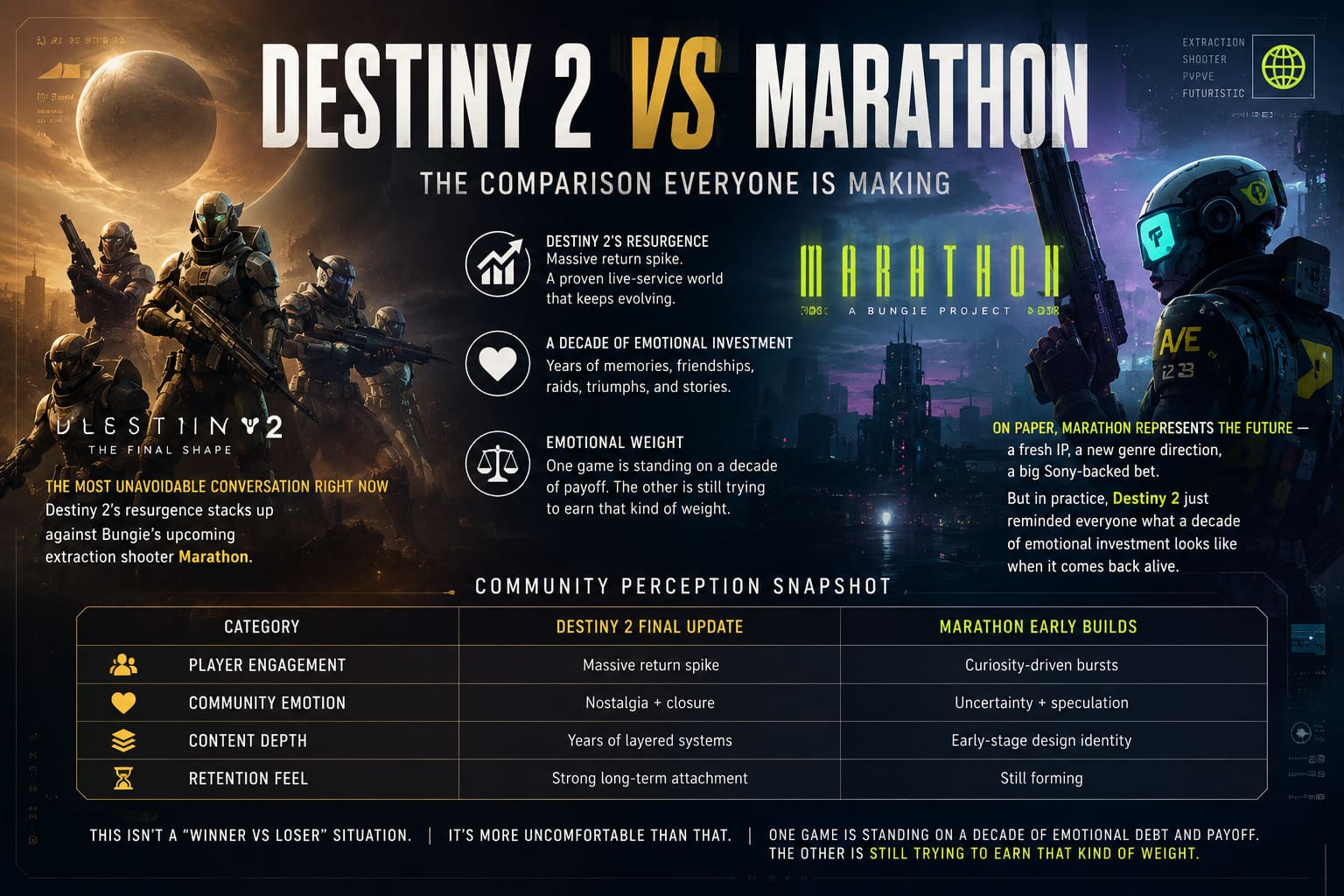
The most unavoidable conversation right now is how Destiny 2’s resurgence stacks up against Bungie’s upcoming extraction shooter Marathon.
On paper, Marathon represents the future — a fresh IP, a new genre direction, a big Sony-backed bet. But in practice, Destiny 2 just reminded everyone what a decade of emotional investment looks like when it comes back alive.
Community perception snapshot
| Category | Destiny 2 Final Update | Marathon Early Builds |
|---|---|---|
| Player Engagement | Massive return spike | Curiosity-driven bursts |
| Community Emotion | Nostalgia + closure | Uncertainty + speculation |
| Content Depth | Years of layered systems | Early-stage design identity |
| Retention Feel | Strong long-term attachment | Still forming |
This isn’t a “winner vs loser” situation. It’s more uncomfortable than that. One game is standing on a decade of emotional debt and payoff. The other is still trying to earn that kind of weight.
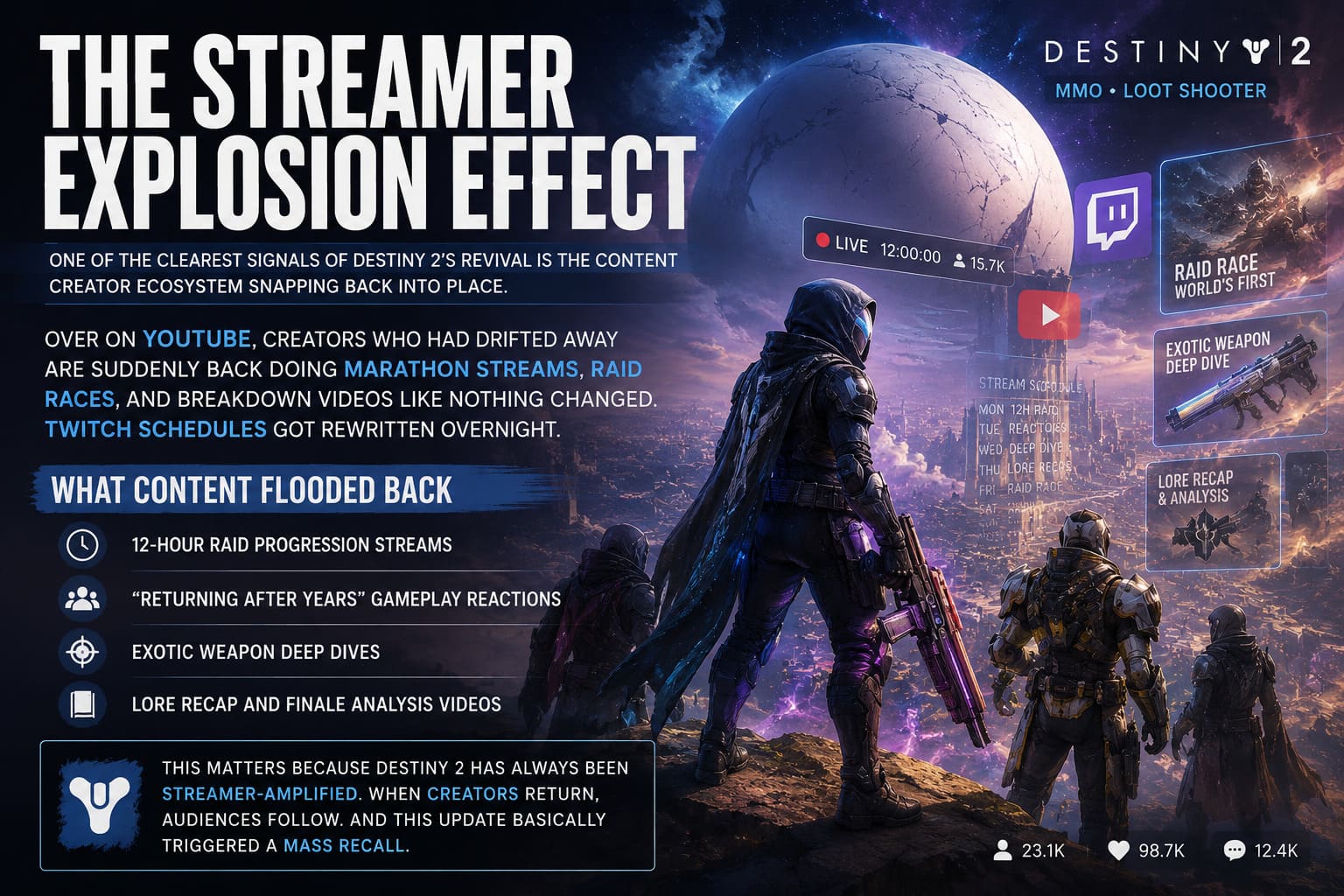
The Streamer Explosion Effect
One of the clearest signals of Destiny 2’s revival is the content creator ecosystem snapping back into place.
Over on YouTube, creators who had drifted away are suddenly back doing marathon streams, raid races, and breakdown videos like nothing changed. Twitch schedules got rewritten overnight.
What content flooded back
- 12-hour raid progression streams
- “Returning after years” gameplay reactions
- Exotic weapon deep dives
- Lore recap and finale analysis videos
This matters because Destiny 2 has always been streamer-amplified. When creators return, audiences follow. And this update basically triggered a mass recall.
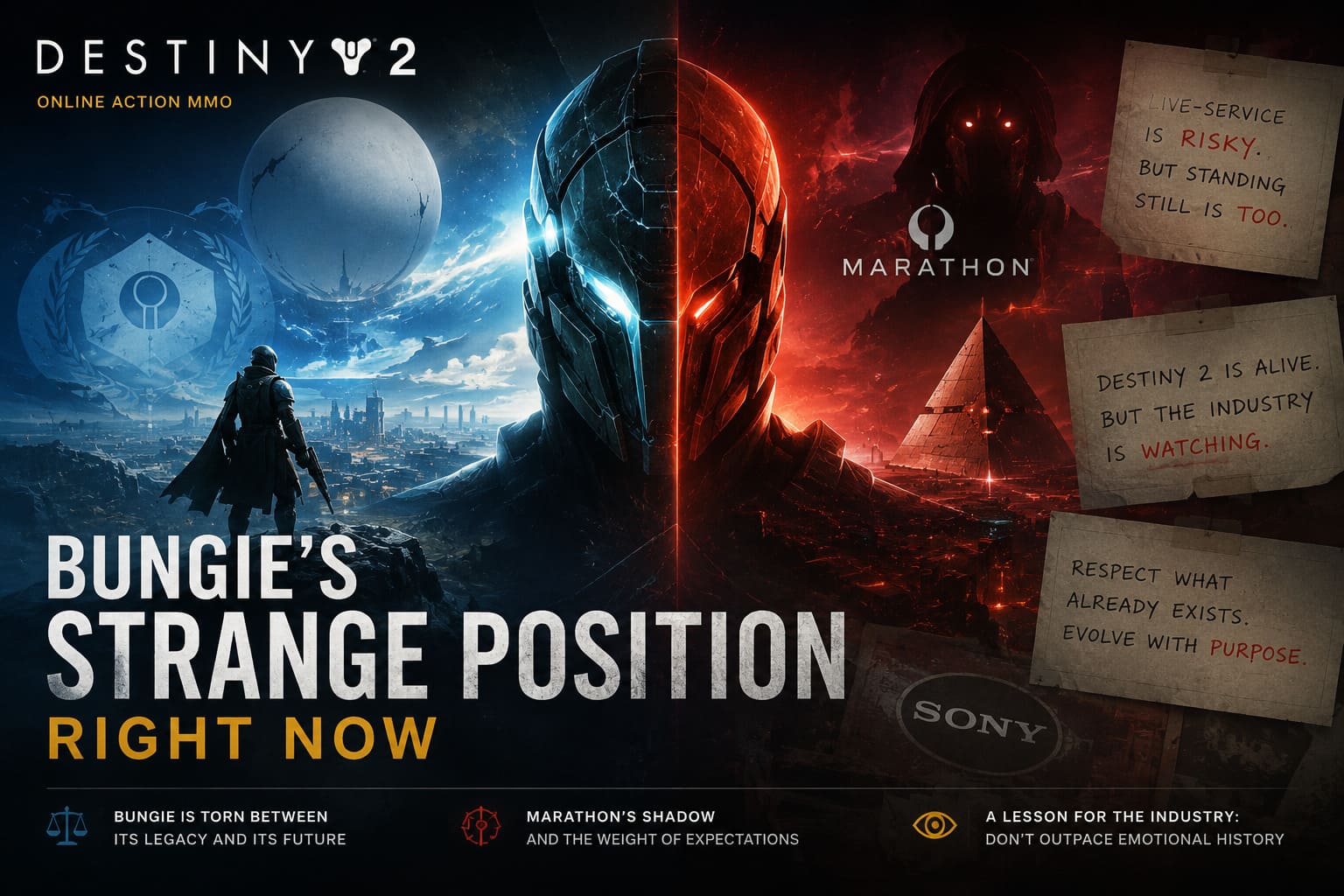
Bungie’s Strange Position Right Now
Bungie suddenly finds itself in a position most live-service studios would kill for — but also one that complicates everything.
On one hand, Destiny 2 just proved it still has massive cultural and financial gravity. On the other, Bungie’s future is heavily tied to Marathon, which now has to exist in the shadow of this resurgence.
This creates a real internal tension: do you lean back into the proven giant, or commit fully to the new direction?
And behind all of that, Sony Interactive Entertainment is absolutely paying attention, because the investment logic changes when the “old” product outperforms expectations like this.
Why This Moment Actually Matters for the Industry
This isn’t just a Destiny story. It’s a live-service industry case study unfolding in real time.
Games don’t die because they’re old. They die because players stop feeling seen. Destiny 2 temporarily reversed that feeling — not by reinventing itself, but by respecting what already existed.
That’s the uncomfortable lesson here for other studios chasing “the next big thing.” You can’t always outpace emotional history with novelty.
Final Verdict: Not a Comeback, a Closure Event That Turned Into a Revival
Calling this a comeback feels wrong. Destiny 2 didn’t return — it reached an endpoint and somehow became more active because of it.
The final update didn’t just add content. It reactivated a decade of player memory, systems, frustration, joy, and nostalgia all at once.
And for a brief moment, Destiny 2 didn’t feel like a live-service game winding down.
It felt like a world refusing to be forgotten.