Frozen Ship Survival Guide: Crew and People Management Strategy
When I first launched Frozen Ship, I expected another city-builder with a cold-weather skin. After several hours, I realized I was completely wrong.
This game isn’t simply about collecting resources or constructing bigger buildings. It’s about protecting twenty real people whose survival depends on every decision you make. Every mistake snowballs into another disaster. One exhausted engineer leads to slower repairs. Slower repairs reduce heating efficiency. Less heat creates illness. Sick workers stop producing supplies. Before long, your entire expedition is collapsing while you’re desperately trying to recover.
As someone who spends a lot of time covering survival and strategy games on stream, I honestly think Frozen Ship has one of the most interesting crew-management systems I’ve seen in years. It constantly forces you to choose between what seems efficient today and what will actually keep everyone alive tomorrow.
If you’re just starting your expedition, here’s the approach that has worked consistently for me.
Why Crew Management Feels Different
Most management games treat workers like numbers.
Frozen Ship doesn’t.
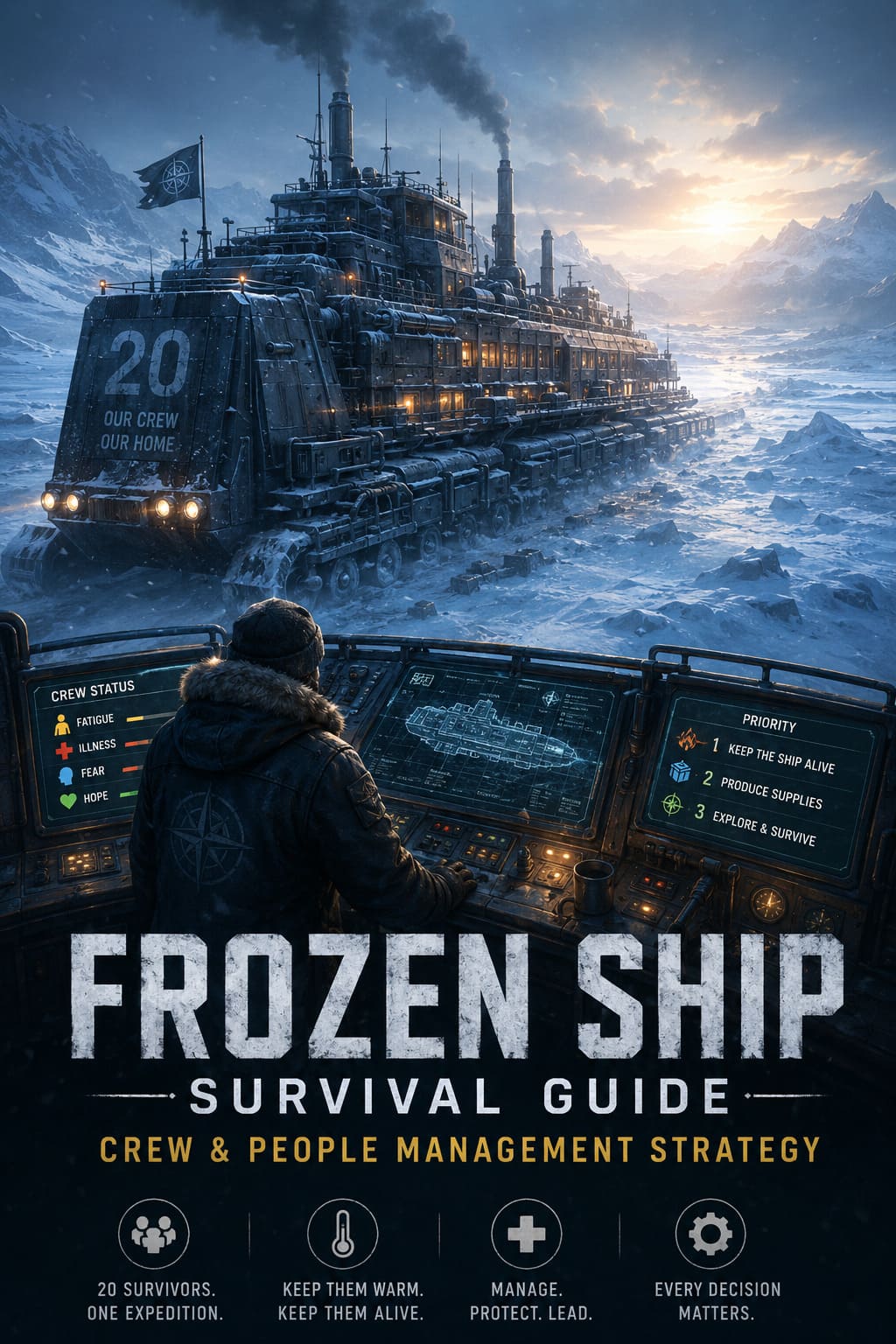
Every member of your expedition feels valuable because your workforce is incredibly small. Twenty people might sound like enough, but once illnesses begin spreading and several survivors need rest, you’ll quickly realize just how limited your manpower actually is.
Instead of endlessly assigning workers through menus, the developers built a fully interactive 3D command bridge where you physically move between workstations to monitor your expedition.
At first I thought it was mostly cosmetic.
After playing for a while, I actually started enjoying it because it makes every management decision feel much more personal.
The Four Stats I Check Every Morning
Before I send anyone outside, I always spend a minute reviewing the crew.
Ignoring these four conditions almost always leads to problems later.
| Status | Why It Matters | My Priority |
|---|---|---|
| Fatigue | Tired workers become slower and more accident-prone. | Very High |
| Illness | Disease spreads quickly inside the ship. | Critical |
| Fear | Panic reduces productivity and causes instability. | High |
| Hope | Low morale can eventually destroy the expedition. | Essential |
People often focus entirely on food and fuel.
Personally, I think Hope is the hidden mechanic that separates successful runs from failed ones.
A crew that still believes in the mission keeps working even during terrible weather. Once morale completely disappears, every other problem becomes significantly harder to solve.
The Bridge Is More Than Just Decoration
One of my favorite design choices is the bridge itself.
Instead of drowning players in dozens of interface windows, Frozen Ship lets you interact with specialized stations.
The ones I use constantly are:
- Command Terminal for checking crew health and assigning work.
- Engineering Station for researching insulation, heating improvements, and structural upgrades.
- Construction Terminal for expanding living quarters and medical facilities.
After several sessions, walking between these stations became part of my routine, and surprisingly it makes the ship feel alive.
My Daily Priority System
One mistake I made during my first few expeditions was trying to do everything at once.
That simply doesn’t work.
Now I divide work into three priorities.
1. Keep the Ship Alive
Nothing comes before heating.
If generators fail or the engine loses power, the temperature inside the ship drops incredibly fast.
I’ve watched a perfectly healthy crew become half-sick after a single bad heating failure.
Repairs always come first.
2. Produce Essential Supplies
Once the ship is stable, I focus on production.
My crafting queue usually includes:
- Hot meals
- Repair materials
- Clothing
- Basic tools
Warm food is surprisingly valuable because it improves more than just hunger. It also helps reduce the negative effects of constant exposure to freezing conditions.
3. Send Exploration Teams
Exploration is exciting.
It’s also one of the fastest ways to lose experienced workers.
I almost never send people alone.
Balanced teams survive much longer and are far better prepared for unexpected encounters.
Rotating Workers Is Better Than Replacing Them
One lesson Frozen Ship teaches extremely well is that burnout matters.
If you leave the same workers gathering resources outside every day, they’ll eventually become exhausted, sick, or both.
Instead, I constantly rotate responsibilities.
A worker who spent yesterday scavenging outside might spend today:

- Cooking
- Crafting
- Performing maintenance
- Resting inside heated areas
The overall productivity stays surprisingly high because healthy workers outperform exhausted ones every single time.
Research That Pays Off Early
Research is tempting because every technology sounds useful.
However, some upgrades clearly provide better long-term value.
- Better insulation
- Heating improvements
- Medical efficiency
- Improved living quarters
These upgrades don’t generate resources directly.
Instead, they reduce how many resources you’ll lose later trying to recover from disasters.
That’s a much better investment.
Medical Facilities Should Never Wait
If I could give only one piece of advice to new players, it would be this:
Build medical infrastructure much earlier than you think you need it.
A dedicated infirmary changes everything.
Healthy workers return to duty much faster, illnesses spread less aggressively, and your overall workforce remains stable throughout long expeditions.
Waiting until half your crew is already sick usually means you’re already behind.
Clothing Is More Important Than It Looks
During my first expedition, I underestimated clothing upgrades.
Big mistake.
Improved coats and thermal equipment dramatically reduce how quickly workers suffer from cold exposure during exploration.
Whenever I find extra fabric or synthetic materials, I rarely sell them immediately.
Instead, I upgrade equipment for my exploration teams first.
The investment pays for itself surprisingly quickly.
Managing Outside Factions
Eventually you’ll meet traders and survivor communities across the frozen wasteland.
This is where Frozen Ship becomes more interesting than a typical survival simulator.
Every decision affects your reputation.
Sometimes an authoritarian settlement offers fuel or valuable supplies, but accepting their methods may hurt your own crew’s confidence.
Meanwhile, helping struggling survivors improves morale but often costs precious resources.
I don’t think there’s a universally correct answer.
Personally, I usually favor decisions that keep my own expedition stable instead of chasing short-term rewards.
Long campaigns reward consistency far more than risky gambles.
Laws Can Save Your Expedition… or Break It
Emergency laws are incredibly powerful.
Food rationing, stricter work schedules, and other temporary measures can keep your expedition alive during difficult periods.
The catch is obvious.
People don’t enjoy living under harsh restrictions.
Every emergency policy has consequences, especially for morale.
Whenever I introduce stricter rules, I try balancing them later with improvements that increase crew comfort or restore hope.
Ignoring morale for too long creates problems that no amount of food can solve.
Frozen Ship Gameplay Walkthrough and Review: Is It Worth Buying? (2026)
Mistakes I See New Players Make
After watching gameplay and talking with other survival fans, several beginner mistakes appear repeatedly.
- Expanding the ship too quickly instead of strengthening existing systems.
- Ignoring fatigue until workers start collapsing.
- Delaying medical construction.
- Sending solo scavengers into dangerous areas.
- Prioritizing resource income over heating.
- Researching luxury upgrades before survival technology.
Avoiding these mistakes alone dramatically improves your chances of surviving the early game.
Is Frozen Ship Coming to PS5, Xbox Series X/S, and Xbox Game Pass in 2026?
Final Thoughts
After spending quite a few hours with Frozen Ship, I genuinely believe its greatest strength isn’t the visuals or even the survival mechanics.
It’s the feeling that every single crew member actually matters.
Losing someone isn’t just a statistic. You immediately feel the consequences across your entire expedition. Repairs slow down. Production falls behind. Morale slips. Before long, one death can trigger an entire chain reaction that threatens everyone else.
That’s what keeps me coming back.
Every successful expedition feels earned because the game constantly challenges your leadership rather than simply testing your resource management.
If you’re planning your first journey into the frozen wasteland, remember one simple rule that has saved nearly every successful campaign I’ve played:
Protect your people first. Resources can always be gathered later, but replacing experienced survivors is a luxury Frozen Ship almost never gives you.