Halloween The Game All Maps List: Every Confirmed Location by IllFonic
If there is one thing a good asymmetrical horror game absolutely needs, it is a map that can make you nervous before the killer even appears. Halloween: The Game looks ready to understand that rule better than most. Developed by IllFonic and published by Gun Interactive, the upcoming 1v4 multiplayer horror game brings the world of John Carpenter’s Halloween into a playable sandbox where one player becomes Michael Myers and four others desperately try to survive the night.
The game is scheduled to launch digitally on September 8, 2026, for PlayStation 5, Xbox Series X/S, and PC. What immediately caught my attention is how heavily the developers are leaning into the atmosphere of the original 1978 movie. This is not a game that seems interested in throwing players into generic horror arenas. The launch maps are built around recognizable Haddonfield locations, quiet suburban streets, isolated properties, commercial areas, and rural spaces where the feeling of being watched can become just as dangerous as Michael himself.
For survivors, knowing the map is going to be absolutely critical. For Michael players, learning where players naturally run, hide, regroup, and make mistakes could turn familiar landmarks into hunting grounds. Here is a closer look at the confirmed Halloween: The Game maps, what makes each location different, and how I expect them to affect actual matches.
Halloween The Game East Haddonfield Map Guide: All Power Switches Locations
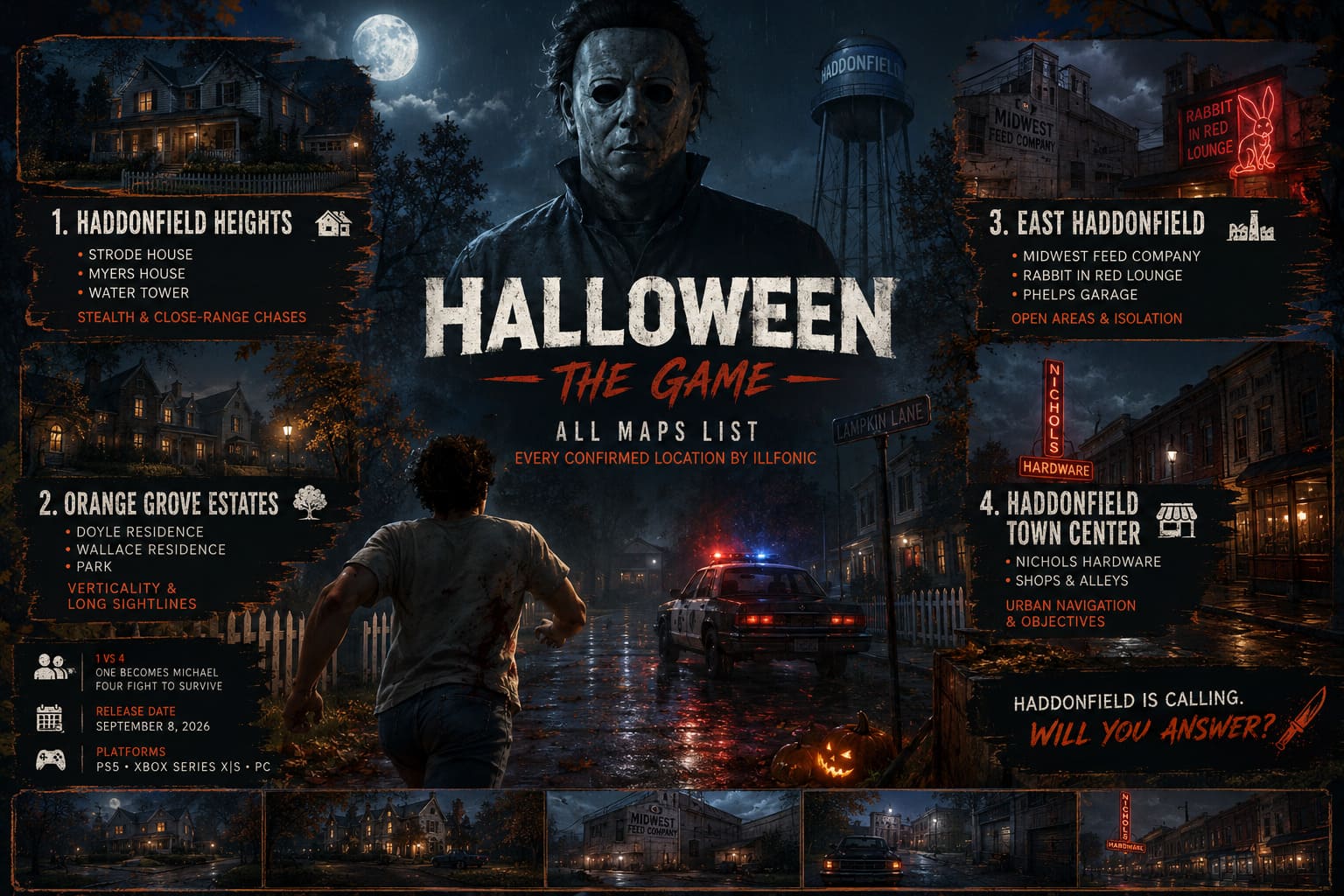
The Four Confirmed Halloween: The Game Maps
| Map | Main Environment | Key Locations | Gameplay Identity |
|---|---|---|---|
| Haddonfield Heights | Classic Suburbia | Strode House, Myers House, Water Tower | Stealth And Close-Range Chases |
| Orange Grove Estates | Upscale Suburbs | Doyle Residence, Wallace Residence, Park | Verticality And Long Sightlines |
| East Haddonfield | Rural And Industrial | Midwest Feed Company, Rabbit In Red Lounge, Phelps Garage | Open Areas And Isolation |
| Haddonfield Town Center | Commercial District | Nichols Hardware, Shops, Alleys | Urban Navigation And Objectives |
1. Haddonfield Heights
Haddonfield Heights is probably the map most fans will want to experience first. It captures the look and feel of the classic Haddonfield neighborhood, combining familiar houses, quiet streets, gardens, hedges, backyards, and the deceptively peaceful atmosphere that made the original movie so effective.
The centerpiece is the Strode house, recreated as a playable location rather than simply a piece of scenery. Its interior layout gives survivors somewhere to search and potentially hide, but houses in a game like this are never truly safe. Narrow hallways can become death traps when Michael Myers gets close, especially if players panic and choose the wrong exit.
Then there is the Myers house on Lampkin Lane. This is one of those locations where simply walking past it should feel wrong. The house is tied directly to the 1963 tragedy that established Michael’s horrifying legacy, and its inclusion gives the map a strong connection to the original film rather than feeling like a loosely inspired recreation.
The Haddonfield water tower serves as another major visual landmark. That matters more than it might sound. In a multiplayer horror game, players need recognizable environmental markers, especially when a match becomes chaotic and everyone is trying to remember where they last saw their teammates.
Gameplay here should revolve heavily around line-of-sight manipulation. Survivors can use hedges, houses, fences, backyards, and other environmental objects to disappear from view. The problem is that Michael can turn those same hiding opportunities against them.
His Shape Jump ability adds another layer to the map, allowing him to move through areas that survivors might assume are relatively safe. A player sprinting through a backyard while thinking they have created enough distance could suddenly discover that Michael has taken a completely different route.
That is exactly the kind of nonsense I want from a Halloween game. You should never feel completely confident that the killer is where you last saw him.
2. Orange Grove Estates
If Haddonfield Heights is the classic Halloween fantasy, Orange Grove Estates appears to be the map designed to test how well players understand vertical space.
This is a more affluent part of Haddonfield, filled with larger Midwestern homes, spacious properties, garages, gardens, and a neighborhood park. The contrast is fantastic: everything looks comfortable and respectable, yet the entire area becomes a hunting ground once Michael starts stalking the streets.
The Doyle and Wallace residences are the major attractions here. Both homes feature multiple floors and more complicated interiors, giving survivors additional routes to consider during a chase.
And that is where things get interesting.
A multi-story building sounds like a survivor’s dream until you realize that every extra floor can become another place to get trapped. Running upstairs might buy you a few seconds, but if Michael cuts off the obvious exit, suddenly that second floor feels like a cage.
Players will need to pay attention to balconies, windows, exterior routes, and backyard vegetation rather than treating houses as simple hideouts. Good survivors will probably learn to enter buildings with an escape plan already in mind.
The surrounding park and larger yards also create longer sightlines than Haddonfield Heights. That can help survivors identify danger earlier, but open visibility is a double-edged sword. The moment you become visible to Michael, that extra space can work against you.
I expect Orange Grove Estates to become one of the more skill-intensive maps because players have to understand both horizontal movement and vertical positioning. If your team constantly gets trapped upstairs, that is not bad luck. It probably means you are using the environment incorrectly.
3. East Haddonfield
This is where the game starts feeling much less comfortable.
East Haddonfield moves away from traditional suburbia and into a rural and industrial section of the town. It represents the area Michael encounters during his journey home after escaping Smith’s Grove Sanitarium, and its visual identity is considerably more isolated than the residential maps.
The Midwest Feed Company is one of the biggest landmarks. Industrial buildings provide interiors to explore and supplies to search for, but they also create very different combat and chase scenarios compared with suburban houses.
Then there is the Rabbit in Red Lounge, a rougher location with a biker-oriented atmosphere. Broken bottles, dark interiors, cramped hiding places, and a generally more dangerous aesthetic make it stand out from the clean residential areas.
The Phelps Garage adds another recognizable location while reinforcing the map’s industrial identity.
What makes East Haddonfield especially interesting is the amount of open terrain between important structures. In a horror game, open ground is terrifying because there is nowhere obvious to disappear.
A survivor might feel perfectly safe inside a warehouse, but eventually they need to move. Crossing a large exposed area while Michael is nearby could be the multiplayer equivalent of walking into a dark basement because you heard a strange noise.
The strategy here should revolve around planning movement before leaving cover. Survivors who simply sprint from one objective to another are likely to get punished. Teams will need to think about where their next piece of cover is, where teammates are located, and which buildings can provide emergency escape routes.
For Michael players, the open landscape creates opportunities to watch survivor movement from a distance and pressure players before they even realize they have been spotted.
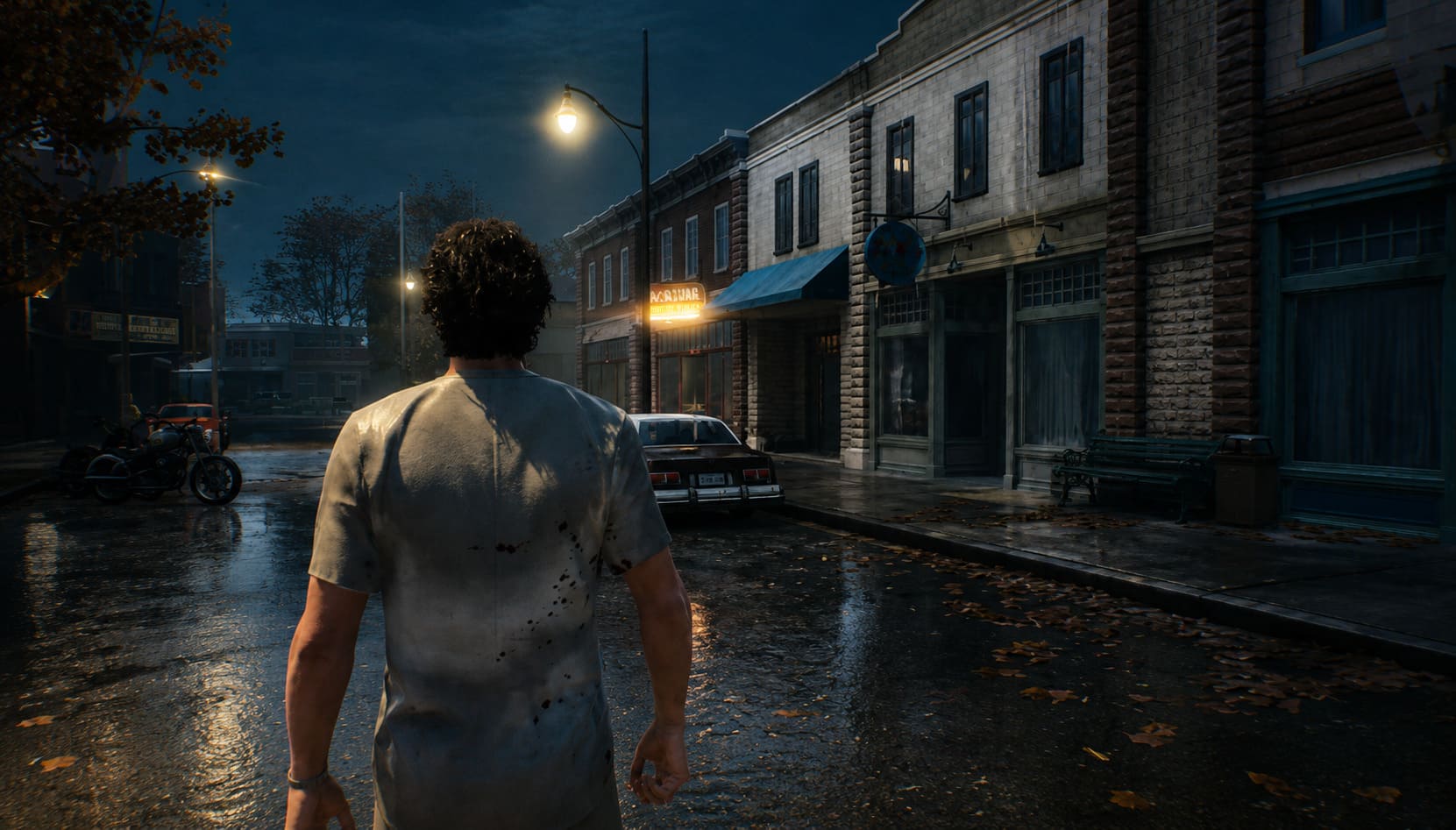
4. Haddonfield Town Center
The fourth launch map takes the action away from residential streets and into the commercial center of Haddonfield.
This is a major change of pace. Instead of relying primarily on houses and gardens, survivors have to navigate storefronts, offices, alleys, utility areas, and wider streets.
One of the biggest landmarks is Nichols Hardware, which serves as both a recognizable location and an important tactical area where survivors can search for useful equipment.
The town center’s layout is particularly interesting because it alternates between wide streets and tight alleys. That creates a constant push-and-pull between visibility and concealment.
Wide streets allow survivors to see danger coming, but they also leave them exposed. Alleys offer concealment, yet they can quickly become traps if Michael approaches from the opposite direction.
The map also puts more emphasis on communication and objectives. Survivors need to locate remaining townspeople, gather what they need, and find functioning phone lines to contact the police. Michael, meanwhile, can interfere with communication by cutting utility lines and sabotaging key infrastructure.
That sounds like the perfect recipe for those matches where everyone starts with a plan and completely loses it ten minutes later.
The town center could become especially entertaining for coordinated teams because communication should matter more here than simply knowing where the nearest house is. A survivor calling out that Michael is blocking one alley could completely change how the rest of the team approaches an objective.
Which Halloween Map Looks Best for Survivors?
If I had to pick the maps I would want to learn first, Haddonfield Heights and Haddonfield Town Center would probably be at the top of my list.
Haddonfield Heights appears to offer the purest classic Halloween experience. It has the recognizable houses, Lampkin Lane, the Myers residence, and plenty of environmental objects that can be used during chases.
Town Center, meanwhile, seems like it could reward communication and map awareness more heavily. The mixture of alleys, streets, interiors, and objectives gives teams plenty of opportunities to split up, regroup, and potentially make terrible decisions.
Orange Grove Estates looks like the map where experienced players could really show off their movement knowledge, while East Haddonfield sounds like the location where careless players will discover that open ground is absolutely not their friend.
Which Map Could Be Best for Michael Myers?
From the killer’s perspective, East Haddonfield sounds particularly dangerous for survivors.
The open spaces make movement easier to observe, and the distance between important structures can make a survivor feel incredibly vulnerable. A good Michael player should be able to use that isolation to pressure players before they reach their next objective.
Haddonfield Heights could also be brutal because players may become too comfortable with the familiar suburban layout. The more predictable their routes become, the easier it should be for Michael to anticipate where they are heading.
Orange Grove Estates may require more precision because survivors have additional vertical escape options, while Town Center looks like the ultimate map for cutting off escape routes and exploiting narrow alleys.
Will Halloween: The Game Get More Maps?
The launch map selection clearly focuses on the world established by the original Halloween movie, but that does not mean the developers have run out of locations.
The obvious fan request is Haddonfield Memorial Hospital.
Anyone familiar with Halloween II knows why this location would be such a perfect addition. Imagine an enormous hospital map with long sterile corridors, flickering lights, locked rooms, stairwells, service passages, and dark basement areas. Compared with the outdoor suburban environments, it would completely change the rhythm of a match.
Smith’s Grove Sanitarium is another location that practically screams for a multiplayer horror adaptation. The setting could provide a more claustrophobic experience built around institutional corridors, medical rooms, security areas, and limited escape options.
There are also plenty of possibilities if the developers decide to explore locations from other parts of the franchise. Industrial facilities, additional Haddonfield neighborhoods, and locations connected to later movies could all provide very different gameplay experiences.
Of course, none of these potential locations should be treated as confirmed until IllFonic or Gun Interactive officially announces them. Fan demand is not the same thing as a development roadmap.
Final Verdict: Haddonfield Is the Real Star
The biggest strength of the Halloween: The Game map lineup is that the environments are not simply decorative recreations of famous movie locations. Each one appears to have its own gameplay identity.
Haddonfield Heights delivers the classic suburban nightmare. Orange Grove Estates introduces verticality and larger properties. East Haddonfield makes open terrain and isolation dangerous. Haddonfield Town Center turns the horror into an urban game of sightlines, alleys, communication, and objectives.
That variety is exactly what an asymmetrical multiplayer game needs. Nobody wants to play the same chase through the same generic neighborhood fifty times, and Halloween has enough recognizable locations to build something much more memorable.
The real test will come when players start discovering the maps for themselves. Every asymmetrical horror game eventually develops its own community knowledge: the best escape routes, the nasty ambush spots, the places where survivors always make the same mistake, and the corners where experienced killers know someone will eventually run.
If IllFonic gets that part right, these maps could become more than fan-service recreations. They could become the battlegrounds where players create their own Halloween stories.
And honestly, that is what I want most. I want the match where you are running down Lampkin Lane, your teammate is screaming over voice chat, the lights disappear behind you, and nobody knows where Michael Myers went.
Because if a Halloween game cannot make you panic while running through a perfectly normal suburban street, what are we even doing?