Coen in The Blood of Dawnwalker: Full Protagonist Lore, Origin, and Mechanics Explained
There are plenty of dark fantasy RPGs where the protagonist gets bitten by something horrible, gains supernatural powers, and then spends the rest of the game trying to figure out what happened. It is a familiar formula at this point.
Coen in The Blood of Dawnwalker is not that kind of character.
What immediately caught my attention about Rebel Wolves’ protagonist is that his entire gameplay identity is tied directly to his backstory. His abilities aren’t simply there because the developers wanted to give players a cool vampire skill tree. Coen’s strange condition, his history in the silver mines, his family, and even the way his body reacts to sunlight are all connected.
That is exactly the kind of character design I enjoy in an RPG. When the story and mechanics actually talk to each other, a protagonist stops feeling like a vehicle for the player and starts feeling like a person.
And Coen has a lot going on.
He is a young man from Laslea who finds himself trapped between humanity and vampirism after the vampire lord Brencis turns him. Instead of becoming a conventional vampire, however, Coen’s body fights the transformation because of the enormous amount of silver accumulated in his system.
The result is something the game calls a Dawnwalker — a character who belongs to neither world completely.
That idea sounds cool on paper, but what makes it interesting is how heavily it influences the actual experience of playing the game.
Who Is Coen in The Blood of Dawnwalker?
Before everything goes wrong, Coen is simply a young man trying to protect his family.
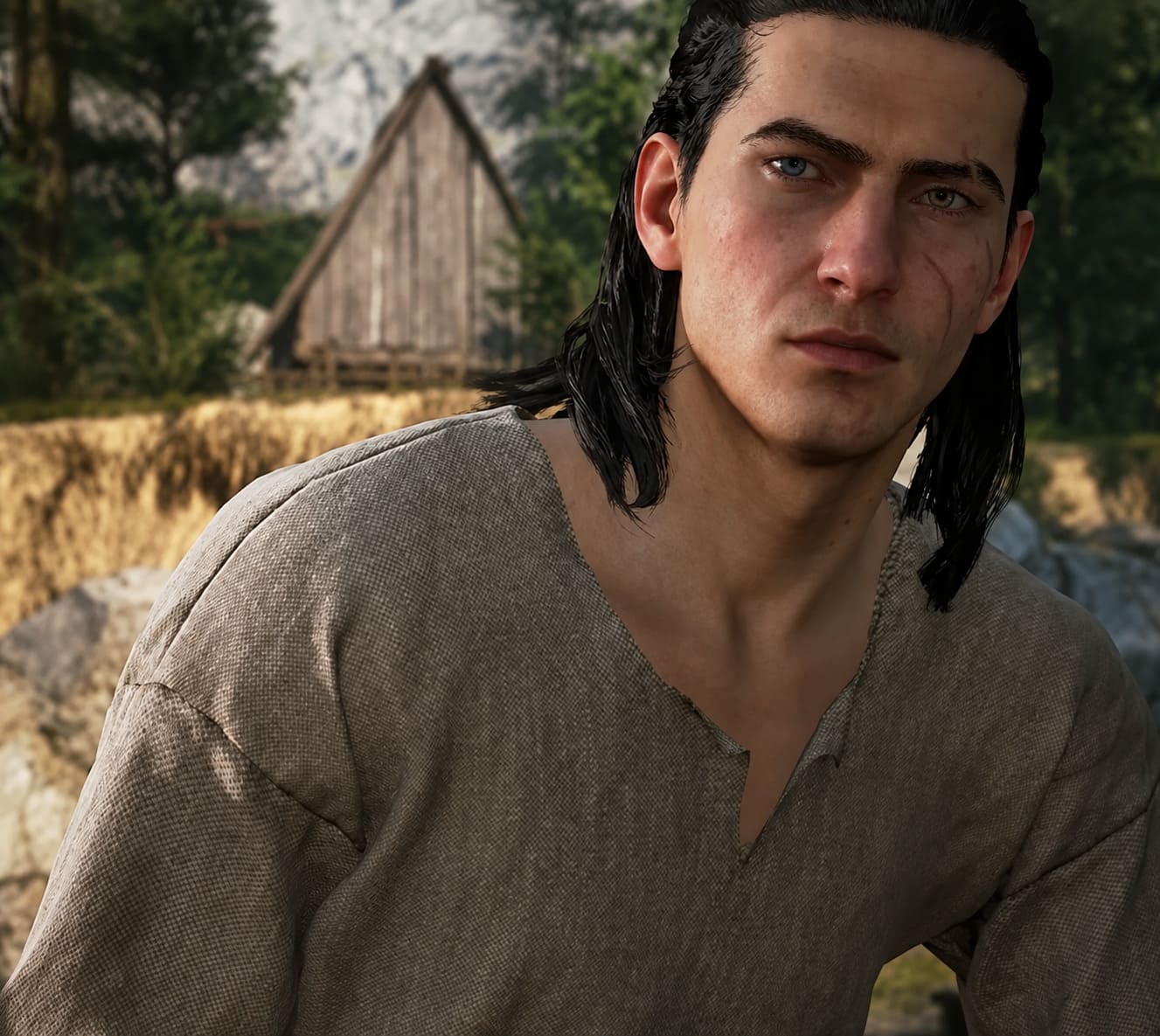
He comes from Laslea, a remote settlement in the Carpathian region of Vale Sangora. Coen is the eldest of four siblings, which already tells you quite a bit about his personality. He isn’t someone who has spent his life thinking only about himself.
His family depends on him.
Coen works in the silver mines alongside his father, helping keep the household alive while his mother suffers from serious illness. At the same time, he dreams about leaving the mountains and discovering what exists beyond the valley.
I actually like this contradiction because it makes Coen feel more believable.
He wants freedom, but responsibility keeps pulling him back home.
The silver mines eventually become one of the most important parts of his story. Years of exposure leave his body heavily contaminated with silver. In normal circumstances, this would simply be a terrible consequence of working in dangerous conditions.
But later, it becomes the reason Coen survives something that should have completely destroyed his humanity.
Coen’s Early Life At A Glance
| Aspect | Coen’s Background |
|---|---|
| Home | Laslea, Vale Sangora |
| Family | Eldest of four siblings |
| Occupation | Silver miner |
| Personality | Curious, ambitious, protective |
| Major Affliction | Severe silver poisoning |
| Later Transformation | Incomplete vampiric transformation |
This is one of those pieces of lore that I think is particularly effective because it doesn’t feel artificially attached to the main plot. The thing that nearly ruined Coen’s health eventually becomes the thing that separates him from ordinary vampires.
The Black Death Changes Everything
The personal tragedy begins when the Black Death reaches Vale Sangora.
The region is already a miserable place, but the plague turns the situation into something much darker. Instead of protecting people, Lord Skender Dragosti responds with brutal measures, ordering soldiers to eliminate people showing signs of infection.
Coen’s youngest sister Lunka becomes infected.
For Coen, there is no complicated political calculation here. He isn’t thinking about kingdoms or ancient vampire clans. He simply wants to save his sister.
So he takes Lunka and runs.
That decision eventually puts him directly in the path of Brencis, the powerful vampire lord of the Vrakhiri.
And this is where Coen’s story takes its first major turn.
Brencis is capable of curing Lunka’s plague using vampire blood. From Coen’s perspective, it is effectively a miracle. But there is obviously a price attached to it.
Brencis isn’t helping the family because he suddenly developed a conscience.
Following the collapse of the human resistance, Coen is eventually attacked and left for dead. Brencis turns him into a vampire and takes control of his family, giving Coen a horrifying deadline.
Thirty days.
Thirty days to deal with the situation, uncover what is happening in Vale Sangora, and somehow get his family back.
For an RPG protagonist, that’s an incredibly effective motivation.
Why Coen Doesn’t Become A Normal Vampire
This is probably the most interesting part of Coen’s lore.
Normally, being turned by a Vrakhiri vampire means the human body loses the fight. The victim becomes a creature of the night, gains supernatural abilities, and becomes vulnerable to sunlight.
Coen’s body refuses to cooperate.
Years spent working with silver have left him saturated with the metal. When Brencis’s vampiric blood enters his body, the transformation becomes incomplete.
Instead of becoming fully human or fully vampire, Coen becomes something in between.
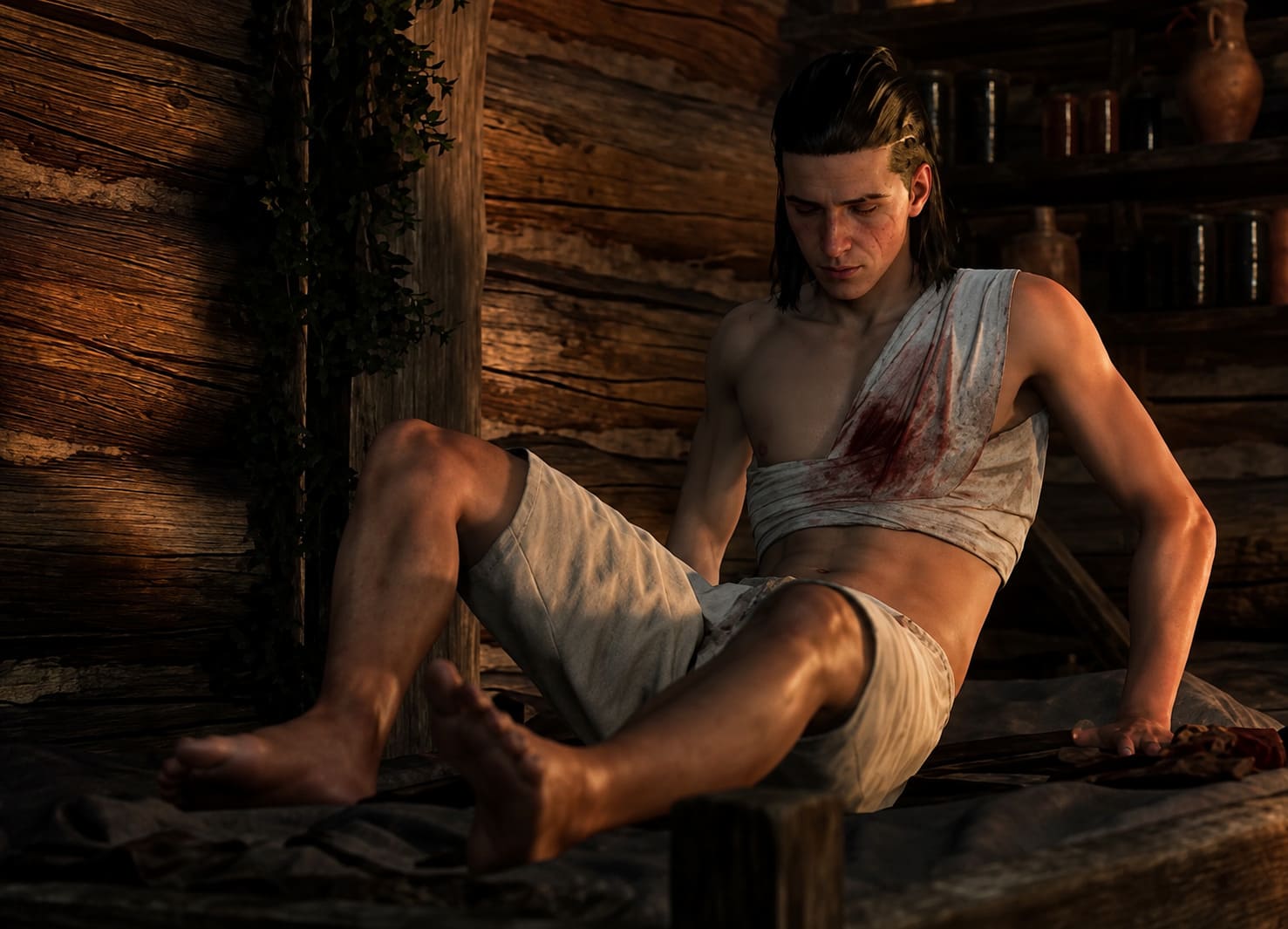
A Dawnwalker.
And I think the name works incredibly well.
Coen can walk beneath the sun, but he is no longer completely human. At night, he becomes something far more dangerous, but even then he isn’t simply another vampire.
His body is basically stuck in a constant supernatural tug-of-war.
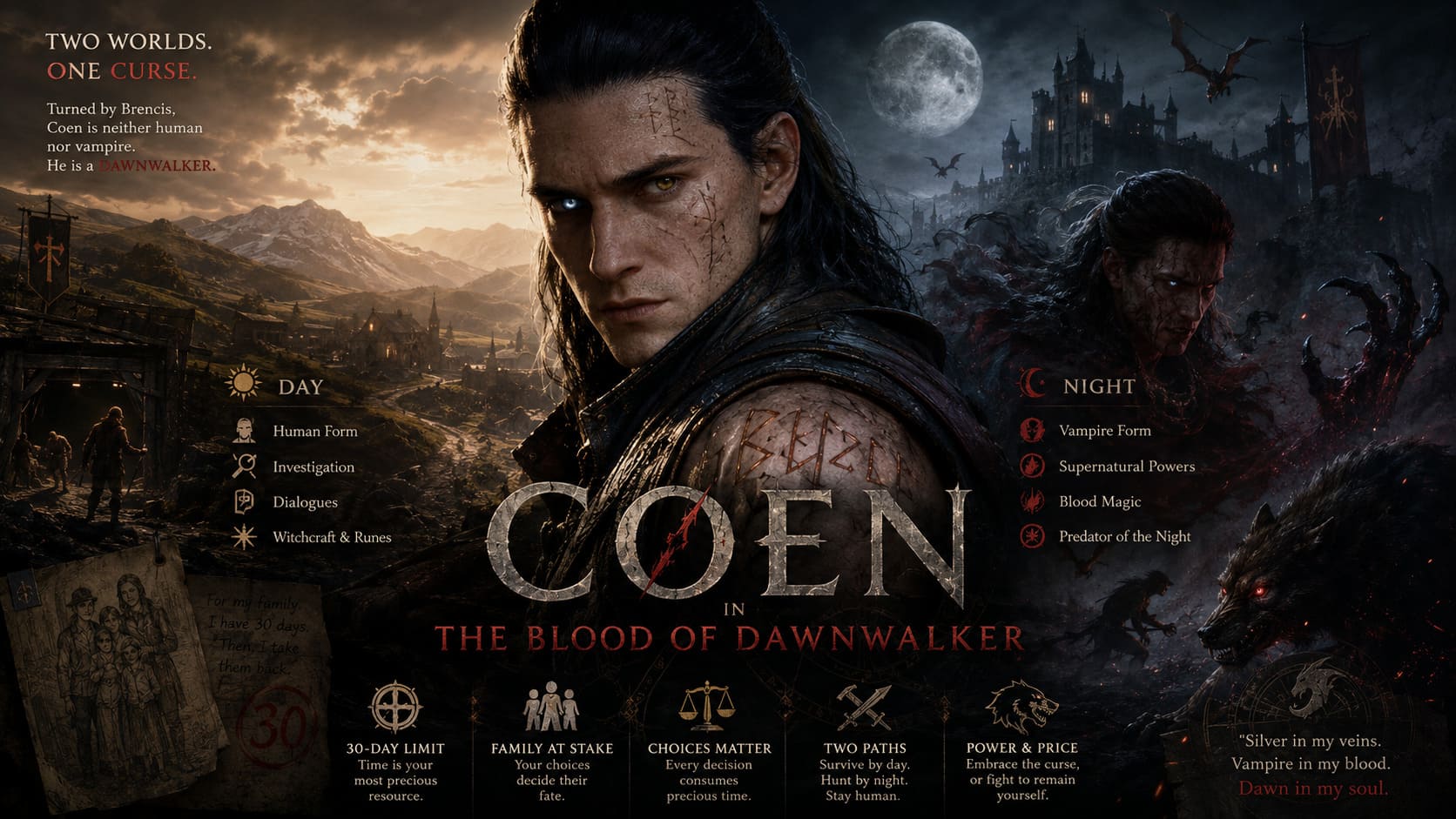
Coen’s Two Forms
| Time | State | Main Strengths | Main Weaknesses |
|---|---|---|---|
| Day | Human | Social interaction, swordplay, investigation | Physically vulnerable |
| Night | Vampire | Speed, claws, blood magic, supernatural movement | Vampire hunters and silver |
| Daylight | Silver suppresses curse | Can safely explore the surface | No major vampire abilities |
| Darkness | Curse becomes dominant | Powerful supernatural combat | Greater supernatural threats |
This isn’t just lore for the sake of lore.
The day/night cycle is essentially Coen’s character development turned into a gameplay system.
Playing Coen During The Day
During daylight, The Blood of Dawnwalker apparently becomes a very different type of RPG.
Coen is much closer to an ordinary human. He can move through settlements, talk with people, investigate situations and become involved in the political and social side of Vale Sangora.
And personally, this is the part of the concept that interests me almost as much as the vampire combat.
I’ve played enough RPGs to know that supernatural powers can sometimes make ordinary exploration feel pointless. Once your character can teleport, destroy enemies with magic and regenerate instantly, talking to some random villager doesn’t necessarily feel important anymore.
Coen’s daytime limitations potentially solve that problem.
He needs people.
He needs information.
He needs to investigate.
He needs to use human skills rather than simply overpowering everyone.
Daytime Abilities
One particularly unusual mechanic involves witchcraft and runes.
Coen can carve mystical symbols into his own skin and use them to communicate with the spirits of recently deceased people. This allows him to uncover information that might otherwise be impossible to obtain.
There is also an interesting connection between the rune system and his transformation.
The wounds created by the runes can heal when Coen enters his vampire state.
So even something as strange as carving magical symbols into your own body is connected to the central conflict inside Coen.
For me, that is exactly the sort of detail that makes a dark fantasy RPG memorable.
Nighttime Turns Coen Into A Completely Different Character
Then the sun goes down.
This is where things get interesting.
At night, the silver inside Coen no longer suppresses the vampire curse as effectively. His body changes and his supernatural abilities become available.
He becomes faster, more aggressive and much more dangerous.
Instead of relying primarily on a sword, Coen can attack enemies with elongated claws, use vampiric abilities and replenish his health by feeding on enemies.
He can also use supernatural movement to approach situations in ways that would be completely impossible during the day.
Two abilities in particular stand out:
- Wolf transformation for rapid movement across the environment.
- Mist form for slipping through defensive positions and approaching enemies unexpectedly.
This completely changes how I would expect exploration to feel.
During the day, you’re investigating a dangerous medieval world.
At night, you become one of the things that makes that world dangerous.
That contrast is fantastic.
The 30-Day Limit Could Be The Real Star
If there is one mechanic I am especially curious about, it is the 30-day time limit.
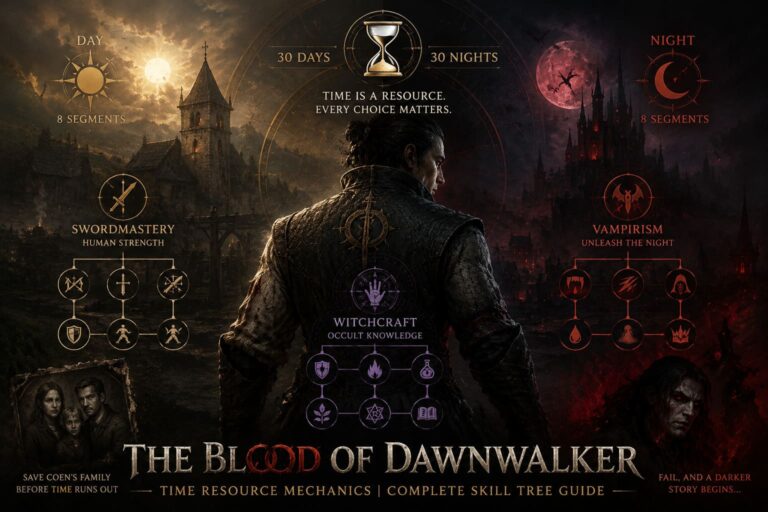
The game doesn’t appear to treat time as a decorative feature. You have a finite amount of it, and your decisions consume that resource.
That creates a problem I absolutely love in RPGs:
You can’t see everything.
If you spend your time helping one settlement, another problem may develop somewhere else. If you chase a particular lead, you may miss an opportunity somewhere completely different.
And because Coen’s family is at stake, every wasted day potentially carries emotional weight.
This is much more interesting than the usual RPG structure where you can save the world, defeat an ancient god, and then spend another 200 hours collecting herbs without anyone noticing.
Here, the clock matters.
Your choices have consequences because time itself becomes a resource.
Coen’s Morality Isn’t Simply Good vs Evil
I also don’t expect Coen’s story to be about choosing between being a heroic human or an evil vampire.
The more interesting possibility is that survival will constantly force compromises.
Do you use your vampire abilities because they make a difficult fight easier?
Do you feed on someone when you desperately need to recover?
Do you help strangers even though doing so could cost precious time?
Do you protect your remaining humanity, even if that makes rescuing your family significantly harder?
Those questions are much more compelling than a simple morality meter.
Coen’s biggest enemy may not be Brencis. It may be the gradual realization that becoming a monster can sometimes be the easiest way to accomplish something good.
That’s classic dark fantasy territory, and I’m completely here for it.
Crimson Moon Steam Deck Optimized Performance Guide: Best Graphics Settings and Layouts
Why Coen Works So Well As An RPG Protagonist
The biggest reason Coen stands out to me is that his limitations are just as important as his powers.
He isn’t a blank character created entirely by the player. He already has relationships, trauma, ambitions and responsibilities.
At the same time, the game gives players meaningful control over how they approach his problems.
That combination can be difficult to get right.
A completely customizable protagonist gives you freedom but often lacks personality. A heavily scripted protagonist gives you personality but can make the player feel like they’re simply watching someone else’s story.
Coen sits somewhere between those two extremes.
His identity is fixed.
His choices are not.
And that is exactly where I think The Blood of Dawnwalker has the potential to become something special.
Final Thoughts: Coen Is More Than A Vampire Hero
Coen could have easily been another tragic vampire protagonist with glowing eyes, sharp teeth and a complicated relationship with the darkness.
Thankfully, his concept goes much further than that.
His childhood in Laslea matters. His family matters. His work in the silver mines matters. The plague matters. His sister Lunka matters. Brencis matters.
And most importantly, his transformation affects how the entire game is played.
During the day, Coen is vulnerable and dependent on human abilities. At night, he becomes a supernatural predator. Between those two states is a character who is constantly fighting to decide what kind of person he is going to become.
That is what makes me interested in The Blood of Dawnwalker.
I’m far more interested in an RPG where the protagonist’s powers create new problems than one where every upgrade simply makes him stronger. Coen’s vampire abilities are impressive, but they also reinforce the central question of his story:
How much of yourself are you willing to sacrifice to save the people you love?
If Rebel Wolves manages to make that question matter throughout the entire 30-day journey, Coen could become one of the more memorable dark fantasy RPG protagonists in years.
And honestly, that’s a much more exciting prospect to me than simply playing another hero who happens to have vampire powers.